
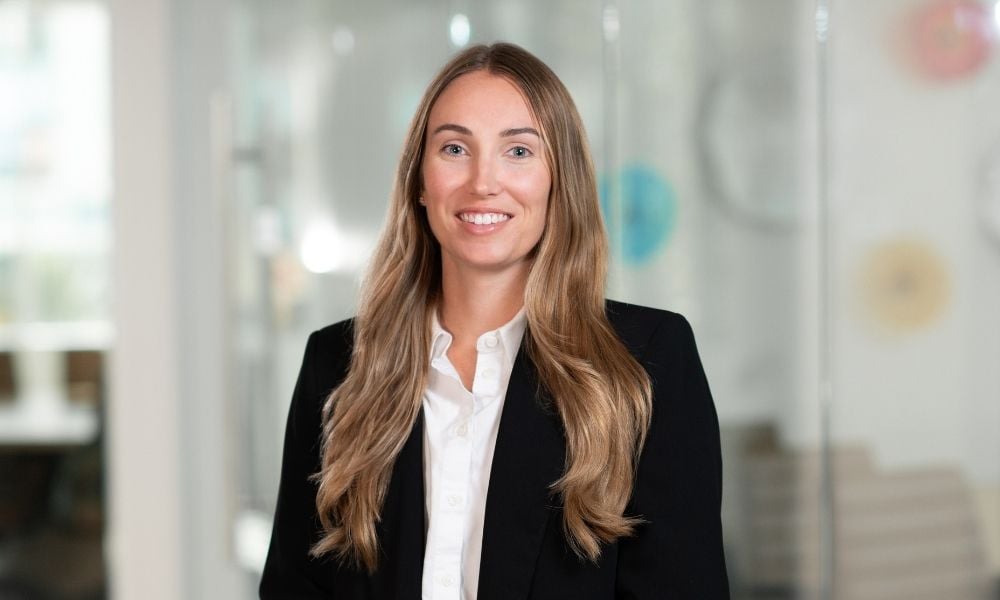
Cyndeo Wealth Partners has hired Casey Jorgensen as chief growth officer, tasking a longtime Dynasty Financial Partners executive with overseeing advisor recruiting, mergers and acquisitions and organic growth as the roughly $3.7 billion RIA presses ahead with expansion plans.
Jorgensen will be based at Cyndeo's St. Petersburg headquarters. She joins from Dynasty, where she most recently served as director, relationship management, and headed the Dynasty Institute for Adaptive Leadership. In that role, she advised several of Dynasty's largest network firms, including Cyndeo, on organic and inorganic growth, talent strategy, operational efficiency and profitability, and built leadership development programs for RIA executives, advisors and staff.
"Casey already knows our business, our advisors, and the vision we have for Cyndeo," Matt Kilgroe, president and chief executive officer of Cyndeo, said in a written statement announcing the move. "She has spent years helping independent advisory firms navigate the opportunities and complexities that come with growth, but what sets her apart is that she understands growth is ultimately about people."
Jorgensen began her career in client service and financial planning before moving into succession and acquisition planning, practice management and business development. She holds the CFP designation. Prior to Dynasty, she was affiliated with Raymond James and Baird, according to her BrokerCheck record with FINRA.
In her new role, she said her mandate is to build a growth engine that can scale predictably without disrupting the firm's culture.
"I've been excited to hit the ground running and see firsthand the enthusiasm from firms and advisors who also recognize Cyndeo as a great destination," Jorgensen said. "There's a strong pipeline and real momentum, and I'm looking forward to engaging with new advisors while helping our current advisors grow and thrive."
Tim Oden, chief growth officer of Dynasty Financial Partners, called Jorgensen "a very unique talent" and congratulated her, Kilgroe, Rise and the Cyndeo team on the appointment.
Cyndeo was founded in 2020 when Kilgroe, a former UBS and Merrill advisor, decided to leave behind the wirehouse space as an independent RIA supported by Dynasty. Fast forward to March this year, and Cyndeo secured a strategic minority investment from Rise Growth Partners, the growth-capital firm led by Joe Duran, in a deal that marked Rise's fourth non-control minority stake in an advisory business.
Cyndeo has seen years of steady headcount and asset growth – from managing $1.2 billion at UBS, Kilgroe now oversees a firm with roughly $3.7 billion in registered assets – including the addition of veteran advisors from Merrill and other wirehouses as the firm built out its footprint in Central Florida and the Southeast. All the while, Dynasty has held a minority equity stake in the firm, continuing to supply the firm's investment banking support on top of its role as a technology and investment platform provider.
Cyndeo's build-out comes in the wake of Schwab's latest RIA benchmarking study, which found independent RIAs as a whole grew assets by 17% in 2025. However, there's a wide gap between the median firm and what Schwab considered as top-performing firms, which gained 2.8 times more in new client assets and 4.2 times more in assets from existing clients than all other firms last year.
The study also found that inorganic activity – mergers, acquisitions and advisors joining with a book of business – has become increasingly common, with 35% of firms with $250 million or more in AUM reporting inorganic activity over the past five years. Looking ahead, 31% of firms over $1 billion said they're actively seeking to buy another RIA, while 56% said they were looking to bring on an advisor with a book of business; another 26% said they were interested in recruiting a principal with transferrable assets.
When asked whey they're pursuing such strategies, firms cited increasing revenue and client growth (91%), acquiring talent (65%) and creating scale (55%) as their top reasons.

About 50% of Mercer’s net new assets in the first half of 2026 came through custodian referral programs, as CEO Dave Welling says the RIA is “adding over a billion dollars every month of new clients hiring Mercer as their advisor.”

Advisor Services drew $120 billion in new assets as Schwab plugged into Claude and applied safeguards blocking unauthorized AI agents.

Headed by former InvestCloud, Envestnet and Microsoft executives, Singularity takes ownership positions in established advisory firms as growth strains in-house operations.

Somerville-based firm departs LPL to gain planning resources and technology it says would have taken years to build independently.

The fee promotion runs through 2028 as hundreds of RIAs custody with Fidelity below its new $100 million asset minimum
Knighthead Life entered the market with a competitive MYGA. A strong launch earned advisor confidence and paved the way for FIAs.
As AI makes financial information more accessible than ever, Lana Hock explains why human judgment, trust, and empathy remain the qualities clients value most in a financial advisor

