
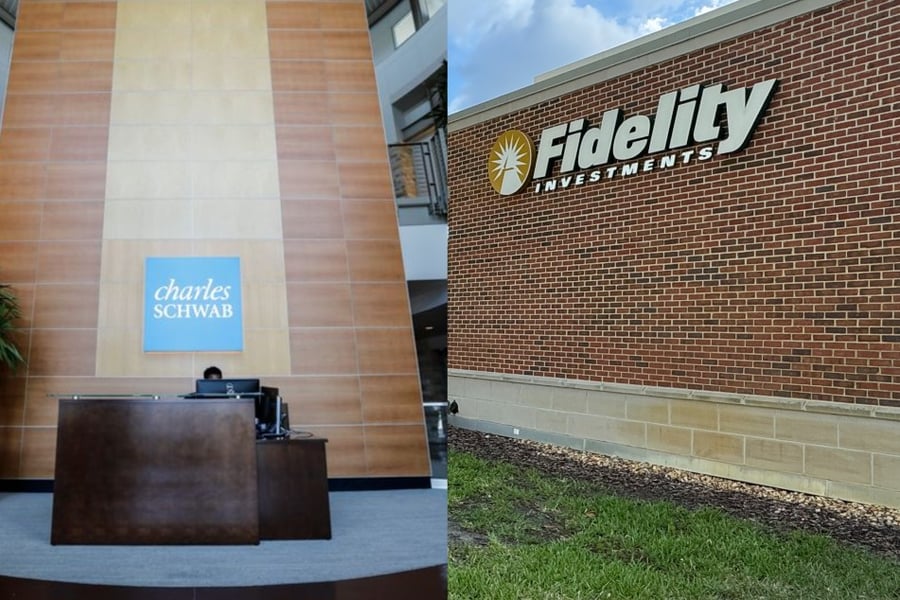
Policy changes from custodians Schwab and Fidelity have RIAs rethinking their strategies around long-short separately managed accounts (SMA), which involves buying long equity positions while also selling short on underperforming stocks to offset capital gains for wealthy clients.
Amid surging demand for the tax-efficient strategy, Fidelity began blocking RIAs in February from opening and funding new long-short SMA accounts and as of May 1 it instituted higher fees for some existing long-short SMA clients. Meanwhile, Charles Schwab recently put a 30% maximum limit on the portion of an RIA’s assets in its account that can be allocated to long-short strategies.
“I'm more surprised with Schwab than I am with Fidelity. Because Fidelity is just saying I'm upping my fees by almost a percent, which is a lot on an investment that's targeted to get 10% returns,” said Falcon Wealth Planning CEO Gabriel Shahin. “I'm more shocked with Schwab. With all due respect, who are you to tell me what's best for our client? That's the one that blows my mind. The fact that Schwab is getting into practice management is wild to me.”
Falcon Wealth, a $6 billion RIA based in California, has about 70% of its client assets custodied with Fidelity and 30% with Schwab. Fidelity notified Shahin that it was increasing financing rates for long-short strategies from 60 basis points to 152 basis points, which falls above the 40 to 120 basis point range (depending on client account size) that Shahin says Schwab charges Falcon Wealth for long-short SMAs.
“All those long-short portfolios are 100% moving to Schwab from Fidelity,” Shahin said of his RIA. “These [long-short SMAs] are really good strategies. I would probably say 40% of our clients that did this are people who sold a business and need write-offs.”
AQR and Quantinno are among the most active investment managers used by RIAs to gain access to long-short SMA strategies. Both Shahin and Andrew Herzog, an advisor with Texas-based RIA The Watchman Group, said that the 30% limit passed by Schwab was a threshold they would never think of trying to reach for long-short allocation.
“It is not for every client we have. It's actually for the vast majority, not appropriate. So we're well below the 30% limit that Schwab just now rolled out,” said Herzog. “The best ones [for long-short SMA] are people who are going to be realizing a capital event, selling a business, for instance, or they have concentrated stock positions, and they want to get out of it because they're overly concentrated.”
Fidelity serves as a clearing and custodian company but not a bank, whereas Schwab is the 12th largest bank in the U.S. by total assets. “Schwab probably had a little bit more control in saying, we will restrict it to 30% of AUM for each RIA, it was a little bit more their choice,” said Herzog. “Unlike Fidelity, who probably had to consult with their bank partner, and the bank just put a hard stop on it for now, or at least severely restricted it. That's my understanding.”
Fidelity has offered access to third-party long/short SMAs since 2023 for third-party wealth management firms. Sources indicated to InvestmentNews that Fidelity is encouraging advisors to diversify long-short SMA providers and will support transfer steps.
“These decisions reflect Fidelity’s long-term approach to monitoring resources across the platform as we manage the growth of long/short SMAs,” a spokesperson for Fidelity told InvestmentNews.
"We are committed to Long/Short SMAs on Schwab's platform," said a Schwab spokesperson. "The changes we have recently shared with our participating RIA clients are designed to ensure Long/Short SMAs on Schwab's platform grow responsibly over the long term. Schwab has the scale, the balance sheet, and the expertise to support this offer and will continue to meet the needs of RIAs and their clients."

Three senior women in wealth management outline the ownership, capital and confidence gaps still holding top advisors back

Schwab's Claude integration blocks Anthropic from retaining advisor and client data for model training, even for users without enterprise plans.

“Today is as big a moment as I have seen in my career,” says Shirl Penney of Dynasty Financial Partners.

TradePMR's Scott Victoria says Robinhood Advisor Network's 25% revenue fee model better serves advisors than basis-point pricing in other RIA client referral programs.

Built in partnership with Dynasty Financial, Schwab, VanguardClaude for Financial Advisors links custodians, CRMs and planning tools for advisor workflows
As AI makes financial information more accessible than ever, Lana Hock explains why human judgment, trust, and empathy remain the qualities clients value most in a financial advisor
Northern Trust’s Ken Lassner shows advisors how to convert volatility into after-tax portfolio gains

