Alternative Investment & Complex Assets Technology

The private markets moment is here
For a growing share of registered investment advisors and wealth managers, alternative investments have become an increasingly important part of client portfolios amid a decline in initial public offerings (IPOs) and companies choosing to stay private for longer.
The median age of a company at the time of its IPO in 2025 was 12 years, which is twice as long as the median of six years in 2000, according to research from the University of Florida. A total of 90 companies went public in 2025, compared to a striking 380 IPOs in 2000, showcasing the rise of venture capital and private equity this century.
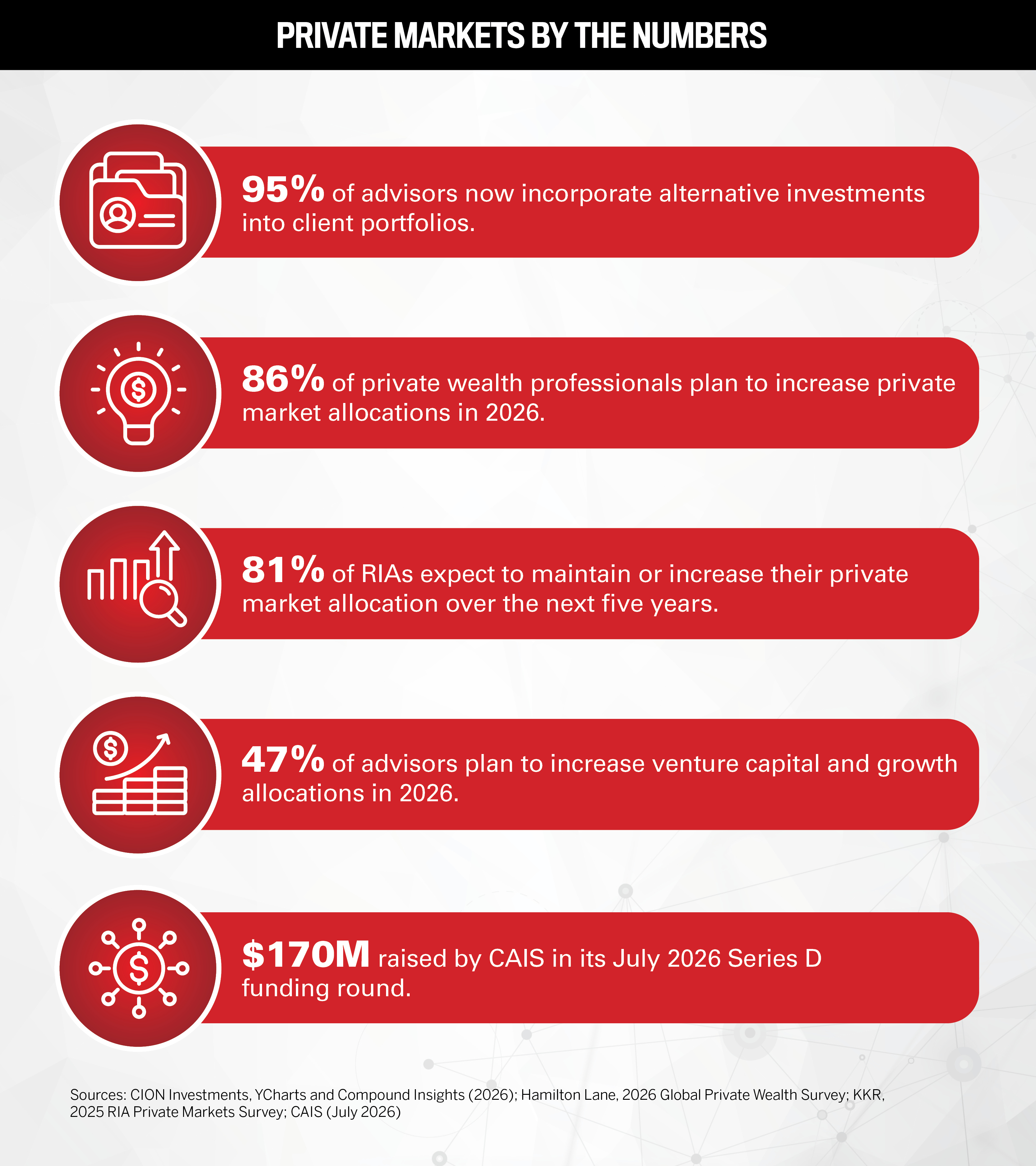
According to KKR’s 2025 RIA Survey, nearly half of the more than 100 RIAs polled already allocate 10 percent or more of their assets under management to private market investments, and 81 percent expect to maintain or exceed that level over the next five years. Hamilton Lane’s 2026 Global Private Wealth Survey, which polled 390 financial advisors across the Americas, Europe, the Middle East, and Asia-Pacific, found that 86 percent of private wealth professionals plan to increase private market allocations this year – with portfolio optimization as the single biggest motivator.
A separate joint survey by CION Investments, YCharts, and Compound Insights, published in July 2026, found that 95 percent of advisors now incorporate alternatives into client portfolios. The structural forces behind the shift to alts are well documented – public markets have been shrinking while private markets have grown larger over the past two decades; the number of listed companies in the United States has declined sharply; and the correlation between stocks and bonds has turned positive, undermining the diversification logic of the traditional 60/40 portfolio. Rolling 24-month correlations between stocks and bonds have averaged around 60 percent since 2022 – a stark reversal from historical norms, as noted in KKR’s Global Macro and Asset Allocation team’s 2026 mid-year outlook.
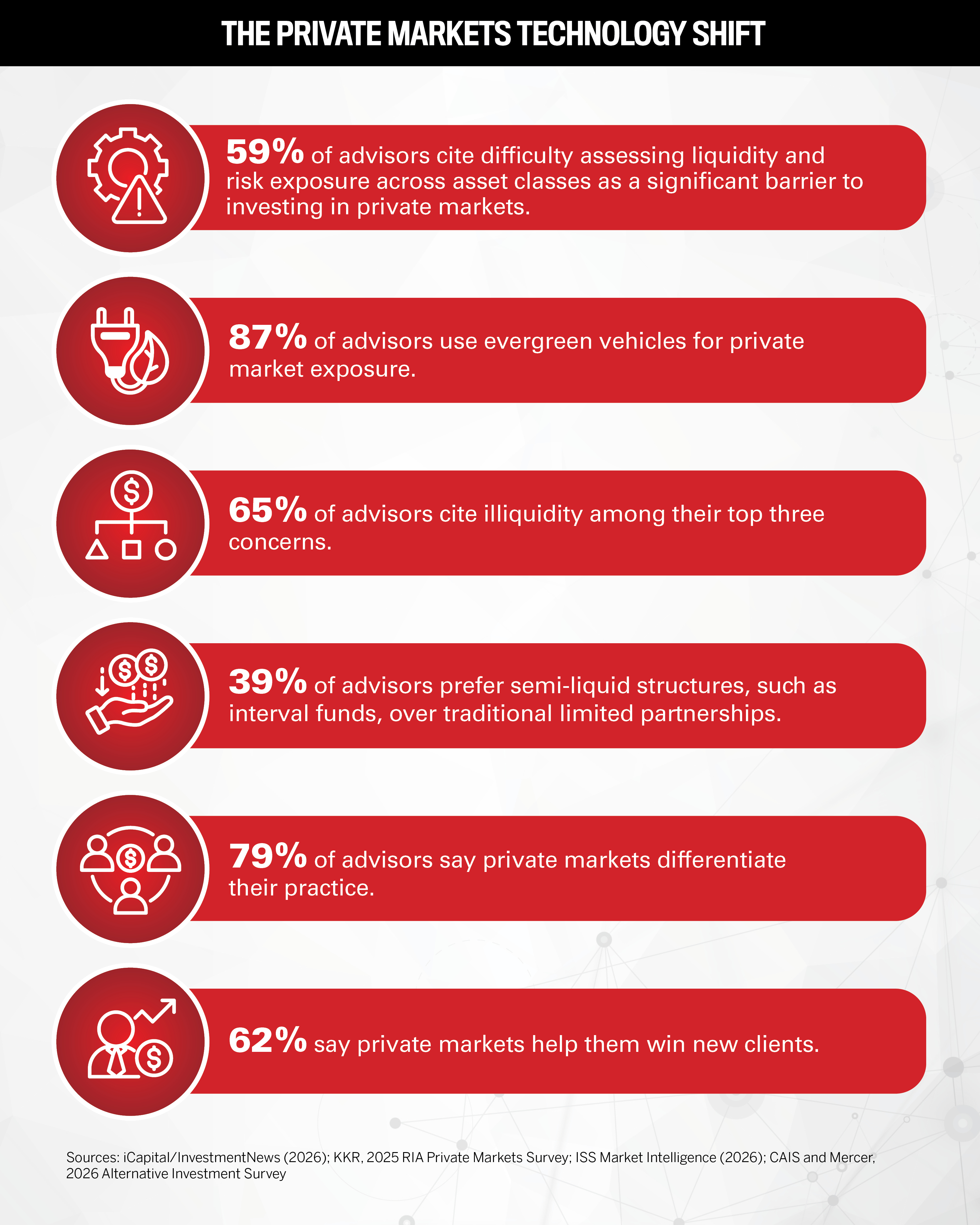
The technology that allows advisors to find, diligence, access, execute, administer, and report on private investments must meet the pace of demand. The operational complexity of alternatives – fragmented subscription documents, capital call scheduling, NAV tracking, and multi-system reporting – has been a persistent deterrent. A study from alternatives marketplace iCapital found that 59 percent of advisors cited difficulty assessing liquidity and risk exposure across asset classes as a significant barrier to investing in private markets.
The private markets technology stack for wealth advisors – once a patchwork of manual workarounds and disconnected portals – is consolidating into purpose-built platforms that cover the full lifecycle of alternative investments. AI is being embedded directly into advisor workflows. Custodians are opening the alternatives channel. And the capital to sustain this buildout is substantial: CAIS, one of the sector’s leading platforms, closed a $170 million Series D round in July 2026 at a reported $2 billion valuation, bringing its total raised to approximately $600 million.
This guide maps the technology landscape – the platforms, tools, data providers, and AI integrations that are reshaping how advisors engage with private markets – and explains why getting this infrastructure right has become one of the most consequential practice management decisions in the industry today.
Building the private markets operating system
The first wave of alternatives technology for wealth advisors solved an access problem – connecting advisors to private fund opportunities they previously could not reach. Platforms such as iCapital and CAIS built marketplaces that aggregated institutional-grade products, lowered minimum investments, and created onboarding infrastructure for the independent channel. The industry has now moved into a second, more complex phase.
With access broadly established, the bottleneck has shifted to operations. Advisors who have committed to allocating 10, 15, or 20 percent of client assets to private markets are discovering that the workflows required to manage those positions at scale are operationally intensive in ways that public market management is not. Capital calls arrive on irregular schedules; NAVs are reported quarterly rather than daily. Subscription documents differ by fund and custodian. Each of these challenges is manageable in isolation, but altogether they can represent a meaningful drag on advisor time. The result has been a significant build-out of the private markets operating system – a layer of technology that handles not just access but the full lifecycle management of alternative investments.
Several companies have positioned themselves as end-to-end private markets operating systems for wealth advisors, each with somewhat different architecture and market emphasis.
The platforms powering private markets
iCapital remains the largest and most broadly integrated of these platforms, covering access, investment structuring, execution, portfolio analytics, and reporting. Its April 2026 partnership with Anthropic to integrate Claude AI models across its platform targeted advisor workflows around education, product engagement, and client enablement. BlackRock’s 2026 integration of Aladdin with iCapital’s wealth platform is equally significant: the most sophisticated portfolio risk technology in the institutional world is now being brought directly into the advisor-facing alternatives workflow.
CAIS serves more than 2,500 wealth management firms representing over 65,000 financial advisors and describes its offering as an operating system covering the pre-trade, trade, and post-trade lifecycle of alternative investments. Its July 2026 Series D funding of $170 million, led by Vista Equity Partners with participation from AllianceBernstein, Blue Owl Capital, Carlyle, and others, positions the company to accelerate its technology and AI buildout. The investor roster reflects how firmly fund managers now view advisor-channel technology as distribution infrastructure. In May 2026, CAIS embedded Claude via a Model Context Protocol server, allowing advisors to query fund data and surface portfolio insights from within their primary workspace without toggling between systems.
Challenger start-up marketplace Allocate covers access, diligence, fund and SPV infrastructure, portfolio tracking, and reporting. Opto Investments targets RIAs and family offices with an end-to-end platform spanning access, portfolio construction, and operations. SEI Access integrates alternatives marketplace capabilities within SEI’s broader wealth-management ecosystem. Dynasty Financial Partners takes a network-based approach, with more than 700 partnered advisors to source institutional-grade private market opportunities its member RIAs could not access individually. In August 2026, the firm announced it had closed more than $200 million in private markets funds over nine months, including Dynasty Growth Equity & Coinvest I at $110 million – above its original target.
Custodians open the alternatives channel
One of the most significant structural shifts is the entry of custodians into the alternatives workflow. In June 2026, Altruist launched an alternatives marketplace that brings private equity, real estate, and infrastructure strategies from Blackstone, J.P. Morgan Asset Management, KKR, and Pantheon directly into the custodial account, with no custody fees for partner funds at launch. Subscription documents, reporting, and billing are handled without leaving the platform, and private market data flows directly into client portfolios alongside traditional holdings. Alto has targeted a separate but related gap: the $18.2 trillion held in IRAs that remains largely out of reach of private markets. Its August 2026 launch of Alto Private Deal Room gives RIAs a single workflow to execute self- and client-sourced private market deals inside client retirement accounts, with custody, compliance, and execution managed end to end.
AI transforms the alternatives workflow
AI is moving from a general productivity tool to a purpose-built capability within the private markets stack. CAIS’s MCP-based Claude integration is technically significant: the architecture allows Claude to draw on CAIS fund data from within whatever workspace an advisor is already using, removing the need to open a separate tab or reenter context. Anthropic has expanded its financial services footprint through partnerships with LPL and Orion and data connector integrations with FactSet, S&P Capital IQ, PitchBook, and Morningstar – positioning Claude as an integration hub rather than a standalone tool. Finseeka represents a more focused play: a platform built specifically for private capital data and AI-driven investment intelligence, targeting the due diligence complexity that general financial data platforms were not designed to handle.
Portfolio management and reporting tools built around public securities are also adapting. Addepar’s multi-asset analytics have made it a natural fit for RIAs adding private assets. Orion’s infrastructure, now augmented with Claude integration, reduces the need for separate specialized tools. Black Diamond/SS&C provides the portfolio accounting depth required at larger advisory firms. GLASfunds has built specifically for the challenges of private fund positions – capital account tracking, performance attribution, and multi-fund reporting.
Liquidity remains the key constraint
According to KKR’s 2025 RIA survey, 87 percent of advisors now use evergreen vehicles for private market exposure, and more than three-quarters rely on third-party platforms for onboarding, subscription documents, and ongoing management. Liquidity remains the binding constraint: the July 2026 CION, YCharts, and Compound Insights survey found 61 percent of advisors named it as their top barrier to expanding alternatives exposure. ISS Market Intelligence data from the same period found 65 percent cited illiquidity among their top three concerns, with 39 percent preferring semi-liquid structures such as interval funds over traditional limited partnerships.
The asset class mix advisors are targeting reveals where technology investment is most urgently needed. KKR’s survey recorded the sharpest year-over-year increase in private infrastructure intent, from 32 to 76 percent of respondents planning to increase allocations between 2024 and 2025. Private credit momentum has cooled – only 23 percent of advisors now plan to raise allocations over the next year, down from 64 percent at year-end 2024, as redemption-gate headlines and rising defaults temper enthusiasm. Venture capital and growth equity have emerged as the leading growth area: Hamilton Lane’s 2026 survey found 47 percent of advisors plan to increase VC and growth allocations this year – the highest of any strategy – yet private company data remains the hardest to standardize and integrate into advisor-facing tools.
Where technology creates competitive advantage
Technology investment in private markets is increasingly a competitive decision, not just an operational one. CAIS and Mercer’s 2026 Alternative Investment Survey found 79 percent of advisors said private markets differentiate their practice, and 62 percent said the capability helps them win new clients. The window to differentiate on access alone is narrowing as platforms proliferate and custodians open the channel.
What will continue to separate practices is the quality of execution: researching opportunities rigorously, constructing portfolios that balance illiquidity against client cash flow needs, and managing the ongoing administration without operational drag. That is precisely where the technology stack matters most.