Cybersecurity, Data Protection & Compliance

The cyber risks redefining RIA compliance
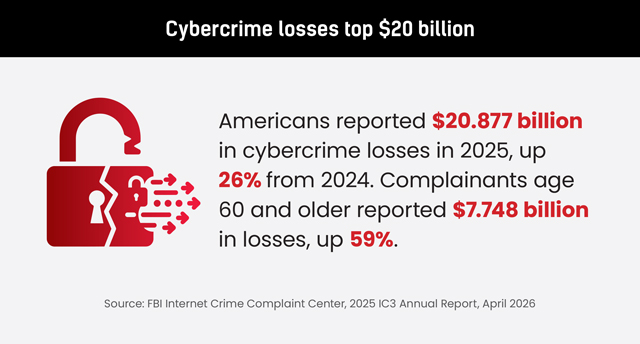
Cyber-enabled crime cost Americans nearly $21 billion in 2025, up from $16.6 billion in 2024, according to the FBI’s latest Internet Crime Report. For wealth management firms, 2026 also marks the first year in which all SEC-registered investment advisors must comply with the amended Regulation S-P data protection standards. Firms with less than $1.5 billion in assets under management had to comply by June 3, 2026, six months after the deadline for larger firms.
The rule requires written incident response policies, client notification within 30 days of a confirmed breach, and service provider notification to the RIA within 72 hours of discovering an incident.
These obligations emerged amid a wave of cyberattacks targeting some of the industry’s largest firms. Edelman Financial Engines, Beacon Pointe Advisors, CW Advisors, Betterment, Pathstone Family Office, and EP Wealth experienced data breaches this year, while Mercer Advisors, Hightower, Cetera, and Ameriprise were named in class-action lawsuits related to alleged breaches.
Compliance teams have taken notice. Cybersecurity (37 percent) and Privacy/Regulation S-P (35 percent) ranked as the second- and third-hottest compliance topics of 2026, respectively, behind AI (85 percent), according to the 2026 Investment Management Compliance Testing Survey, which surveyed 411 firms and was released by the Investment Adviser Association, ACA Group, and Yuter Compliance Consulting.
The common thread among regulators, plaintiffs, and attackers in 2026 is a single test: whether a firm can demonstrate that its controls work.
The breach wave reaches the largest RIAs
Mercer Advisors, which manages more than $100 billion, was named in class-action lawsuits alleging that 5.7 million internal records were exposed in a mid-February breach by the hacking group ShinyHunters. The complaints claim Mercer refused a ransom demand before client data was leaked.
A cyberattack on fellow mega-RIA firm Hightower affected 131,483 individuals, according to a Maine attorney general filing. A former employee is seeking $5 million in a class-action lawsuit, which Hightower has called baseless, according to the same report.
Overland Park, Kansas-based Mariner Wealth Advisors disclosed that a criminal third party accessed cloud applications used by three employees in November 2025, exposing data on 8,995 individuals. Ameriprise reported a March 2026 breach affecting 47,876 customers, according to a Maine attorney general filing.
Not every firm fared equally. Beacon Pointe said fewer than 0.5 percent of its clients were affected. Michael Cocanower, CEO of RIA cybersecurity provider itSynergy, told IN that the gap in exposure points to differences in the efficacy of firms’ internal risk controls.
AI industrializes social engineering
Several of 2026’s most visible attacks targeted people rather than systems. Point72 Asset Management, Millennium Management, Two Sigma Investments, and Citadel were targeted in a coordinated AI voice-phishing campaign. Point72’s initial review found no client information was stolen, and Two Sigma said it blocked the attempt. “Before they could attack 50 entities in a targeted attack, now they can do 1,000,” Vinod Paul, president of Align Managed Services, told Bloomberg.
Advisors now rank this threat above regulatory risk. Nearly eight in 10 RIAs named wire fraud and social engineering as a major risk in the 2025 Golsan Scruggs Bi-Annual Risk Survey of approximately 8,000 RIAs. About four in 10 cited errors introduced by AI tools as the first year the survey measured either concern, according to the same report.
Attackers compromise a client’s email, scan it for financial correspondence, and impersonate that client to the RIA, Brian Francetich, shareholder and director of Golsan Scruggs RIA, told IN. Kevin Thompson, founder and CEO of 9i Capital Group, said his firm now requires a phone call to a known number before acting on any client request received digitally.
Older clients carry the most exposure. FBI-reported losses among people over 60 reached $7.75 billion in 2025, up from $4.88 billion a year earlier. Edward Jones is now offering Carefull’s AI fraud-monitoring platform to more than nine million clients through more than 20,000 advisors, after Osaic’s advisor network partnered with Carefull in 2025.
Regulators move from guidance to proof
The SEC’s Division of Examinations named Regulation S-P amendments, ransomware, and AI-driven attacks among its 2026 examination priorities.
M Holdings Securities, a Portland, Oregon-based broker-dealer and investment advisor, paid a $325,000 penalty after email account takeovers at several branch offices exposed records of approximately 8,500 individuals. The firm had no written information security policies across its member firms before September 2020, according to the SEC.
At the state level, Massachusetts Secretary of the Commonwealth William Galvin fined Fidelity Brokerage Services $1.25 million over a breach affecting approximately 77,000 customers. A user could view other customers’ documents by changing a 10-digit image ID in the browser, and Fidelity failed to notify affected beneficiaries and relatives, some of them minors.
Recordkeeping cases now carry a data-protection dimension. FINRA fined St. Louis-based Benjamin F. Edwards & Co. $750,000 after at least 3,560 business text messages, including sensitive personal information, went uncaptured.
FINRA has also moved toward shared defense, launching its Financial Intelligence Fusion Center for member firms to exchange cyber and fraud threat intelligence.
The SEC is also reconsidering how it weighs compliance costs for smaller firms. Under a proposal released in January 2026, the agency would raise the threshold for treating an RIA as a “small entity” under the Regulatory Flexibility Act to $1 billion in assets under management, up from the $25 million level last amended in 1998.
The SEC estimated that 15,850 of 21,650 registered RIAs manage less than $1 billion, meaning about 75 percent would qualify as small entities, compared with 3 percent under the current threshold. The change would require the SEC to consider the effects of new rules on a much larger share of the industry during rulemaking, Max Schatzow, a partner with RIA Lawyers, told IN.
Vendor risk and the AI data question
Regulation S-P makes third parties a compliance perimeter. Jonathan Addington, president of CyberSecureRIA, put it plainly to InvestmentNews on August 19, 2025: “You can outsource IT tasks, but you can’t outsource liability.”
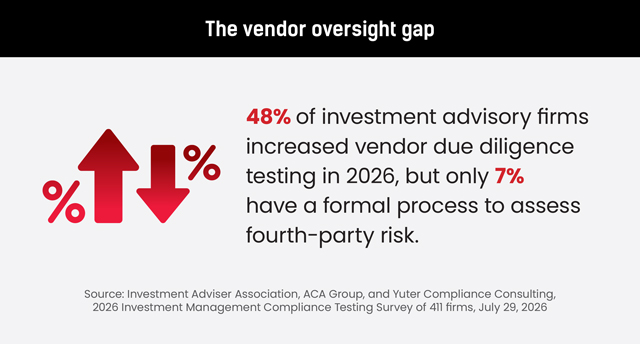
Firms are responding unevenly. Forty-eight percent of firms increased vendor due diligence testing in 2026, and 39 percent made significant changes to third-party risk management programs, according to the ACA Group’s IMCT Survey. Only 7 percent have a formal process to assess fourth-party risk, and 14 percent have updated incident response plans for AI-related disruptions, according to the same survey. RIA in a Box, used by more than 2,600 RIAs and wealth managers, offers a cybersecurity module with phishing simulations and vendor due diligence.
AI tools are the newest vendor category. Schwab’s Claude integration for its network of more than 16,000 RIAs bars Anthropic from retaining data for model training, masks account numbers, and excludes Social Security numbers and dates of birth.
Retention policy is the next fault line. More than 90 percent of firms still delete data after the five-year minimum under SEC Rule 204-2, Archive Intel CEO Larry Shumbres estimated, while SmartRIA CEO Patrick Hunt argued longer retention could improve AI models. Every record kept to train a model is also a record exposed in a breach, a trade-off firms will need to document. Leila Shaver of My RIA Lawyer warned that AI notetaker summaries sent by email become official books and records in the eyes of regulators.