Jump to Winners | Jump to Methodology
Meet the best wealth managers and advisors under 40 in the USA, chosen for trust-building and plain-spoken advice
By Chris Sweeney
of retiring advisors have no formal succession plan, even as retirements accelerate industry-wide, Cerulli Associates finds.
of rookie advisors call mentoring important, though most say they don't actually receive real career guidance from one.
advisors nationwide now rely on the platform Rising Star Charles Heuring built from scratch as founder of IAMS Wealth Management.
is the assets-under-management target Envisage Wealth has set, and the firm is already ahead of schedule, says Rising Star and CIO Alexander Reed.
of advisors already use AI in their practice, yet most say client trust still requires a human touch, Edward Jones research finds.
of advisors have adopted AI tools, and many now say it saves them meaningful time each week, AssetMark reports.
Sources: Cerulli Associates, Edward Jones / Morning Consult, AssetMark, and interviews conducted for this report.
Among this year’s best wealth managers and advisors under 40 in the USA, the best have a proprietary skill that’s enabling them to thrive, and it has nothing to do with picking stocks or foreseeing macro trends. They can take something genuinely complicated, understand what their clients want, and hand it back to them with nothing lost in translation. Simplicity is the new sophistication.
The investment world runs on jargon and acronyms that most professionals privately admit add nothing but distance, and the advisors on this year’s list have built their careers on refusing to hide behind them. Anyone can memorize a contribution limit or run a model portfolio. What separates this year’s InvestmentNews Rising Stars is the ability to turn complexity into something a client can hold onto and to do it consistently enough that trust stops being earned meeting by meeting and starts being assumed.
That skill has never mattered more. Wealth management is barreling toward a demographic cliff: more than a third of financial advisors plan to retire within the next 10 years, and 27 percent of those advisors have no formal succession plan in place, according to Cerulli Associates’ The Cerulli Edge – U.S. Advisor Edition, 3Q 2026. Every one of those retirements hands a book of client relationships to whoever can earn them fastest. At the same time, artificial intelligence (AI) is doing to financial advice what it has done to other knowledge professions: commoditizing the parts that used to feel impressive. Anyone can ask a chatbot how a Roth conversion works. What a chatbot cannot do is sit across from a client, read the fear in a follow-up question, and answer it in a way that actually lands.
Among the 2026 Rising Stars list, now in its third year, some are building technology platforms deliberately designed to disappear into the background, while some are betting their firm’s future on the idea that better tools make expertise more valuable, not less. Some are simply refusing to let a client leave a meeting confused. All of them are proof that in an industry about to change hands, the advisors who win are the ones who make the complicated feel simple and the unfamiliar feel safe.
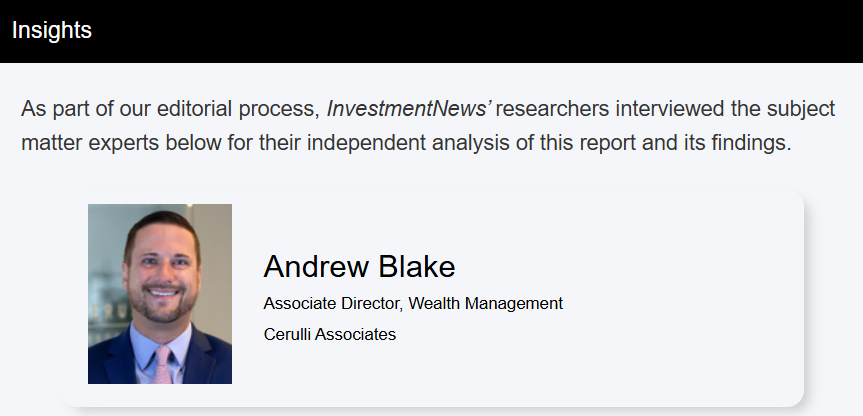
The wealth management industry’s succession problem is not abstract, and it is bigger than any one interview can capture. Andrew Blake, associate director, wealth management at Cerulli Associates, points to a structural gap:
more than a third of advisors plan to retire within 10 years
roughly a quarter of those have no formal succession plan
“It’s beneficial for advisors that do have a succession plan to share it with clients and make early introductions to those who will eventually run the practice,” Blake says. “The next generation of advisors must forge relationships with the next generation of clients to ensure a seamless transition that keeps the relationship in place.”
The key to filling that gap is being able to speak to clients in a simple and engaging manner. According to The Cerulli Edge – U.S. Advisor Edition, 3Q 2026, roughly 35.3 percent of advisors, representing 40.1 percent of industry assets under advisement, expect to retire within the next decade, a wave the firm estimates will touch nearly $14.5 trillion in assets. Of those retiring advisors, 27 percent say they are unsure of their succession plans, representing roughly $4 trillion in assets without a clear plan for who takes over. The same research found that 73 percent of advisors cited the length of time required to learn the business as a major obstacle, and 67 percent said day-to-day training itself demands too much of a senior advisor’s time – exactly the kind of mentorship gap Blake describes.
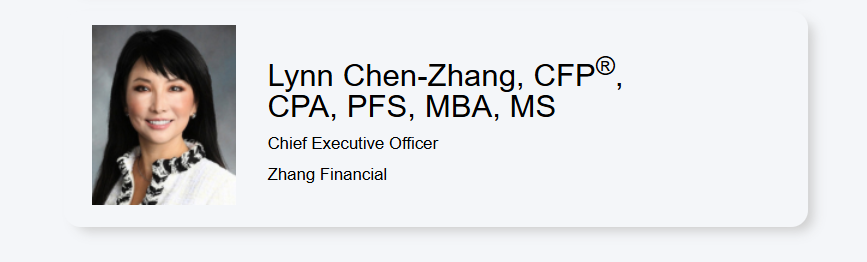
Lynn Chen-Zhang, CFP®, CPA, PFS, MBA, MS, CEO of Zhang Financial, frames the challenge less as a numbers problem and more as an inheritance problem. “This generational transition creates an extraordinary opportunity for younger advisors, but inheriting client relationships should never be viewed as automatic,” she says. “Clients need to develop confidence in the next generation well before a transition occurs.”
Erin Botsford, founder and CEO of The Advisor Authority, frames the same succession problem in blunter terms. “Inheriting a book of business and keeping it are two different things,” she says. “Clients aren’t automatically going to transfer their trust from one generation to another. The younger advisor still has to demonstrate that he or she can lead the relationship, communicate with confidence, and bring meaningful value to the family.”
Botsford argues that what actually separates a Rising Star from an advisor who has simply accumulated years in the business is never technical knowledge alone. “Technical competence is important,” she adds. “But technical competence alone rarely creates an extraordinary career.”
All three experts converge on the same warning about AI: it can make advisors faster, but it cannot manufacture the trust that clients place in a person. “AI and digital tools can make advisors more efficient by accelerating research, improving data analysis, streamlining administrative work, and helping personalize client communication,” Chen-Zhang says. “However, technology does not replace an advisor’s fiduciary responsibility, professional judgment, or empathy.”
Botsford makes a similar case from the technology side: “As technology makes information and analysis increasingly available to everyone, information itself becomes less of a differentiator. The advisor’s value shifts toward judgment, communication, trust, and the ability to help a client make good decisions.”
Blake adds that mentorship, the traditional mechanism for passing on that judgment, is falling short of what young advisors need: 94 percent of rookie advisors and practice management professionals consider mentoring important, yet only 42 percent of rookies report receiving real career-growth guidance from a mentor.
Independent survey data backs up that human-touch argument. A Morning Consult survey of 201 financial advisors conducted for Edward Jones and published in July 2026 found that 82 percent of advisors are already using AI in their practice, and 69 percent say it has had a positive effect on the industry. Yet 68 percent of those same advisors said building and maintaining long-term client trust still requires a human touch.
Source: InvestmentNews Rising Stars 2026 nomination data
Age: 35
Role and firm: President and Chief Executive Officer, IAMS Wealth Management (Elkhorn, Nebraska)
Key achievements: Supports more than 50 independent financial advisors nationwide,
overseeing roughly $500 million in assets under advisement
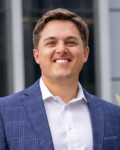
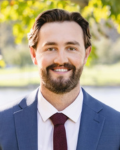
Charles Heuring founded IAMS Wealth Management in Elkhorn, Nebraska, in 2016 with no clients, no brand recognition, and a handful of advisors willing to bet on him before the firm even had a name. A decade later, the firm, registered as an investment adviser with the U.S. Securities and Exchange Commission, supports more than 50 independent financial advisors nationwide, overseeing roughly $500 million in assets under advisement, with 10 of those original advisors marking their 10-year anniversary with the firm next year. He says, “It’s been hard to trust other people to kind of carry the torch for me, but it’s been fun seeing them embrace that. I’m starting to see the benefits of scale.”
What makes Heuring’s approach distinctive is what he has chosen not to build. Rather than positioning IAMS as a consumer-facing brand, he has deliberately kept the firm behind the scenes, letting each advisor’s own business identity lead the client relationship. “I might be a little different than other people because we’re more of a platform,” he says. “If you looked in our office, our advisors have 40 different branch office logos. There are not a lot of IAMS Wealth offices everywhere. We really empower their brand to own the client relationship, and we’re kind of the silent back-office engine.”
That instinct extends to how he has handled growth. IAMS has fielded acquisition interest and approached other firms itself over the years, but Heuring has consistently walked away rather than compromise the culture he built from zero. “I’m really cautious about taking care of our culture, just making sure we don’t grow too fast or outpace ourselves,” he says. “There are ways to maybe cut a corner or earn an extra dollar or merge another firm, but I really just like what we have, and I’m first and foremost cautious of ruining that. I want to grow purposefully instead of growing for the sake of growing.”
Heuring is candid that the role comes with a kind of isolation the recognition doesn’t fully account for. Running a platform built around other people’s businesses, he says, means there’s rarely anyone checking his own work, for better or worse. He also describes his day-to-day less like running a single firm and more like overseeing dozens of small businesses at once, treating the variation across his advisor base as a constant source of data rather than a headache to manage.
“It can be lonely at the top,” Heuring says. “No one’s patting you on the back for making good decisions or coming down on you when it’s a bad decision. You live with that yourself. So, to have a little bit of recognition is really, really neat.”
Q: What do you feel you bring to the role that’s particularly strong?
A: I think, first and foremost, I try to genuinely connect with people. I know that’s probably what a lot of people say, but I think we try to walk the walk, and that’s how I lead my team. We started from scratch, and a lot of our advisors actually had never done this before. So they put a lot of trust in me and the vision we were building. It comes down to earning their trust and earning their respect, and that just comes from doing the little things over time.
Q: What do you look for in the advisors and team members you bring on board?
A: I think, even more than anything else, it’s about mindset and camaraderie. I think if they come in knowing they’re shoulder to shoulder with their teammates, we celebrate successes. We do most of our service through the phone, and a lot of our advisors tell me they can hear that over the phone when they’re talking to our team – they can just say, ‘Hey, I know you guys are working for me; we’re not just a number.’ We know everything about our customers – their spouses’ names, their kids’ names, their favorite sports teams, and where their summer vacation is.
Q: How is AI changing what you’re building?
A: We’re actually developing our own technology to blend a lot of our tools together into one tool – we’re calling it the IAMS Advisor Dashboard, still just one login to do everything. Most of our advisors are one-person teams, so their time is money. We want them not in the dashboard – we want them meeting with people. What I’m excited about is getting it at the institutional level, where we can all be working from the same data set. From a compliance standpoint, that’s a big asset too – actually owning that technology instead of supervising 40 offices that all use their own independent AI. That’s a little bit of a nightmare for our compliance team.
Q: What’s the biggest internal challenge you’re managing as the firm grows?
A: Growing and scaling and helping advisors grow, but not turning our back on what got us to where we’re already at. Keeping that culture, that small family office feel, and that personal knowledge of our advisors – I want that to stay with us even if we double, triple, or quadruple in size over the next five years.
Q: Where do you see IAMS in 10 years?
A: We’ve already outkicked our expectations, to be honest. We just built out more of our office – we have room for about 25 employees now; we’ve got 12 so far. I have no plans of really slowing down. If I’m looking in 10 years, I hope we’re four or five times as big, and I hope we’re helping four or five times as many people. This recognition is even a nice kind of benchmark, affirming that we’re on the right track and just doubling down and knowing that if we keep doing what we’re doing, the sky is really the limit.
Age: 35
Role and firm: Chief Investment Officer, Envisage Wealth (Columbus, Ohio)
Key achievements: Led due diligence on a $1.5 billion AUM acquisition in Calabasas, California,
tracking ahead of the firm’s $10 billion AUM target for 2031
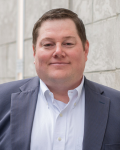
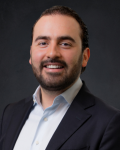
As chief investment officer and a member of the executive leadership team at Envisage Wealth in Columbus, Ohio, Alexander Reed sets the firm’s investment strategy and oversees manager selection, asset allocation, and portfolio construction. Over the past year, he has led due diligence on the firm’s strategic merger to date, involving a $1.5 billion-asset manager based in Calabasas, California, expanding Envisage’s presence in the ultra-high-net-worth market. The firm set a target of reaching $10 billion in assets under management by 2031 three to four years ago and, according to Reed, is tracking ahead of schedule. Strategic acquisitions and continued AI adoption have been identified as two key levers to help the firm achieve that goal.
Reed’s central argument is that AI raises the bar for advisors rather than lowering it. Much of his strategic focus over the past year, he said, has been helping his own team separate the mechanics of the job from the reason clients hire them in the first place. “How do we redefine our purpose and what we do as financial advisors vs. the task of asset allocation or of writing a financial plan?” he says. “Our purpose is to ask the right questions and turn insight into confident and reliable action.
“But the purpose is to give confidence to our clients to meet their needs and hit their goals. That’s been a lot of my strategic role the last 12 months: helping people understand where AI will fit, where we need to reassess resources, and double down on other areas that make our team special.”
Away from the numbers, Reed points to temperament as much as technical skill. Asked what he brings to the CIO role beyond investment expertise, he pointed to an even keel as much as passion for the work. He also described the job as something he never fully switches off from, treating markets and business strategy as close to a hobby as a profession, alongside cooking, travel, and family, with the team around him describing him as highly competitive and uncomfortable with complacency in a fast-changing industry.
“You have to be passionate,” Reed says. “That helps take the highs and lows out of the job. Within investments, and especially as a CIO, you have to have a pretty even-keeled personality. You can’t get overzealous or excited in one market or the other. A lot of that has to do with just having a repeatable process, establishing perspective, and always trying to find the devil’s advocate.”
Q: How is AI changing the value an advisor provides?
A: It’s already having a great improvement in my productivity and the team’s, but the mindset I try to instill in the team is that better tools don’t replace expertise; they reward it. If you had Tiger Woods’ swing coach, his clubs, his balls, and his dietitian, would you be playing like Tiger Woods? No, there’s something different there about experience and expertise that gives you better insight. A lot of people can learn what to do when it comes to their finances – like contribute to your 401(k) or contribute to a Roth IRA – but knowing the task isn’t the same as understanding the purpose behind it.
Q: You mentioned clients bringing more outside information into conversations. What’s changed there?
A: We really focus on trying to be as objective as possible and just give perspective to clients. Oftentimes it’s these echo chambers of noise, whether it be a podcast or YouTube channel that we get laser-focused on, and we just try to put down the walls and say, ‘Okay, here are the objective facts, here’s the perspective.’ There are no absolutes when it comes to investing – it’s about probabilities, and they’re always changing. We try to be that behavioral coach when it comes to investing – that’s kind of the most important piece.
Q: What does the CIO role look like going forward, and where is the firm headed?
A: I think doubling down on leveraging technology to deliver fast, relevant, objective data and insights to our clients is going to be more and more important – that’s going to be more and more of my focus, what moves the needle for clients in the future.
Age: 39
Role and firm: President and Senior Wealth Advisor, Willow Chute Financial (Benton, Louisiana)
Background: Army reservist who deployed to Iraq in 2010 and spent years
consulting other financial advisors
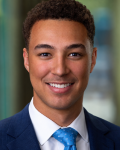
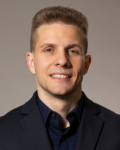
As the president and senior wealth advisor at Willow Chute Financial in Benton, Louisiana, Matt Stephens is an Army reservist who deployed to Iraq in 2010. He personally spent years consulting other financial advisors before building his own practice, an experience that shaped both his investment approach and his communication style.
The habit that defines his practice, he said, is refusing to talk to clients about their money the way the industry talks about it internally. “They don’t think that way,” Stephens says. “They think, ‘I need to be saving more, or I don’t know that I’ve saved enough,’ or there’s some other nonquantifiable, nonnumerical factor that people are thinking about their problems in their own head. If you talk to people about their problems in numerical terms, they don’t get it. That’s not a context where we talk about problems in numerical values. We talk about them and how they feel and how they impact us. And that’s how clients need to hear results as well.”
Stephens runs two distinct equity models for clients: a conservative portfolio built around large, dividend-paying companies with strong market share and a more aggressive model weighted toward technology and data-driven firms. For seven-figure accounts, he often blends the two. He manages individual stock positions directly rather than through mutual funds or ETFs, a choice he says keeps portfolios lean enough to explain in the 30-second conversations that define his approach with clients. He developed that skill during his years in consulting, where he learned to distill information for other advisors down to only what was essential, targeting explanations using a client’s reaction as a real-time signal of whether the message landed.
Beneath the confident, plain-spoken delivery, Stephens is candid about the weight of the job itself. He recently hired an assistant who, within her first weeks, arrived at the same realization he has quietly carried for years: that the numbers on a screen represent someone’s entire life savings. Rather than dwell on that pressure, he manages it structurally, running every recommendation past his team for a second opinion and through planning software before it ever reaches a client, so that by the time he delivers advice, it has already been stress-tested.
“We’re dealing with people’s life savings, like everything they’ve accumulated in their lifetime,” Stephens says. “Usually, we’re managing all of it. So yeah, it is some pressure. I try not to think about it in those terms just because I think it would probably scare me to death sometimes. I just try to do a good job for folks who are giving me that level of trust.”
Q: What do you think is your biggest strength as an advisor?
A: When people understand what you’re telling them and they get it, it gives them confidence that you know what you’re doing. Being a younger person in the industry, that’s been important for people who have worked with previous financial advisors for potentially decades but then choose to work with me. It’s because they might have worked with that advisor for a long period of time and never really understood what this piece meant or how it connected to another piece. In them understanding it, they have all the confidence that I grasp it and that I’ve got it under control.
Q: You’ve grown partly by acquiring retiring advisors’ books of business. What makes that work?
A: If you have the buy-in and the warm introduction from the outgoing advisor, that is so much better than someone coming off the street, meeting you for the first time, trying to build that trust. That has its place, and that needs to happen. But getting clients by acquisition, especially if it’s a good fit and everybody is on board with what’s happening – for me, it was two aging advisors who wanted to retire pretty rapidly. One was relocating and one was taking care of an ailing wife.
Q: How do you use AI in your practice?
A: So [Claude] gave me last year’s IRS limit. I asked it, ‘Hey, why did you give me the 2025 limit, not the 2026 limit?’ It said, ‘Oh yeah, you’re right, I should have given you the 2026 limit.’ Right there, it told me I can’t use it for the details. I can use it for the concepts, and AI will catch up – it’ll get there; it may already be there, and that happened about a year ago. I think AI has got a lot to offer, especially in my industry, but I’m hesitant to give it a lot of trust.
Age: 38
Role and firm: Co-Founder, Richards Lathrop and Associates (Irvine, California)
Background: Grew the firm to more than $115 million in assets
under management within its first seven months, with no account minimums
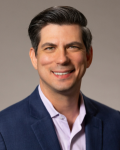
Christian Richards III played football from age five through a Division 1 scholarship at the University of Michigan before finishing his college career at Stony Brook and signing in the NFL with the Seattle Seahawks. That path, not a traditional finance career track, shaped how he built Richards, Lathrop & Associates: a firm explicitly designed to serve the clients other advisors overlook.
Richards and co-founder Michael Lathrop both trained at small boutique firms managing roughly $1 billion in assets, where the prevailing ethos was client-first service. They left when they watched that model get squeezed out.
Richards traces the firm’s founding mission to a single moment early in his football career. At a Seattle Seahawks rookie meeting, top brokerage firms sat down with the team’s draft picks and largely ignored the players like him. That conviction has become the firm’s defining policy, as Richards, Lathrop & Associates doesn’t have account minimums. Richards traces that policy directly back to where he’s from. He grew up in Pacoima, a small enclave in North Los Angeles County, where, by his own estimate, fewer than one percent of people had more than $5,000 to invest. “My family and friends would not be ideal clients for the average wealth management firm and certainly not from the wealth management firms that I came from,” he says.
Richards, Lathrop & Associates’ growth has come fast; it passed $115 million in assets under management within its first seven months, but Richards treats scale as secondary to the standard of service he and Lathrop set out to deliver. “We intend to grow as large as we can, as long as we can keep those core tenets in place,” he says. “And once we get to a place where we feel that we’re not providing that same level of service that we intended when Michael and I started, then we’ll stop. I think we’re very well compensated in this industry, and so for us it's not about more; it's about doing what we set out to do in the right way.”
Q: How did your athletic background shape your approach to wealth management?
A: As a financial counselor, our clients look to us for leadership in all things financial and making sure that we put a plan together, which is something that I learned as an athlete over the years. You don’t go into a game with hopes to win and be prosperous without a game plan. And so obviously there’s a direct analog there between my career in athletics and my career as a wealth manager. And then also, teamwork – I’m a firm believer in that. There have been a lot of things that I’ve been able to accomplish in my life, and none of them I’ve accomplished by myself.
Q: What’s the biggest fear you hear from clients today?
A: It permeates throughout socioeconomic status. Those things are always central; the fear is, am I going to outlive my assets? Specifically, today, primarily what I’m hearing is a fear of what this transition into an almost exclusively technology-driven, AI-driven economy and global economy will mean, not just for most of my clients, who tend to fall in the 45–60 age demographic. They’re worried about the world that their kids and grandkids will inhabit and what industries will be able to provide them an income that is sustainable for them.
Q: What sets your firm apart when it comes to actually growing client wealth?
A: It’s where we create the most value; we have a high-level tax strategy and education that allows us to help clients keep more of their money in their pocket, which inevitably leads to more growth as you save and invest and are diligent in those areas over time.
Source: InvestmentNews Rising Stars 2026 nomination data. Winners rated each trait's importance to becoming a leader in wealth management.
The next 12–24 months will test how well this generation of advisors can convert individual recognition into institutional continuity.
Cerulli’s data suggests the retirement wave is not a distant risk: with more than a third of advisors planning to exit within a decade, nearly $14.5 trillion in assets in motion, and only a minority of those retiring advisors with a formal transition plan, firms that fail to build deliberate succession pathways risk losing client relationships along with their retiring advisors.
AI adoption will likely accelerate on both sides of that transition, and it is already further along than headlines suggest: separate research from AssetMark, published in September 2026, found that 85 percent of advisors have adopted some form of AI-integrated solution, with more than half saving at least four hours a week as a result.
Rising Stars like Reed are betting that AI raises the value of human judgment rather than replacing it, while Stephens’ experience with an outdated contribution limit illustrates why advisors are treating AI as a research accelerant rather than a source of client-facing fact. Heuring’s approach – building proprietary technology at the institutional level rather than leaving 40 offices to adopt AI independently – points to where compliance-conscious firms are likely headed next: centralized, auditable AI tools rather than a patchwork of individual advisor experimentation.
I feel like I win more when I help other people succeed.
You have to be passionate. That helps take the highs and lows out of the job… you have to have a pretty even-keel type of personality.
I have very sophisticated software that helps me test the boundaries of the advice. So by the time I’m communicating it to a client, it’s been through a stress test and I can defend it.
What distinguishes this year’s top wealth managers and advisors under 40 is not a single formula for growth. Heuring built trust by staying out of the spotlight and empowering advisors to own their own brand. Reed built it by arguing that expertise, not technology, is what actually moves clients forward. Stephens built it by acquiring the trust that retiring advisors had already earned and making sure clients could understand, in 30 seconds or less, exactly what he was doing with their money.
Across all three approaches, the throughline is the same: technical skill earns a seat at the table, but trust, deliberately and patiently built, is what keeps a client relationship intact through a generational handoff.
How were the 2026 Rising Stars selected?
Nominations opened in May 2026, when InvestmentNews invited financial advice and wealth management professionals nationwide to nominate exceptional young talent. An independent panel of five industry leaders reviewed nominations and determined the final winners.
What eligibility criteria did nominees need to meet?
Nominees had to be 40 years old or under as of October 1, 2026, and demonstrate a clear commitment to a career in wealth management, along with concrete contributions to their organization and the broader industry.
How is artificial intelligence changing the role of a financial advisor?
This year’s winners describe AI as a tool that increases the value of human expertise rather than replacing it. Advisors are using AI for research, note-taking, and administrative efficiency, but most remain cautious about relying on it for client-facing numbers or regulatory details, citing real examples of AI producing outdated information.
Why does succession planning matter so much in wealth management right now?
According to Cerulli Associates’ The Cerulli Edge – U.S. Advisor Edition, 3Q 2026, more than a third of financial advisors plan to retire within the next 10 years, and 27 percent of those advisors say they are unsure of their succession plans. That gap creates both risk and opportunity for younger advisors who can build client trust before a transition occurs.
What role does mentorship play in developing young advisors?
Mentorship is widely considered important across the industry, but Cerulli Associates research shows a significant gap between intent and execution: 94 percent of rookie advisors and practice management professionals call mentoring important, yet only 42 percent of rookies report receiving real career-growth guidance from a mentor.
What trends will shape wealth management leadership over the next few years?
Industry experts point to three converging trends: an accelerating wave of advisor retirements, growing institutional adoption of AI tools, and a shift toward advisors who can combine technical competence with genuine client relationships rather than relying on either alone.
Starting in May, InvestmentNews invited financial advice and wealth management professionals across the country to nominate their most exceptional young talent for the third annual Rising Stars list.
Nominees had to be aged 40 or under (as of October 1, 2026) and be committed to a career in wealth management, with a clear passion for the industry. Nominees were asked about their current role, key achievements, and career goals, as well as the contributions they’ve made to shaping the industry. Recommendations from managers and senior industry professionals were also taken into account.
The Rising Stars were determined by an independent panel of industry leaders composed of:

IN's 2026 Rising Stars report is proudly supported by the California Alternative Investments Association and the National Association of Insurance and Financial Advisors.