
Office address: Centralbahnplatz 2, 4051 Basel, Switzerland
Website: bis.org
Year established: 1930
Company type: international financial institution
Employees: 600+ (globally)
Expertise: central banking cooperation, monetary policy analysis, financial stability and macroprudential policy, reserve management for central banks, foreign exchange and gold services, asset management for official reserves
Parent company: N/A
Key people: Pablo Hernandez de Cos (GM); Andrea Maechler (deputy GM); Veronique Sani (secretary general); Dessislava Guetcheva-Cheytanova (general counsel); Luis Bengoechea, Jens Ulrich, and Hyun Song Shin (department heads)
Financing status: shareholder‑owned company
The Bank for International Settlements (BIS) is an international bank that serves central banks worldwide. It supports monetary and financial stability and serves bodies like the US Federal Reserve. In 2025, 63 member central banks own it, with headquarters in Basel, Switzerland.
In 1930, officials founded the Bank for International Settlements to manage German reparation obligations. Over that decade, rising tensions in Europe made cooperation harder, so central banks used the BIS for discreet support.
During World War II, it helped move gold reserves from Europe to New York to protect them. Over time, the bank shifted from handling reparations to supporting central banks as they worked to keep money and credit stable.
After 1945, European countries turned to the BIS to help rebuild their monetary systems. The Bank for International Settlements acted as technical agent for the European Payments Union, which supported trade and currency convertibility.
By 1958, this work helped restore convertibility across Europe and allowed the Bretton Woods system to operate fully. Through regular meetings in Basel, central bank leaders quietly coordinated actions to keep exchange rates and markets steady.
From the 1960s onward, growing cross‑border capital flows drew the BIS into wider global issues. Central banks used it as a forum to discuss dollar funding strains, gold questions, and exchange pressures.
Later financial crises reinforced the need for closer coordination on rules and oversight. In response, global authorities used the Bank for International Settlements as a base for new bodies focused on financial stability.
To support these roles, the BIS built a research function focused on links between the real economy and finance. Its researchers publish studies, host visiting academics and run the BIS Research Network and Advisory Panel.
According to the Bank for International Settlements' 2025 report, private credit was estimated at about $2.5 trillion and showed growing exposure to retail investors and leverage. The study noted that funds offering frequent redemptions on long-term loans could face liquidity strains, especially as links between banks and private credit deepen.
BIS offers investment-focused services that help central banks and official investors manage reserves and market risks:
These offerings are designed for central banks and other official bodies, not individual investors. The Bank for International Settlements also provides training, knowledge‑sharing, and technical support that help reserve managers strengthen investment and risk management practices.
The Bank for International Settlements states that its work culture centers on people, mission, and a clear purpose. Below are values that support this culture:
According to the BIS, staff work in a global team, with competitive pay and a clear rewards package:
The Bank for International Settlements says varied backgrounds and thinking styles are essential to serving international central banks. It cites gender, sexual orientation, nationality, race, age, abilities, beliefs, and education as protected dimensions.
Pablo Hernandez de Cos is the GM of the Bank for International Settlements. Hernandez de Cos previously served as governor of the Bank of Spain. He holds a PhD in economics, plus degrees in economics, business administration, and law from universities in Spain.
The Bank for International Settlements' management team includes the following senior leaders and specialists:
Overall management sits under the GM, who reports to the board of directors, with the deputy GM supporting strategic and operational decisions.
The Bank for International Settlements provides the data that links foreign hedging flows to dollar weakness, giving investors a clearer story. Its work shows how non‑US investors' hedge decisions weaken the dollar in stress periods. These studies help advisors and asset managers read global flows and plan future currency strategies.
The bank also tracks how crowded key emerging‑market currency trades have become. By flagging Colombian and Mexican pesos trading well above 10‑year averages, the organization gives managers a concrete gauge of crowding risk. This kind of benchmark work should keep the BIS central to how future EM strategies and risk limits are set.
Laurence D. Fink, chief executive of BlackRock Inc., stepped up his criticism of some exchange-traded funds such as those provided by Société Générale SA, saying that he doesn't want them to damage the industry
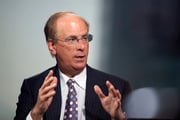
BlackRock boss Larry Fink has once again slammed synthetic ETFs, which are sold mainly in Europe. His point? The funds make investors counterparties in swaps. But the head of Societe General's Lyxor unit, which sells such exchange traded funds, has fired back. | <a href=http://www.investmentnews.com/apps/pbcs.dll/gallery?Site=CI&Date=20110921&Category=FREE&ArtNo=921009998&Ref=PH>The ETFs with the biggest outflows &raquo;</a> | <a href=http://www.investmentnews.com/apps/pbcs.dll/gallery?Site=CI&Date=20111110&Category=FREE&ArtNo=111009917&Ref=PH>Top 10 dividend-paying ETFs &raquo;</a>

Asset managers telling clients to pounce with BRICs and others down 35% from 15-year average

Or at least, that's the concern of top economist Bruce Kasman, who is worried about a simultaneous recovery in both developing and emerging nations. Why? Because it would ignite inflation -- and torch bondholders in the process.
Emerging-markets central banks risk triggering a “1994-style” sell-off in global bonds as soon as next year if they are still tightening monetary policy when the Federal Reserve begins raising interest rates

Critics want regulators to zero in on 'little cancers' -- instruments that confuse buyers and generate large fees

Low-inflation has investors flocking to U.S. Treasurys, despite sky-high deficits: U.S. the 'least dirty shirt' says Pimco's Gross
Although five exchanges will soon vie to clear credit default swap trades in Europe and the United States, the number is likely to dwindle to one on each side of the Atlantic in the next couple of years, according to analysts and industry participants.
