
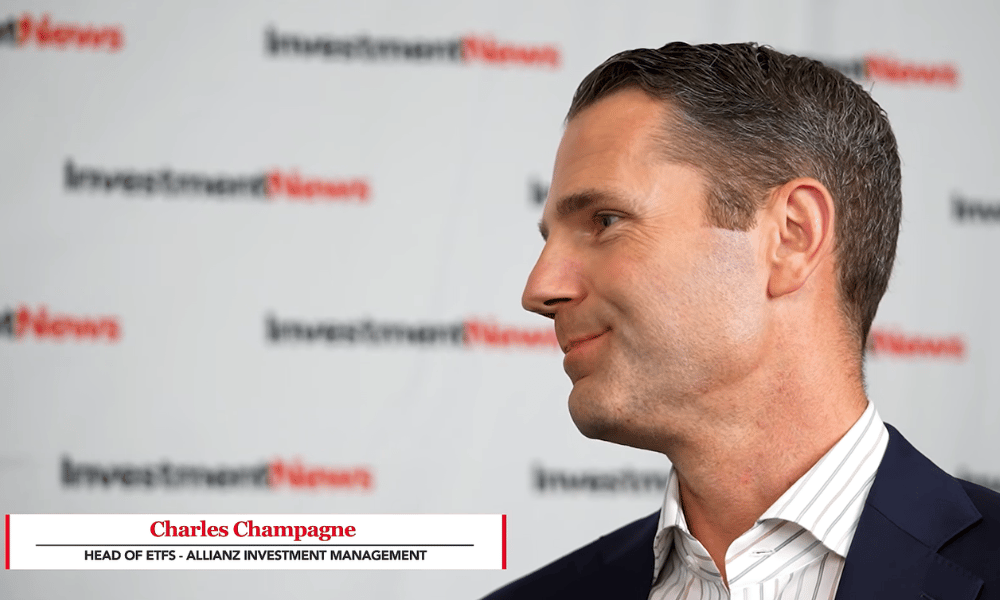
Advisors are still adding buffer ETFs after three years of strong equity markets, according to Charles Champagne, head of ETFs at Minneapolis-based Allianz Investment Management. The draw, he said, is a known level of downside protection.
Champagne spoke with InvestmentNews’ James Burton at Schwab IMPACT 2026 in Boston. He made a similar case for buffers at last year’s IMPACT in Denver.
A buffer ETF uses options to track an index up to a cap, while absorbing a likewise-predetermined slice of losses. For example, AllianzIM's U.S. Equity Buffer20 ETFs seek to track the S&P 500 over a 12-month outcome period: it cushions the first 20% of losses (before fees), in exchange for a cap on gains, according to the firm.
“Flows into these products are still growing,” said Champagne. This up-tick in buffer ETFs comes despite three years of very strong equity markets. Taking those two facts together, “that shows me that even in a really good environment, people want some certainty in their portfolio,” Champagne added.
Early adoption came from pre-retirees and retirees, he said. It accelerated in 2022, when stocks and bonds fell together. Also speaking at the Boston event, Schwab’s Collin Martin traced doubts about the 60/40 portfolio to that same year.
Champagne pointed to two risks keeping up buffer ETF demand; Stock volatility was driven up by 2025’s tariff turmoil and the 2026 Iran conflict, while the AI trade adds concentration risk.
“I wouldn’t go that far to say that there’s a bubble or something that could be disruptive in the future, but… when you have a lot of the marketplace relying on such a narrow focus, there’s embedded risk there,” he said, echoing AI capex risks that other IMPACT speakers flagged. “We encourage investors to always consider risk management within their portfolio, even when we're seeing really strong markets."
A buffer ETF pairs the upside potential of a broad index with built-in protection against a set range of losses. “For example, if you have a 20% buffer on the S&P 500, essentially what you are protected from is zero to negative 20%. But you’re also going to participate in some of the upside,” Champagne said.
That protection has a price: “[The upside] is generally capped. We do have other structures, but there is some upside limitation to pay for that protection,” he said. Losses beyond the buffer pass through to the investor, buffer ETF prospectuses show.
The main blind spot is misuse. “I would say just knowing how to properly use these types of products is one thing,” Champagne said. Advisors need to weigh the length of the outcome period, the level of protection and how the fund captures upside, he added.
“If you’re more interested in a deep level of protection, or if you want to have it as a buy-and-hold position, so you want the most upside potential over a longer period of time, there are different products that work well in different environments,” he said.
Watch the full InvestmentNews interview with Charles Champagne for more on buffer ETFs.
For advisors, the work starts before the trade: match the buffer, cap and outcome period to each client’s goal, and check where the fund sits in its outcome period on the day of purchase.

“Advisors should not sit on the sidelines,” said Advisor360’s Milind Mehere.

Rather than bringing clients into the custodian's world, Julian Lopez, Head of Enterprise Solutions Group at Schwab Advisor Services, says the firm meets advisors where they are.

Prospects vet advisors on Google and AI search before calling, and firms without a sales process lose them.

Fidelity remains Halbert Hargrove’s main custodian as the RIA exits Schwab’s referral program before its January 2027 minimum hike.

InvestmentNews traveled to Boston, Massachusetts, to cover Schwab's annual conference. All video coverage can be found here.
A continuity plan is one of the most important risk tools an advisor has, and the right successor is easier to find among peers
Advisors are broadening the conversation beyond savings to help clients prepare for the realities of longer lives

