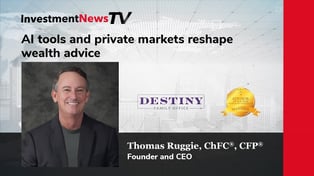
Many retirees spend decades building wealth but struggle with the transition to spending it. In this InvestmentNews TV panel, leading advisors Jeffrey DeHaan, Stan Gregor, Philip Chao, and Thomas Ruggie discuss retirement income strategies, longevity risk, and how financial professionals can help clients confidently turn their savings into a sustainable retirement lifestyle.
00:00 - Jeffrey DeHaan
Prior to World War II, retirement really wasn't a thing anywhere, let alone just in this country.
00:05 - Stan Gregor
The closer you get to a guarantee, uh I'd say the closer you get to somebody else is making more money than you are.
00:10 - Philip Chao
The job that we're trying to do is to make sure you do not end up uh living in a tent under a freeway bypass.
00:15 - Thomas Ruggie
If you don't spend it, somebody's going to.
00:18 - Gregg Greenberg
Welcome [music] to InvestmentNews TV. I'm Gregg Greenberg. There's one theme that keeps coming up in my interviews and in conversations with the advisor intel group. Clients have done the hard part and saved, but money can't bring themselves to spend it. The research shows the same thing. A TIAA survey found more than half of Americans worry about running out of money. On today's webinar, we will be discussing the following topic. From saving to spending, helping clients turn wealth into retirement income. Joining me are a panel of people who deal with this topic every day. Jeffrey DeHaan, managing partner at Clearwater Capital Partners, Stan Gregor, CEO of Summit Financial, Philip Chao, managing member and CIO of Nexus 338, and Thomas Ruggie, founder and CEO of Destiny Family Office. Welcome, gentlemen.
01:23 - Jeffrey DeHaan
Thank you.
01:24 - Stan Gregor
Thanks.
01:25 - Philip Chao
Thank you.
01:26 - Gregg Greenberg
So, the first question I'm going to ask, and I'm going to ask it to Jeffrey, and then we're going to go around the horn, is that I keep hearing from advisers that their clients have enough but won't spend it. Why is that so hard? And what have you found actually that shifts a client's mindset?
01:43 - Jeffrey DeHaan
I think the first thing that's important to realize when you're having this discussion with uh with clients is that prior to World War II, retirement really wasn't a thing anywhere, let alone just in this country. So, we're in maybe three generations of Americans that have ever had to deal with the challenge of how to sustain themselves over a prolonged period of time, how to accumulate enough wealth and then be able to distribute it successfully. Um, so we just don't have a lot of institutional knowledge in this country around how this is supposed to work. A lot of families just feel like they're in R&D mode, uh, for lack of a better term. So, what I found is helpful to help people kind of move out of that what we could consider scarcity mentality, um, is a lot of education. Uh, you know, we use a lot of of financial modeling softwares like everybody has, right? To make sure that people understand that it's not just A to B. We're not just planning for the perfect scenario. We're stress testing. We're taking into account the fact that things are by design not going to go uh the way that we expect it to because life just doesn't work that way. And I think when people start to understand, you know, the work that's going on under the hood, um you know, that there is a lot more depth to this consideration to the thought process of how we're going to get them to, you know, through a retirement. they start to get a little bit more comfortable with not just the idea of it, but the actual expression of it as those unexpected events, whether it be a market event or a life event, comes to fruition.
03:00 - Gregg Greenberg
Now, I'm going to ask Stan once again. I keep hearing from advisers that that their clients have enough, but they just won't spend it. So, why is that so hard? And what have you found that actually shifts a client mindset? Stan, let me know.
03:17 - Stan Gregor
Right. Thanks. Great, great question. And Jeffrey, great feedback and commentary. So uh from my perspective it's a great problem to have right so the halves versus the have nots um that question is a great example of how the world has changed right you think about our parents' generation and a generation before that uh there were the Rockefellers and the Rothschilds and there was everybody else and it was truly paycheck to paycheck and the inheritance was the home right it was it was the land the home there never was this excess of net worth like we have today. And you have seen a significant shift in the investment capabilities or mentalities of what we have access to as a world. And it's a beautiful luxury that people now it's not just going paycheck to paycheck. They are accumulating significantly more than the previous generation. So there is a fortunate situation where that is taking place. And we all grew up with the examples of what happened during a depression. So I don't know if even if you do have the excess capital, I don't know if you're going to wind it down to zero, but there are financial planning tools out there with life insurance and whatnot that you know we try to educate our clients about. But I don't even know when you when you look at that super high net worth family how they can spend all that money, right? So that is a luxury. And you know the reason why financial planning is so important right now is it's preparing for that next generation too and what does that look like and how do they continue with that legacy. So it's a great problem to have as I mentioned earlier and it's just becoming more and more dynamic and I am curious with this experiment. What does our next generation do with it? Because there is a significant amount of net worth that's going to be rolling over into the next gen and will they do what we did and build upon it or are they going to be the generation that actually spends it? I don't know.
05:14 - Gregg Greenberg
Okay, fellow. Once again, I keep hearing from advisers their clients. They have enough money, but they simply won't shell it out. So, why is it so hard? And what have you found that actually shifts a client's mindset?
05:31 - Philip Chao
So, I will take the chapter out of Stan's book who just said that Jeff did a great job and so did Stan talking about on an individual basis. So, I do a lot of work both on an individual basis as well as an Arisa plan qualified retirement plan standpoint. And what we have found which you were uh citing uh TIAA there's some self-s serving aspect to their surveys. Of course they sell annuities. So obviously uh they would say that I'm not saying it's false but it's real but they really push that button and I think that's right. So what are they really talking about is longevity risk. We are all talking about that. Um and not everybody deals with it differently. Uh we are living longer. Uh the medical science has improved. uh I believe some statistics suggest that uh the babies born this decade has 50% chance live to age 100. Um you know when social security first came about 65 the average life expectancy I believe was 66 or some silliness that you really don't have a retirement if you're going to die the year after you quit working. So like Jeffrey said it's really not an issue before per se. uh is more and more of an issue as medical science advances. So, we're really talking about the ability to sustain one's life. If we're talking to the you know the upper 1% or the 1% or the 10% or the one whatever percent you want to say that the upper part of the K-shaped economy, this is less of an issue is much more about leaving a legacy which is what I think Stan was talking about. uh but for the mass uh affluent or below uh that is only one of the concern they are concerned uh that they will outlive their income. So I when I talked to a lot of uh plan uh participants I said that the job that we're trying to do is to make sure you do not end up uh living in a tent under freeway bypass. Um so those are things that they worry about. Number two, longevity also suggests that I think um Alzheimer association said that that as we get older, the chance of us having mental um is issues or frailty significantly enhance is about $400,000 for anybody who suffers from dementia or whatever mental illness uh to the day of death. That's a lot. That's a lot more than what the average American have saved when they retire. And I will just shut up by saying one more thing [laughter] is that in the old days there was such a thing called the defined benefit plan. Um this is not something that we have the luxury nor do we necessarily want to work for a company for 53 years and then never don't worry about it because we'll be taken care of. So this whole shift from employer taking care of all the risk such as the funding risk, the investment risk and the longevity risk is shifted to all of us individuals. And I suggested without the nice gentlemen on this on this call most of them are just not able to handle all three all three risks. That's I think are some of the reasons why they are not willing to spend
08:34 - Gregg Greenberg
and we have one nice gentleman left to opine on the question that's Thomas Roui. Thomas what are your thoughts?
08:44 - Thomas Ruggie
Well my thoughts are I mean we are advisers and as advisers it's our job to help manage those expectations for clients. So, you know, if a client is not financially prepared to live the lifestyle that they want, we need to be candid and blunt and have information to support that. But if a client is in a situation where they've got enough assets to maintain their standard of living, you know, we should be able to encourage them to do so. And you're right, a lot of clients are reticent to spend that money. And my response to them is always, hey, if you don't spend it, somebody's going to, you know, whether it's heirs, children, grandchildren, whoever it may be. So, I think the key is not just having an investment strategy for clients, but really having a distribution strategy for clients that are at or near retirement.
09:35 - Gregg Greenberg
Surveys say most people want guaranteed income, but a lot of advisors, they tell me annuities are still a challenge to use. So, where do you land on that? And what would need to change for annuities to work better in the RAIA model? Let's go to the top again with Jeffrey.
09:50 - Jeffrey DeHaan
I think the surveys are probably absolutely accurate, but I would suggest there's probably a sampling error in there in terms of the way the question is worded. I think what the majority of my clients would say they're really wanting isn't guaranteed income, it's stable income. In other words, they want the peace of mind to know, like we were just talking about, that they can live the lifestyle they want without having the risk outliving money. Um, annuities in their basic form are forms of insurance. you are offloading risk from the client to a third party. That third party has to have enough financial benefit to not only cover the downside of that risk that they are insuring against, which in this case is longevity, but also make a profit on top of that. That comes off of your client's balance sheet at the end of the day. Um, and so again, I think when we think about where do annuities work and where do they not, that's a huge component of our considerations is there an actual insurance need here in which case a product uh might make sense where uh what could be different about them or what are things that are kind of uh holding us back from using them in other cases. The first and most common thing that comes to my mind is going to be the complexity uh that that are involved in a lot of these products. In my experience in financial services, when a product becomes more complex, it's very rarely in the bene to the benefit of the consumer. It's almost always a unique way to continue increasing revenue flows to that insurance carrier that's writing the policy or contract. Um, so getting the complexity down and getting back to the pure insurance component of this so that we can use it when you need it and not have to have, you know, 50 million versions of every single contract it seems like there is today. And then the final piece of course would be the costs that come along with that. Uh so many of them are just prohibitively uh expensive. It tips the scale more towards not using the insurance product because the drag of the costs make it harder for it to be worthwhile.
11:43 - Gregg Greenberg
All right, I'm going to repeat the question. I'm going to address it to Stan. Stan's survey say most people want guaranteed income, but a lot of advisers tell me annuities are still a challenge to use. So where do you land on that? And what would need to change for annuities to work better in the RAIA model?
12:05 - Stan Gregor
All right. Well, again, I I question who was in a survey and how we got to this this question. Okay. Um, every person on this phone is an investment and financial planning expert and I always go with the same question. Would I would I buy an annuity for myself? And the answer is absolutely not. I see I see zero value in selling that product. uh we're all smart enough to know if you look at an annuity product, you can bifrocate it and create various uh components of it that are going to give you a much higher return. And whether it's life insurance for one component or other fixed income vehicles you can go into but you know annuities are the old way that it was done when the client base was extremely not sophisticated and it was an easy thing to go out and promote because that's all that was out there. Okay? So you can buy a treasury bill, you can buy, you know, uh bonds, corporate bonds and whatnot or you can buy an annuity which was an easy sell. Uh, unfortunately the industry has not changed and I'm just being real direct. I mean, the insurance companies make a ton of money on these products. Uh, when you look at the inflation components, you look at other variables that you can be investing in, it's not what I would be telling my clients to go into. So, so um, if you're asking me, I don't even think the cl the product is appropriate for somebody that has a high school education that can understand that there are other options to go into. So, um, and going back to guaranteed income, I agree with what Jeffree said. Clients want to know that they have a stable form of income coming in, right? It could be real estate. It could be many different components. The closer you get to a guarantee, uh, I'd say the closer you get to somebody else is making more money than you are, right? That's just my the way my brain goes. uh so there are other solutions which advisors should and know about should know about and clients should know about and when I see annuities come into play is when the client base is really basic in experience and knowledge and you just don't want to get into the complexion of you know inverse effects of rates and pricing and how that works. So annuities from a ease of sale maybe makes sense, but I would not be putting family or friends or my own capital into annuities as a form of income. That's just my that's my opinion.
14:41 - Philip Chao
I have a little different way of thinking about annuities. Um there are really, you know, three groups of people. all the all of us are really dealing with the highest income one/3 or higher assets. Our career our industry is fairly new. Um I think somebody made a comment that uh you know you dial back to the big to the depression era where I don't think we had all these advisers running around helping people. Uh so even for us we are we are sort of a new career uh in only in the last 30 years maybe 40 years. So there are three groups of people. There's the high truly high net worth individuals which we are really serving as RAAS. Um then there is the low-income folks uh who are making money up to the social security wage base where the replacement ratio of their income is substantially taken care of assuming social security remains secure and not insecure by 2030 which we all know what's happening. Um, so from a income standpoint, they are substantially replaced uh to make sure again they are not living in a in a tent under a freeway bypass. So essential living expense is what we're talking about here for the high net worth of fluent individual. Essential living expense is like a given. I mean, we're not going to eat dog food. And I don't mean it as a joke because uh 60 Minutes back in the 70s did a did a did a piece that older folks are actually eating dog food because they cannot afford I mean you can look up I'm sure it's on YouTube somewhere. Uh and very sad. Uh and then there is the people in between in other words the ones who are making above the social security wage base but not quite the highest net worth individuals. Uh those people uh will have a gap. Now I'm not here to sell TI annuity or anybody else's annuity. That's not what I'm talking about. What I'm saying is that there are certain groups of people who feel insecure uh that they don't have the knowledge or people like us not going to live with them forever. That one day maybe we are gone and they are still living and they don't have the good fortune of having any one of those people like us helping them. So it's really a insecurity. It's not about right or wrong. So there are certain individual who prefers to say at least my basic income needs are taken care of by some kind of guarantee whatever that means in for a moment and the rest I still want to be managed you guys. I still want to leave a legacy. I still want to do all those things. So we can then divide our assets into not everyone but that population into really two parts. One is really taking care of our essential living expenses come hell or high water so to speak. I have my basic stuff taken care of. Even if Philip Chao, our adviser, died and went to heaven, I'm not worried because I know my basic income is taken care of. And then I have the, you know, Disneyland money. I can take my grandchildren to Disneyland every year if I want. And also the problem with annuity is that it is not keeping up with inflation as we, you know, realize today. CPI has gone up and having annuity alone is devastating because you are living a downward spiral. So having people like Summit and other people who can help you as a as a client uh to manage the remaining portion of the assets to keep up with the inflation for that segment of the population. It may make sense. I'm hedging all my answers here.
17:51 - Thomas Ruggie
Finally, Thomas, what are your thoughts? Well, I'll keep my answer short, Greg. Um I mean I think that I would replicate a lot of what Jeffrey and Stan in particular said. Um, I would question where this survey came from because it certainly sounds like a survey from TIA or uh an insurance company. And I think the a very simple answer that would help eliminate some of the products being sold that shouldn't be sold is to change all of them to fee-based products. And fee-based products are available in the insurance world. But um pardon the way I'm going to say this, but 19 out of 20 people that are shleing these products are doing so to gain the commission, not to work on a fee-based plan.
18:48 - Gregg Greenberg
All right, next question. Longer retirements are breaking some of the old rules of thumb. So, how are you deciding what a client can safely take out each year, and how often do you revisit that number? We'll go to the top again, Jeffrey.
18:59 - Jeffrey DeHaan
the blocking and tackling the math side of this equation really even though we have to be planning over a longer horizon the basics of what we're trying to achieve are changing dramatically. Right? In other words, the math we're doing, the modeling we're doing is still very similar. Um, and back to one of my previous responses, it requires that we stress test those systems. help people understand what does longevity risk do to uh a stream of income that you're planning to draw off of uh a portfolio of assets uh over time. Uh even if we say that's, you know, not a high probability event that this person is going to live to say 100 uh years old, we still want to make sure that we have a plan together that if they do wake up on their 100th birthday that we're not in trouble because it's real hard to backtrack at that point and uh get back into the workforce, right? So it's about uh proactive planning to the second component that is especially for our retirees. We're looking at those numbers at least annually with them in terms of just updating models to make sure that things are still trending and it's not always rerunning the full like Monte Carlo analysis or those kind of things. It's more spot-checking where are cash levels and spend rates compared to where we expected them to be. How are we trending over time? you know, so that we aren't setting off alarm bells because of a one-off one-time thing, but keeping track of the idea that if there is an issue, we want to catch that early on. So, you make a very small tweak and by the time we're, you know, 20 years down the line, the impact that we've made with that small tweak is big enough to have offset the negative event.
20:30 - Gregg Greenberg
All right, I'm going to ask that question again, this time to Stan. Longer retirements are breaking some of the old rules of thumb. So, how are you deciding what a client can safely take out each year? And how often do you revisit that number?
20:41 - Stan Gregor
I'm going to pile on what Jeffrey just said, right? It all starts with a plan, right? And plans are created to be amended and obviously updated and whatnot. So, we have philosophy within the summit world. Every one of our clients has a financial plan that we try to adhere to. I say try because some clients want to make changes, some clients do not. What we are experiencing Greg is a completely different way of asset appreciation that we've seen in the last 10 years than the previous generation did not see. Okay. You look at the 70s and the 80s and now with the whole component around AI what we started as a plan uh thank god and you know to a positive point has yielded a much higher asset value right in the last 5 years than we planned for. So there is more that can be taken out. And what we constantly struggle with is sharing with a client, you know, go experience life the way you want to experience it during retirement. Here's what you can take out. And I like it or not, the equity markets moves that we've seen, we have clients saying, "Well, you know what? I I'd rather keep it in a little longer to have a little bit more later." So you have that dynamic you're working with as well. But it's it goes to my fir your first question and my comment. This is a luxury that we have that no other generation had before. And what I don't know and I can't predict is will the ch will the music stop, right? Will this change at some point? Will we go through a downdraft that we're not we've not seen in a while? I don't know that that answer. And that's why the prudent thing that we always do is when you have access, you move some of that risk into something that's more stable and secure that if you do have a downturn to uh to Philip's point, you're not under the freeway, right? Eating the sardines or can you know dog food. So, it's all part of a plan and it's critical that that's being done. And the last piece I will say is educating the client on where things are is so important, right? So, it should not be a set it and forget it. It should be here's the plan that we set out every year. Um, are we still on the same track? Do you still agree with the philosophy that you asked us to work with? If the answer is yes, right, we amend or we keep in place what's in what's in play or if there's change, what does that change look like? So that without a plan, I don't know how you do it. But, uh, we focus on making sure we have a client financial plan for every one of our relationships.
23:08 - Philip Chao
All right, fella. your thoughts. As I was listening, I think of the uh go- go uh slow go and no go years. Uh and so it's very difficult to say that oh, we need a 4% under all goes. Well, they're not all the same uh on some level. Uh but I think inflation is a real thing. Not only because it's rare as ugly head and being very sticky these days, but I think it's going to continue as more people age. the cost of health care, long-term care and all that uh is going to be a higher inflation than the general inflation. Decades ago, uh we have talked about having a old age CPI which is a very different CPI than our CPI that we live on today. And that CPI most likely going to be higher. I don't know how much higher but most likely higher. It's just simply a supply and demand. and they got a lot more baby boomers uh retired is the biggest population um and then the exers are not exactly a small generation and so I think the demand is going to be greater and so we need to be very careful about inflation so just simply saying a single number um unless it's a real number when I say real I mean I mean inflation adjusted number so if you say an inflation adjusted number 4% is a very different thing than a 4% normal uh so it is all these words are all over the place and everybody wants a easy, oh, this is the way we should do it and that's it. Well, all of us on this call on this video and you know very well it's not that easy otherwise we will all be out of a job. Uh and so I totally agree that we each one should have a plan and each one should review that plan as frequently as the advisor deem appropriate for each plan situation. Um, so hence go back to go years, you know, the first 10 years of retirement, you know, oh yeah, I finally got my million dollars in my wallet. I can't wait to go do all the crazy things I need to do. And good advice will say, well, hold on for a second. Uh, you'll regret that when you're 85. Uh, whatever. Uh, and then you go into the slow go years where they settle down and their requirement is going to be less, but on the other hand, the medical expenses probably going to starting to look higher. And those are the type of wave of spending that we need to be more cognizant of and uh and really is about inflation and not only about longevity risk of course longevity risk uh but really be more dynamic and really tracking our clients more closely. Finally, I would say well what's AI? I mean they apparently AI can read X-rays better than humans and if they can spot issues way in advance preventive medicine is going to make people live even longer than they should. So although you suggest the opening is that boy isn't that wonderful we live longer. Well for some yes that's my answer.
26:11 - Thomas Ruggie
All right Thomas your thoughts. I have a saying that that strategy trumps performance. And what I mean by that is having a well-thought-out strategy is as if not more important than what the performance on the portfolio is because as time goes on it you know that the averages come closer and closer. We have a proprietary strategy we call the retirement distribution strategy. It's a bucketing strategy. So basically a 10-year bucket, an 11 to 20 year bucket and a 20 plus year bucket. So based on the longevity of each of these different buckets, we have different investment strategies that are dependent upon the client's personal situations. But of course in bucket one, we have 10 years of their income needs in a low risk, more conservative portfolio. So market has a big downturn, we're not worried about that because we have the income sitting there for the client. Market has a big, you know, a big spike, we use that as an opportunity to rebalance. Bottom line is our clients with our strategy really never have to worry about the day-to-day gyration of the markets which in my opinion is where they should be.
27:10 - Gregg Greenberg
Final question and we'll just go back up to the top again with Jeffrey. So Jeffrey, what's the mistake you see most often when clients move into retirement and what would you tell an adviser who's building a retirement income process for the first time?
27:26 - Jeffrey DeHaan
So, I would say there are three things that are the most common kind of corrections we need to make with new clients coming in that are nearing or early in retirement. The first is kind of back to what Stan was saying. It's not having a plan. Uh people that are just kind of going back of the envelope math, gut feeling, I think I'm okay, are either about to pull the trigger or already pulled the trigger on a retirement and uh you know, it wasn't fully baked uh yet. So, so failure to have a plan is by far the biggest. Uh the second I would say is underestimating health care expenses. Very much like what Philip has been talking about today. Um and not just long-term care expenses, but even just private health care uh expenses for those that are retiring prior to Medicare age can be a pretty big slap to the face if you're not prepared for it, especially for higher income people uh that that no longer qualify for certain ACA subsidies. And then the final piece is nothing to do with money, but it's not having purpose. Not coming into retirement with an idea of how are they going to fill their time? How are they going to find purpose in their lives? The people kind of like my first point, not having a plan that just kind of show up in retirement saying, "Now what? There's only so much golf and coffee dates you can make uh before you start getting a little bit uh antsy or itchy." So, those would be those would be those. As far as what uh advice I would give, it's that this is a far more complex decision set than what it may seem on the surface. You've got to have the right tools. Most importantly, you've got to have the right expertise. You got to be looking for tales everywhere, right? You got to be trying to think about not just what's the best case scenario, but have a, you know, what are the things that could derail you and is there something that needs to be done now to prevent that based on, you know, the risk levels and the probabilities.
29:20 - Gregg Greenberg
All right, Stan, the man with the plan. There you go. So, what's the mistake you see most often when clients move into retirement? And what would you tell an adviser building a retirement income process for the first time?
29:34 - Stan Gregor
Again, what Jeffree said, I want to build upon it. It is it's complex, right? So, most clients make the mistake in my opinion of, you know, I retired now. It's not as sophisticated. I don't need as much sophistication. I can kind of coast or whatever. And I think it's a it's a that could be a drastic mistake, whether it's healthcare costs or whatever. The costs are a big thing, but that client does not have a job going forward, right, in retirement. They don't have the ability to earn income to make up for whatever may have happened, healthcare costs, the market downturn. So, in my opinion, I think this is where a financial advisor truly earns his or her stripes. I think it's more important for a client to have a real quality advisor during retirement than in the in the in before retirement. Okay. Uh so having somebody that is active, having somebody that's truly managing their net worth, right? Things change, things happen, medical things happen, uh you know, a a new grandchild. I mean there is so many different components that you you're kind of dealing with solving those issues with what you have saved whereas in the prior part of your life you were always earning enough or you were earning and saving and it was a combination of I'll work two more years I'll make up the shortfall. You don't have that luxury when you are retired. So, in summary, uh not having the right advisor with his thumb on the pulse is one of the biggest mistakes I see over and over like they just want to do it struggling or do it themselves and it's not the time to do it yourself.
31:00 - Philip Chao
All right, Philip, your thoughts? It sounds self- serving that you kind of live without me, but I think I can concur. U kidding aside, we are pretty fortunate that we typically get a client not at retirement. And I assume most of the folks don't on this conversation that we actually get them years before they retire. So we start with budgeting and we really actually ask them to write down a budget uh just so they can look at that budget uh because at the end of the day we're solving for a certain income replacement or driving income whatever that means. And so uh 100% of the time they don't know and they don't they say well great can you give me a budget sheet? I mean it's like the first time they've seen a that's silly right? So I do and we go through it and we ask and then it is where our expertise comes in as granular micro as we can and say are you sure that you know you don't have a net Netflix oh yeah we have a Netflix bill that's really whatever so really not about me digging into what hell they spend their money but for them to understand where are all the money being siphoned off where are they going I'll tell you this right now I still carry two of my adult daughter's cell phone bill. One is already married and I'm still paying. All right? So, one day I'm going to retire. Why am I keep paying? Well, I just got used to it. I just pay and if I drop one and the other the other one will feel, you know, favored or whatever. Um, so I'm giving you a silly example, but there are every family is a little different and every family and their relationships among themselves and with their children and the loved ones are different and there are considerations. So, so we start with the budget and we start looking at the sources of income and all that which all everybody knows. So, basically it's the same thing as saying we need a plan but the plan is based on what their standard of living can be. So, we don't tell them hey you can only live off this. We say, "Well, what is it that you would want to live off?" And then we realize that, "Sorry, it's not going to make it. You have to make 18% a year. You got to go find somebody who can give you 18% because I can't." Um, or this is fantastic. Whatever. So, it's a dialogue. is a is a process and then we come up with that first and then we go forward and actually we do this annual review just to check to make sure that their income hasn't requirement hasn't changed because it's one thing to think about what they need in retirement. It's very different when they are actually in retirement. So when they are in retirement I already tell them in advance this is what you say in paper on paper when you are in retirement it could be different and then we adjust and adjust. So it's a dynamic process very similar to the other two's comments is really we are there we are by their side we look at it we help them and we make changes that's appropriate over time.
33:51 - Thomas Ruggie
Thomas bring us on. I think the uh the fallacy that some clients have in retirement is a thought process that they're younger when they retire so they can spend more money because they're not going to need as much as they get older. And I in my 35 career, I've never seen that to be the case. What I would suggest to an advisor is to plan for longevity. I think it was Philip, but somebody on the panel gave a quote that somebody being born this decade has a 50% chance of living to 100. I happen to believe that the statistics for that are significantly higher. I think that the chances for the five of us sitting on this panel is probably 70% have the ability to live to 100. I think AI and biotech and healthcare is going to allow us the ability to not only live longer but to live a great lifestyle longer. So, you know, when I started in the business, we ran our financial plans to age 80, then it went to 85, then it went to 90. Now we're at 100. And uh if you look at a whole life insurance policy, they're typically running that to 120. And as much as I detest most insurance companies, I think they've got a pretty good grasp on actuarial life expectancies. And I would suggest to plan for people to live longer.
35:28 - Gregg Greenberg
All right. Well, thank you gentlemen for joining today's webinar. Once again, I'm Gregg Greenberg for InvestmentNews TV. Thanks for watching.