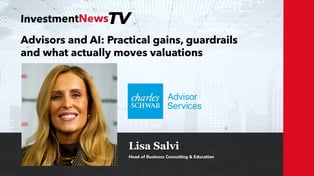
Advisor360° CEO Milan Neher says AI is a bigger shift for wealth management than robo-advice. Clients can now analyze their own financial documents, so advisors must be smarter than the tools. He also argues that hyper-personalization strengthens the advisor-client relationship rather than eroding it.
[00:00] Software is almost becoming free. The data that the adviser had yesterday already is outdated.
[00:21] James Burton: Hi everyone, James Burton here from Investment News at Impact 2026 in Boston. Delighted to be joined by Milind Mehere, CEO of Advisor360. Milind, welcome. Thanks for joining us.
[00:33] Milind Mehere: Thank you for having me.
[00:34] James Burton: You're relatively new in the role. Congratulations. What do you hope to bring to Advisor360 as we turn into 2027?
[00:43] Milind Mehere: So, thank you very much. I have been in the role 5 months, but I was on the board for 2 and a half years before that. So I have a pretty good idea of the space and I was also building in the space and have been building in wealth management, asset management for the last 13 years. So I have a pretty good idea about the industry.
[01:01] My mandate is how do you evolve a SaaS company in the new AI world? The rate of change is extremely fast, but there is a lot of noise. So as a CEO, how do you separate noise from signal? Ultimately it is all about solving the advisor's problem, who serves people like you and me.
[01:23] I think that's really my mandate in the next 12 to 24 months, to separate the noise from the signal, launch some products that are going to really help our advisor ecosystem. For your viewers who don't know us, we have pretty large insurance company broker-dealers as our customers. So we have been supporting millions of households and tens of thousands of advisers. It's very production-hardened software, but we have to evolve as the land around us evolves.
[01:54] So that's really the mandate.
[01:56] James Burton: Yeah. Okay. That's interesting. So evolving. You turn around every corner at this conference and people are talking about AI and there's lots of buzzwords. As you pertinently said before we went on live, efficiencies happened two years ago.
[02:11] What does the future hold? What should advisers be looking for in their day-to-day implementation of AI using systems like Advisor360 that is the future and not things that have already passed?
[02:24] Milind Mehere: With any new software system or technological advancement, there are steps that happen. As I said, efficiency is old news. It happened two years ago. That was the first use case. CRM is a pretty big and important component of an advisor's life, and if you put an AI layer on top of it, it can give you interesting outcomes such as meeting prep.
[02:48] I think going into the future, one of the big things that we are excited about is how do you separate automation from autonomy, right?
[02:54] What AI enables us to do is provide us with autonomy. So if you are an adviser, what can AI do to really free up your time, your energy, and help you grow your business?
[03:10] These are all cliched buzzwords, right? So what does that really mean? Think about the data that you have. It's connected across a variety of different systems. It may be more or less fragmented. Ultimately, you're serving a consumer whose financial life or biography is changing daily.
[03:34] Markets go up and down. You're getting income, bonuses, you may lose a job, sign a house, mortgage payments, expenses. Every day that graph is changing. The machine sees it all.
[03:45] For example, right now when we are speaking, Kevin Walsh is meeting and that could reset interest rates. That is going to have impact on credit cards, mortgages, and a bunch of financial instruments. So the data that the adviser had yesterday already is outdated.
[03:59] Imagine tomorrow morning you log on to your dashboard and suddenly see, here are 10 customers who are going to be impacted by mortgage rates or by the Iran crisis or whatever may be the macro trend or a micro thing in their life.
[04:13] Now if you have that list, great. I'm going to call Ian because here is the impact and tell him, here is the impact, but here is how I'm solving it. Then agentically tee it to be solved.
[04:24] For example, if your mortgage is going to get reset and go from 2% in the ZIRP era to 6% today, you now suddenly have, let's say, $1,000 of extra payments that you have to make.
[04:35] Imagine if your advisor called and said, "Don't worry, I've taken care of it because these are the investments that are going to bridge the gap for you and I'm already on it and have made the trade so you don't have to worry about it."
[04:48] That's what AI lets you do where the human is at the center, making critical decisions and judgments, but the system is making it very efficient and very accurate.
[05:00] So that's really it. It goes from automating a few reports to an autonomy that the system is allowing you to do. I think that's really where AI is going in the next 12 to 24 months.
[05:08] James Burton: Okay. What is the biggest part of that that's going to inform whether that is a success or a failure with an advisor? Is it a trust thing? Is it an execution thing? How is that actually going to work?
[05:21] Milind Mehere: Very good question. Listen, I think at the end of the day there are two important aspects to build hyper-personalization and intelligence.
[05:30] One is the data itself because unfortunately the advisor ecosystem is so fragmented. So, how do you get clean data upon which you can actually run your context layer or your intelligence layer? That's not an easy problem to solve. Everybody in the industry is grappling with it.
[05:48] We at Advisor360 had this concept of a unified data layer long before AI was popular. It's been one of the foundational elements of our software.
[05:56] Those are the types of things that are going to be extremely important. How do you get a unified data layer that is clean, structured, and something that you can actually run AI models on to get less hallucination, much more accurate information, and something that's actionable?
[06:13] So that's point number one. Point number two is trust. Even for meeting prep, the way we do meeting prep is we have provenance of where the data came from.
[06:24] If you're only looking at CRM, you're not going to know how to validate portfolio management data or portfolio accounting. We can do that. I can say it came from this system versus that system.
[06:36] So I think data and trust are going to be foundational elements to actually prove out which use cases will stick.
[06:44] Ultimately, your question around how do we know it's successful? It's going to be around adoption.
[06:50] You're going to have many use cases in the coming quarters similar to meeting prep that are going to take off. I gave you an example of what we are calling Pulse, the signals that you get from macro signals and micro signals.
[07:06] But then you turn it into agentic workflows that will solve the problem that it's actually identified.
[07:09] Agentic onboarding can be another one. Talk to your data is the third one. You connect all the stuff, now you should be able to do a bunch of things with it.
[07:19] There are a bunch of use cases and workflows that we are launching in the marketplace that are all in the service of how do you get advisers to be super advisers, ultimately in the service of the consumer.
[07:35] James Burton: Is there a risk, conversely, that hyper-personalization actually takes away some of the personalization with the advisor-client relationship or not at all?
[07:46] Milind Mehere: That's a very good question. The simple answer is not at all.
[07:51] Frankly, if you think about your own advice experience, we always were frustrated in the last 5 or 10 years. Whoever is using an advisor is like, "Why doesn't he or she give me more specific info here?" Is the house view webinar on Thursday at 10:00 a.m. really relevant to me? What's happening broadly may not be relevant to me.
[08:16] So I think personalization is absolutely important. The example I gave you, your mortgage is getting reset. If you got that call, the trust level between you and the adviser has gone up 10x.
[08:28] Those are the types of moments that AI can help create where now you're really focused on your end customer. You're treating each customer as if they were your only customer.
[08:39] Everybody knows that you have 400 other customers. Right now what you're doing is battling memory, and human beings are not great at that. Machines are very good at it.
[08:47] So why should you do that? You should outsource that to the machines. What you are good at is saying, "Okay, I need to call Ian today because of ABC reason."
[08:57] You pick up the phone, you're hyper-focused, and you can get a lot done. Then you can spend time on two things. One is growing your business, which organic growth is a big problem in the industry. Second is playing a little bit more golf.
[09:12] So it's a win-win situation.
[09:15] James Burton: I guess here's a final question. Milind, what should advisers be doing now to either prepare for this or get ahead of this and make sure that, like you said, in 12 to 18 months they are ahead of the game?
[09:28] Milind Mehere: Listen, I think this is a reckoning for the wealth management industry, much more than when robo-advice came out or any of the technologies over the last 20 years.
[09:38] I'll tell you why. In December 2023 when GPT came out, it reset many expectations, not just for software or finance, but generally how we operate.
[09:50] Now what has happened is a consumer with one click can upload their tax returns, upload their financial statements, and get very smart.
[10:01] So now the responsibility has shifted on the adviser to really be smarter than what GPT can answer. For that, all the stuff we discussed today is very relevant: personalization, connecting the data, establishing trust, and knowing the right signals.
[10:17] Advisers should not sit on the sidelines. They should figure out the pockets of opportunity. By the way, we spoke a lot about front-end workflows. There is middle office and back office work that has a lot of cost associated with it.
[10:31] They should not sit on the sidelines. They should pick any two, three, or four problems and figure out partners that can help solve them. It's very easy to test.
[10:40] Obviously, you should be careful with data privacy and security. That's very important.
[10:48] But I would say they need to jump in, test out a few workflows, and I think AI and the companies supporting it are going to be very innovative.
[10:57] In my mind, data capture is free. Software is almost becoming free. The question is how do you blend the context and stitch workflows together that actually solve the problem?
[11:07] I think that's going to be the differentiation. That would be my advice to advisers: do not sit on the sidelines. Jump in and see where the technology will truly help them.
[11:19] James Burton: Fantastic. Thank you so much for your insights. I appreciate it, and thanks everyone for watching. See you next time on Investment News.