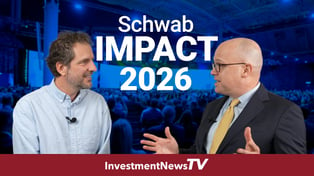
At Impact 2026 in Boston, Omar Aguilar, CEO and CIO of Schwab Asset Management, tells InvestmentNews’ James Burton why today’s AI spending boom differs from the dot-com era. Aguilar says mega-cap companies with strong free cash flow and balance sheets account for roughly 60% to 70% of AI capital expenditure. He also flags growing reliance on debt markets heading into 2027, expects slower economic growth, capex and earnings, and explains how Schwab is positioning portfolios, with bonds now providing an additional source of return.
[00:00] The big difference now is that if you look at the companies that are spending money in AI, they actually are the ones that are really good in terms of generating free cash flow. We've seen in the labor market, nobody's hiring, nobody's firing.
[00:28] James Burton: Hello everyone, James Burton here from Investment News at Impact 2026 here in Boston. Delighted to be joined by Omar Aguilar, CEO and CIO of Schwab Asset Management. Omar, welcome.
[00:39] Omar Aguilar: Yeah, thanks for being here.
[00:41] James Burton: Just picking up on the AI theme there. Obviously, incredible growth potential. It's in all the headlines, has been for quite a while now. I guess the journalist question is, are we in an AI bubble? And if we are, when's it going to pop?
[00:56] Omar Aguilar: Yeah. It's a very typical behavioral finance question where the typical thing is called anchoring, where people go back and look at different events in the past and say, "All right, this looks like the late '90s and the dot-com and how that burst."
[01:12] The big difference now is that if you look at the companies that are spending money in AI, they actually are the ones that are really good in terms of generating free cash flow. A lot of these hyperscalers, a lot of the 60% to 70% of the capital expenditure that goes into AI has come from these mega-cap companies that have significant amounts of cash flows and very strong balance sheets.
[01:34] That's very different to what it was in previous bubbles where you have companies that don't generate earnings or companies that are borrowing a lot of money. Now, I think that's the part that gets a little bit tricky because going into 2027, what we have seen is that more and more companies are starting to rely on the debt market to continue to expand the capex cycle.
[01:57] I think that transition starts to get a little bit worrisome. So, I think we're going to have to watch how the credit market behaves going into next year, as many of these opportunities may not translate into positive outcomes.
[02:07] James Burton: Right. Do you anticipate, with that in mind, a slowdown of sorts in the new year? And I guess a double question, how are you then positioning yourself for what you think will happen?
[02:19] Omar Aguilar: Yes. So we do anticipate a deceleration of economic growth. We anticipate a deceleration of the capex cycle. We anticipate a deceleration of earnings growth.
[02:30] So, going into the next phase of the economic cycle, we have gone through the heights of the economic cycle and at this point we're in the process of starting to decelerate. We already heard from a couple of tech companies that are reducing their capex. They're not stopping it, but they're reducing their capex.
[02:46] We've seen in the labor market nobody's hiring, nobody's firing, but still in that process, and we expect that to translate. So we do expect a deceleration of economic activity going into next year.
[02:57] Interest rates being high and the Fed continuing to raise rates also provides another catalyst for deceleration of economic activity. So we do expect that.
[03:07] Now, how do we position the portfolios for now? It is to continue to emphasize diversification, to stay invested, and actually recognize the opportunity for the bond part of the market to provide another source of return that in the past was not there.
[03:22] If you actually think about it, with the level of interest rates and the income that those bonds generate now, that provides an engine that was not there before.
[03:30] So the whole concept that there is no alternative other than equities is suddenly going to the backside because now you have several engines that can generate returns going forward.
[03:41] James Burton: Fantastic, Omar. Appreciate your insights. Thanks so much for joining us and we'll see you next time on Investment News.