

Historically, innovation and disruption cycles in financial planning software have tended to have long timelines – often stretching a decade or more. In the 1990s, the market leaders were detailed cash-flow based tools like NaviPlan and MoneyTree. Those became supplanted in the next decade starting with the release of MoneyGuidePro in 2000 (which gained popularity with its simplified goals-based planning approach) and eMoney Advisor in 2001 (which would take off later in the decade with the success of its client portal and personal financial management dashboard). MoneyGuidePro and eMoney would see their market share rise, and the incumbent Naviplan's and MoneyTree's share fall, up through the mid-2010s when the newcomer RightCapital came onto the scene and found traction with its dynamic interface that allowed for more collaborative in-meeting planning (as well as its lower price point without sacrificing much in the way of planning breadth and depth). Since then, according to Kitces Research on Advisor Technology, RightCapital's market adoption has grown while the incumbent MoneyGuide's has fallen (while eMoney has stayed relatively steady atop the market) so that up until now there has been a fairly stable 'Big 3' of eMoney, RightCapital, and MoneyGuidePro – albeit with MoneyGuidePro in danger of slipping farther down and out of that group and going the way of the incumbent providers that it once displaced.
At this point, with two of the three market leaders having been around for at least 25 years and the relative newcomer being over 10 years old, it's fair to wonder where the next disruption in financial planning software will come from, and the emergence of AI technology over the last few years has provided a very plausible vehicle for that disruption (just as streamlined, goal-based planning was the vehicle for MoneyGuidePro's success and data aggregation and cloud-based software were the vehicles for eMoney's).
The tricky question, however, has been how to actually integrate AI into financial planning while keeping it both reliable in its output and compliant with SEC and state requirements? Since its early days AI has been notoriously opaque in how it generates its outputs (essentially a 'black box' into which text goes in and out but little is known about the calculations that go on inside) and prone to 'hallucinating' its responses – neither of which are desirable characteristics for software on which recommendations are based that need to be verifiably in the client's best interest. And so while other categories of advisor technology like client meeting support, outbound prospecting, and (perhaps ironically) compliance have quickly embraced AI use cases, the current incumbent financial planning software platforms have been slow to integrate AI, with RightCapital only recently debuting its Iris 'AI planning agent' in June 2026 and neither eMoney nor MoneyGuidePro having yet launched any publicly announced AI tools.
Which makes it notable that this month saw two major announcements from AI-powered startups seeking to gain a foothold among the long-entrenched incumbents in the financial planning software category. First, Hazel, the increasingly comprehensive AI tool made by Altruist, announced the launch of its new 'financial planning agent', which is packaged along with its existing AI notetaker and tax planning agent. And then, Conquest, the Canadian financial planning software (notably created by the founder of NaviPlan) that has been available in the U.S. since 2022 but primarily focused on enterprise firms, has announced that it will now be available to smaller firms on a 'self-serve' (i.e., able to sign up online without a sales call) basis.
Notably, the two providers take different approaches to financial planning, with Conquest looking more like a 'traditional' financial planning platform (with standardized planning modules, data entry fields, and sliders to adjust scenarios, and probability-of-success calculations) and Hazel's output being more customized to the individual client. But despite the surface differences, their approaches to the AI side are quite similar: Both use AI for streamlining data entry, analyzing client data, and suggesting recommended planning strategies, while the actual planning calculations are handled by deterministic (i.e., non-AI) calculators. Which increasingly seems to be the way that AI-enabled planning software (including other tools like FP Alpha and Hive Tax for tax, Advice.ai and Wealthstream for financial planning support, and Wealth.com and Luminary for estate planning) is threading the needle between efficiency and reliability/compliance: Allowing AI to do the things it's good at like parsing documents, entering data, and analyzing the results, while hard-coding the calculations that underlie the planning recommendations (and creating space for the human advisor to review for accuracy and tailor their recommendation to the specific client).
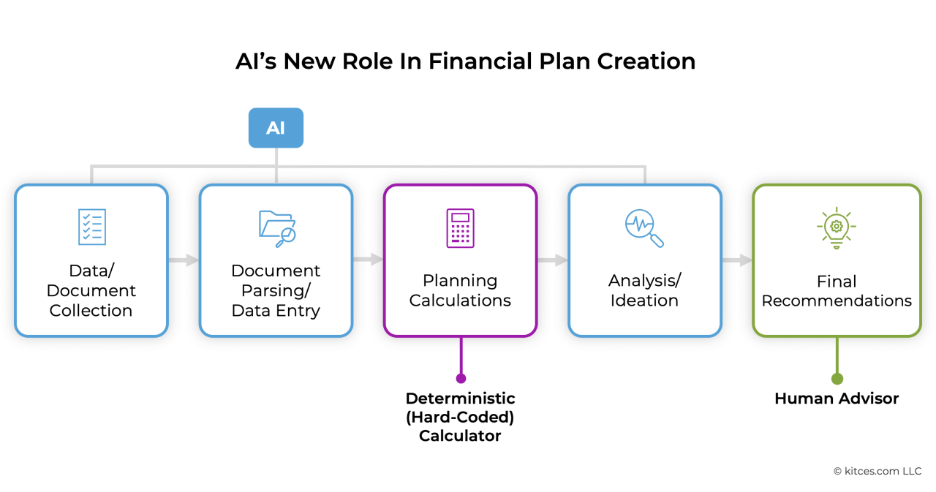
What remains to be seen, however, is whether or not advisors will warm to this AI-enabled approach to financial planning. There's no doubt that AI could cut significant time from the time needed to build a comprehensive financial plan: According to the most recent Kitces Research on Advisor Productivity, a new financial plan can take from 15–25 hours of team time to create, with the bulk of that time coming in the laborious data collection, data entry, and analysis stages that AI now promises to expedite. Except for many advisors, the amount of time it takes to build a whole financial plan is an indication of how much importance they place on the plan's accuracy and depth for producing reliable recommendations. Historically, advisors have been largely unwilling to sacrifice plan depth for time savings, as evidenced by the number of 'Planning Light' options on the AdvisorTech Map that have failed to gain much traction, and even MoneyGuidePro which is arguably the 'lightest' of the Big 3 planning software providers with its more focused goals-based approach. The most popular financial planning software platforms today, eMoney and RightCapital, are among the most in-depth and time-intensive to create plans in, not because they're needlessly inefficient but because they produce plans in extensive depth and breadth. Although AI may be able to cut down significantly on the time it takes to create a plan, that won't matter if advisors don't feel like the plan they create captures the full scope of the client's financial situation or the planning scenarios that are possible.
Ultimately, given how slowly shifts in the financial planning software landscape tend to occur (because even with new innovations in the space, advisors just really don't like to change their software or deal with the hassle of moving hundreds of client plans onto a new platform), it will likely be several years before we see how the effects of AI are playing out. Notably, new generations of AI-native software can have a disruptive effect on incumbent platforms, even in the slower-moving realm of advisor technology: See, for instance, the CRM space where incumbents like Wealthbox and Redtail that were relatively slow to adopt AI are seeing pressure now from startups like Slant. But switching CRM platforms is a different beast than switching from one financial planning software to the other, because the latter gets much closer to the heart of the advisor's value proposition for their clients. But if AI really can deliver on its promise to streamline plan creation without sacrificing depth or accuracy, then over time we might see the makeup of the "Big 3" shift once again, as today's AI-native startups (eventually) become the established incumbents going into the next innovation cycle.
This article first appeared on the Nerd’s Eye View at Kitces.com at https://kitc.es/advisortech-oct2026, and has been reprinted here with permission.
Ben Henry-Moreland
Ben Henry-Moreland is a Senior Financial Planning Nerd at Kitces.com, where he specializes in writing and speaking on financial planning topics including tax, practice management, and technology. He also co-authors the monthly Kitces #AdvisorTech column. Drawing from his experience as a financial planner and a solo advisory firm owner, Ben is passionate about fulfilling the site’s mission of making financial advicers better and more successful.
Michael Kitces
Michael Kitces is Head of Planning Strategy at Focus Partners Wealth, which provides an evidence-based approach to private wealth management for near- and current retirees, and Focus Partners Advisor Solutions, a turnkey wealth management services provider supporting thousands of independent financial advisors through the scaling phase of growth.
In addition, he is a co-founder of the XY Planning Network, AdvicePay, fpPathfinder, and New Planner Recruiting, the former Practitioner Editor of the Journal of Financial Planning, the host of the Financial Advisor Success podcast, and the publisher of the popular financial planning industry blog Nerd’s Eye View through his website Kitces.com, dedicated to advancing knowledge in financial planning. In 2010, Michael was recognized with one of the FPA’s “Heart of Financial Planning” awards for his dedication and work in advancing the profession.

Sam Su worked at UBS Financial Services in San Francisco from 2008 to 2023 before jumping to Morgan Stanley.

Wealthspire’s Ground Control is also expanding in London, adding a business manager focused on music and global touring

The REIT allegedly promised investors a fix while the problem grew by $200M.

Fund categories are a useful starting point – but they can hide meaningful differences.

New Lifetime Blend+ suite aims to help 401(k) savers build retirement income beyond traditional public market allocations.
Growing wealth, evolving priorities, and untapped opportunities are reshaping how women approach long-term investing.
Knighthead Life entered the market with a competitive MYGA. A strong launch earned advisor confidence and paved the way for FIAs.
