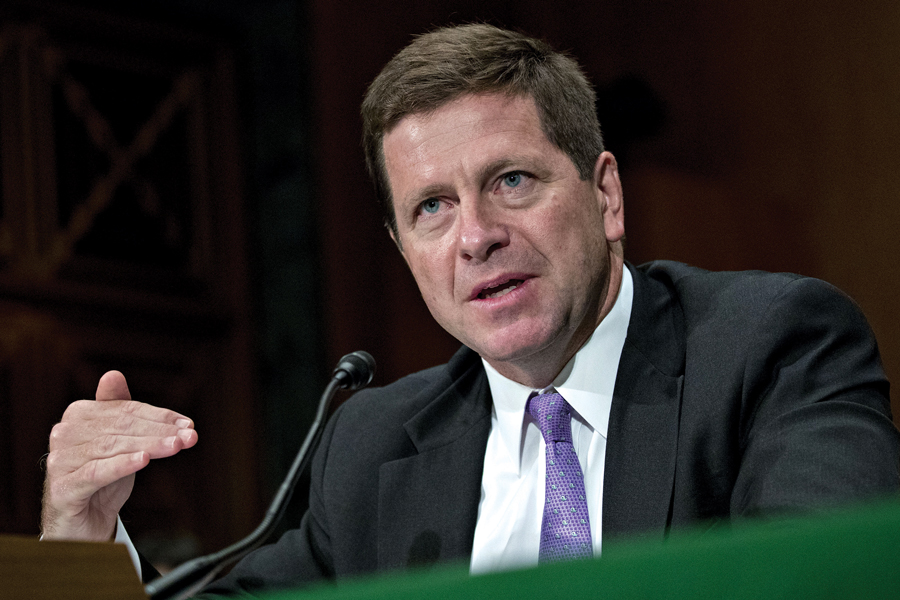
Securities and Exchange Commission chairman Jay Clayton wants retirement investors to have greater access to private funds.
In
an interview Tuesday at the U.S. Chamber of Commerce in Washington, Mr. Clayton said managers of traditional defined-benefit pension plans can make investments in
private equity and other illiquid offerings, which can achieve greater returns than public companies, that cannot be made by individual investors in 401(k) or individual retirement accounts.
"That retirement money in the defined-contribution plan doesn't have the same investment opportunities that a defined-benefit plan has, even though they're both retirement dollars," Mr. Clayton told David Rubenstein,
co-founder and co-executive chairman of the Carlyle Group, a private-equity firm with $216 billion in assets under management.
Although Mr. Rubenstein said he didn't want to lobby Mr. Clayton on the air, he did make a pitch for letting retirement investors allocate a small amount of their assets to private offerings.
"Probably wouldn't be that damaging if 5% of it was lost or didn't do as well," Mr. Rubenstein said, referring to a portion of one's retirement portfolio. "So, some percentage maybe should be allowed."
Mr. Rubenstein criticized the
SEC's accredited investor rule, which requires investors to meet a certain income or net-worth threshold to qualify to purchase private investments such as those his firm manages.
He used the example of a man who inherited $100 million from his parents but was a high school dropout and "barely literate." That person would qualify as an accredited investor. Mr. Rubenstein countered this with an example of someone who graduated at the top of his Harvard class in economics but took a job with a nonprofit. That person wouldn't qualify to buy private securities.
"You just outlined some of the problems with our current rule," Mr. Clayton said.
The SEC is considering modifications to the accredited investor standard, and
bills are likely to be re-introduced this year in Congress that would allow people with certain expertise or professional credential to participate in private offerings even if they don't meet the income and net-worth criteria.
Last year, more capital was raised in the private markets than in the public markets, and unqualified investors don't have access to those opportunities, Mr. Clayton said.
"We want to make sure retail is not left behind," he said.