
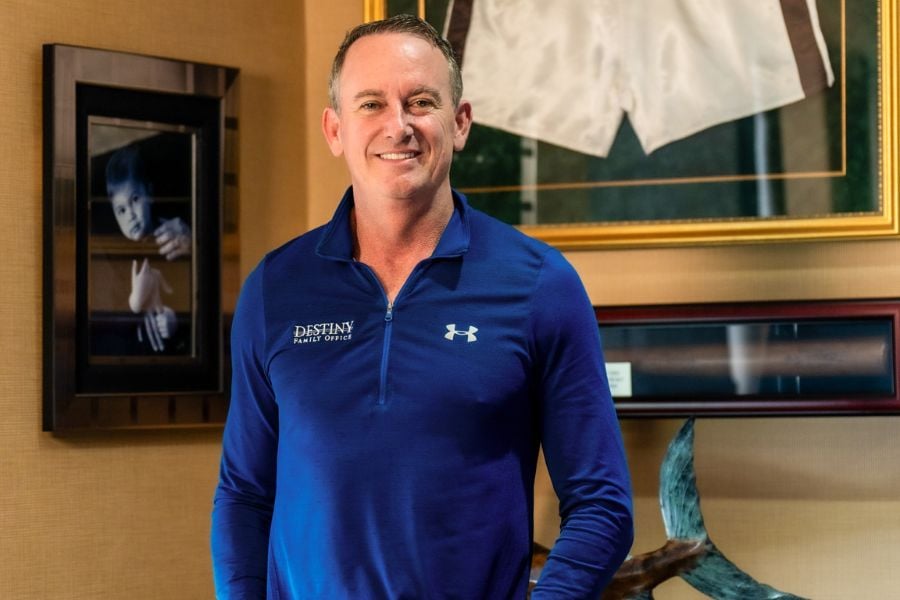
In the world of wealth management, innovation is key to success, as is early adoption of new tools and techniques. One man who knows this better than most is industry veteran Thomas H. Ruggie, founder and CEO of Destiny Family Office.
Having begun his career in 1991, Ruggie went on to found both Ruggie Wealth Management and Destiny Wealth Partners, with the latter exceeding $1 billion in assets in 2023. Ruggie believes his and his team’s success hinged on them being at the forefront of financial planning innovation.
“We’re definitely not in the innovator category, but I do believe in most situations we’re in the early adopter category,” he explains. “We went fee-based pretty well ahead of the curve and got onto the alternative investment and the direct investment train pretty early on, as well as getting into the family office side early.
“I do believe that alternative investments are going to continue to play a key role, not only in the high-net-worth and the ultra-high-net-worth market, but even in the mass affluent market. That’s because a lot of alternative investments have opened up to this market.”
One unique trend that’s close to Ruggie’s heart is the emerging interest in collectibles as an asset class – especially regarding his own love of sports memorabilia.
“A lot of high-net-worth people love tangible assets,” says Ruggie. “I have a pair of Muhammed Ali’s boxing trunks – that’s an asset for me – and it has appreciated at a very nice rate, and yet I still get to see it every day. That’s appealing.”
In assessing management of these collectibles, however, Ruggie thinks that, in general, planners are pretty woeful at understanding their value or worth.
“We’re able to speak to clients that share the same passions,” he says. “We’ve developed a scorecard for anybody that has a desire to have collectibles as a potential asset class. If a client came to me regarding investing in cars, we have resources and contacts available that can be of assistance. And that’s exciting to me.”
With his experience in dealing with ultra-high-net-worth individuals, Ruggie points out a significant challenge the industry is grappling with – an overload of data.
“There’s too much information … it can make it difficult to decipher,” he says. “Fintech, for example. Right now, we use the big players in the Fintech space within our organization, and because we’ve done next-gen research, we’re evaluating some very sexy-looking tech deck opportunities. However, there’s always that concern that if you move away from the big player that’s going to support you 10 years from now and move to a smaller player, is that going to be an issue?”

Investors bet on AI-driven portfolio automation as advisory firms grapple with time-consuming manual work and rising demand for personalization.

Michael C. Graham passed away in November. He was 53.

The proposed changes around retail communications and certain representations of projected performance or targeted returns have tangible implications for B-D firms' compliance policies and procedures.

The independent wealth firm's latest move in Massachusetts a dedicated non-advisory platform for ultra-wealthy families as RIA family office spinoffs keep multiplying.

Savant Wealth Management's tax subsidiary is taking a new name and two new partners as the RIA continues layering accounting services onto its wealth platform.
Northern Trust’s Ken Lassner shows advisors how to convert volatility into after-tax portfolio gains
Dan Biagini of American Equity says the steady decline of pensions, longer lifespans and a reset in interest rates are rewriting how advisors build retirement income

