
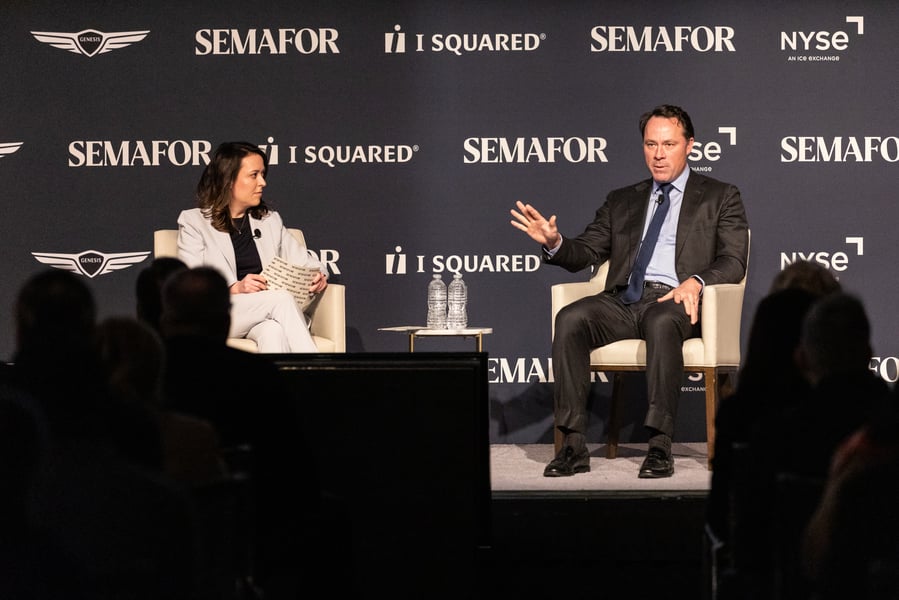
HPS Investment Partners founding partner Michael Patterson confirmed that his private credit firm nearly went public before opting late last year to sell to BlackRock, the world’s largest asset manager with over $12 trillion.
“Almost rang the bell here, like really close,” Patterson said Tuesday at the New York Stock Exchange during an event hosted by news outlet Semafor. “We literally had a meeting with a really well-respected mutual fund who was a potential buyer to our IPO.”
Patterson’s comments confirm previous reporting from Bloomberg, which wrote in December 2023 that HPS submitted a confidential filing with the SEC for an initial public offering amid the private credit boom on Wall Street. HPS, which manages $179 billion in private and liquid credit assets according to its website, instead agreed last December to sell to BlackRock in a $12 billion all-stock deal that was finalized earlier this year.
“We made a recent choice to try to put ourselves in a position where we absolutely feel the pressure to grow, but we think we can grow intelligently as part of a bigger place,” said Patterson, who is now a senior managing director in BlackRock’s private finance division.
Since HPS was acquired by BlackRock, the private credit firm has entered the RIA market through its investment in roll-up firm Lido Advisors announced in May. Lido remains an active acquirer of RIAs and totals over $38 billion AUM following its most recent move to buy a New Jersey-based firm in November. Lido Advisors, whose other investors include Charlesbank Capital Partners and Constellation Wealth Capital, hired former SEC regional director Elena Ro to be its new chief compliance officer in August.
Some recent defaults have triggered fears in the $1.7 trillion dollar private credit market, headlined by JPMorgan CEO Jamie Dimon warning of “cockroaches” following the recent collapses of auto parts maker First Brands Group and auto lender Tricolor amid fraud allegations. Patterson downplayed concerns of any broader issue in private credit.
“I don't think the existence of defaults is prima facie evidence of any sort of problem in the private credit markets. But I will say there are going to be defaults. We have made almost 1,000 loans over the last 18 years as a part of HPS, we've had defaults. Every single default was a surprise,” Patterson said Tuesday night at the NYSE.
Defaults in the private‑credit market have shown a mixed picture. According to a November report by S&P Global, the trailing‑12‑month default rate for credit‑estimated companies fell to 4.55% by the end of Q3 2025, down from roughly 5% at the start of the year. At the same time, the total number of defaults rose to 132 over the past 12 months, compared with 125 for all of 2024, indicating that while the overall risk per dollar lent has decreased, more individual companies formally defaulted.
“The promise of private credit is that when those surprises happen, you put yourself in a better position to recover as much as possible for your investors,” added Patterson. “To me that's the promise of private credit, and I think we as an industry are still in a position to deliver on that.”

Bill would make PE firms liable for portfolio company debts and close carried interest loophole as alternatives push into 401(k)s.

While technical expertise is necessary, sustainable trust is only possible for advisors who know how and when to lean on the emotional side of advice.

Betterment, F2 Strategy and WealthReach push AI deeper into advisory firm operations with three deals this week.

Retirement expectations widen from reality, according to Natixis Investment Managers' annual Global Retirement Index.

Half of planners have seen clients raid retirement savings or cut contributions as affordability pressures mount, CFP Board finds
As AI makes financial information more accessible than ever, Lana Hock explains why human judgment, trust, and empathy remain the qualities clients value most in a financial advisor
Northern Trust’s Ken Lassner shows advisors how to convert volatility into after-tax portfolio gains

