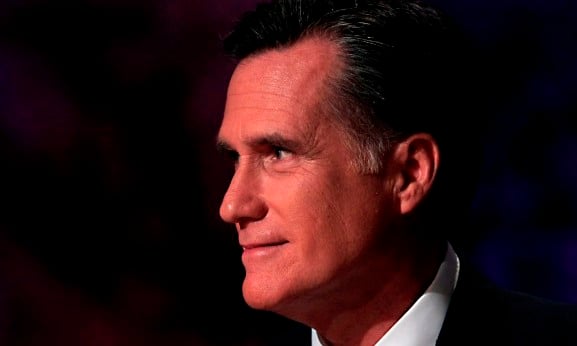
Republican presidential candidate Mitt Romney's plan to reduce tax rates would need to be financed by ending widely used benefits such as the mortgage interest deduction, said Erskine Bowles, who was co-chairman of President Barack Obama's deficit-reduction commission.
Romney is “partly right and partly wrong” when he says he can cut tax rates by 20 percent and make up the money by curtailing tax breaks, Bowles said on Bloomberg Television's “Conversations with Judy Woodruff,” airing this weekend.
“One area that Governor Romney is wrong is you can't just affect the top 15 percent” of Americans, said Bowles, whose bipartisan plan would cut spending and raise taxes. “It's just not enough money there in getting rid of the tax expenditures that only affect the upper-income people. You're going to have to affect people down through the brackets.”
Romney and Obama are clashing over tax policy, with the president maintaining that Romney would slash taxes for top earners and the former Massachusetts governor saying his plan would unleash economic growth.
Romney wants to cut all individual income tax rates by 20 percent, reducing the top rate to 28 percent from 35 percent. He would lower the corporate tax rate to 25 percent from 35 percent, eliminate the estate tax and end taxation of investment income for people making less than $200,000 a year.
Broaden the Base
Romney, 65, said he embraces the concept of lowering tax rates and broadening the base that Bowles and commission co- chairman Alan Simpson used. There's one big difference: Bowles and Simpson want to use some of the revenue from curtailing tax breaks to reduce the budget deficit. Romney would dedicate all of the money to pay for lower tax rates and assume that faster economic growth would make up some of the difference.
Romney said he would make sure the tax code is as progressive as it is today.
“One of the absolute requirements of any tax reform that I have in mind is that people who are at the high end, whether you call them the 1 percent or 2 percent or half a percent, that people at the high end will still pay the same share of the tax burden they're paying now,” Romney said on CBS's “Face the Nation” on June 17. “I'm not looking for a tax cut for the very wealthiest.”
$5 Trillion
Romney's plan would cost the government about $5 trillion in forgone revenue over the next decade on top of the cost of extending the income tax cuts now scheduled to expire Dec. 31. Romney hasn't specified which tax breaks he would limit.
The Bowles-Simpson plan would cut the top tax rates on individuals and corporations to 28 percent. It would limit tax breaks for mortgages, charitable contributions and health insurance without eliminating them. Bowles is a Democrat who was White House chief of staff to President Bill Clinton. Simpson is a Republican former senator from Wyoming.
Unlike Romney, Bowles and Simpson include two features that would raise taxes for high-income or wealthy taxpayers. They would treat capital gains and dividends as ordinary income. They also would assume that the estate tax continues with a top rate of 45 percent.
Deficit reduction should take place over 15 years so that it doesn't slow down the economy, Bowles said.
“What they tried to do in the U.K. was to do it really quickly, trying to get it, you know, to a balanced budget within five years,” he said. “We have it over a much longer period of time, so we don't disrupt this very fragile economic recovery.”
Most Similar
In a memo released yesterday, the Obama campaign said its plan -- not Romney's -- was the one that most closely resembled the Simpson-Bowles plan.
“Despite his praise for the Simpson-Bowles approach, Romney's plans are fundamentally incompatible with it,” wrote James Kvaal, the campaign's policy director.
Obama, 50, disagrees with the Simpson-Bowles plan's cuts to defense and
Social Security, the memo said.
Like Romney, Republicans in the U.S. House have proposed tax rate cuts without specifying what tax breaks they would cut.
An estimate released by the Democratic staff of Congress' Joint Economic Committee attempted to calculate the effect of reducing tax rates while eliminating tax breaks for health care, charitable contributions, state and local taxes and mortgage interest. It said individual middle-class families would pay more taxes under such a plan, while higher-income families would pay less. The benefits of the House Republican plan, they wrote, are “skewed dramatically” to high earners.
'Laugh Test'
That estimate doesn't reflect any actual Republican plan or the interaction between tax provisions. Sage Eastman, a spokesman for House Ways and Means Chairman Dave Camp, a Michigan Republican, said it “doesn't even pass the laugh test.”
“They made a host of bogus assumptions to levy a partisan attack on tax reform,” he said in an e-mailed statement today. “The American people want a flatter, simpler tax code that eliminates special interest loopholes in order to lower tax rates and make the code fairer.”
Bowles said he didn't expect Republicans to stick to their no-tax-increase pledge, particularly because the end-of-year fiscal cliff could throw the economy into
recession.
“I'm not worried about it a bit, because I think you will see, as we get closer and closer to this fiscal cliff, you will see more and more Republicans come out and say, you know, we have to have some revenue,” he said.
Crapo, Coburn
Two current Senate Republicans -- Mike Crapo of Idaho and Tom Coburn of Oklahoma -- were on the Bowles-Simpson panel and supported the proposal.
The plan, released in December 2010, fell three votes short of the 14 votes needed on the debt commission to send it to Congress for a vote. Among the opponents were Camp and Senator Max Baucus, a Montana Democrat, the top two tax-writers in Congress.
Bowles also said he thought the Obama administration was prepared to make significant changes to entitlement programs, based on conversations he has had with administration officials.
--Bloomberg News--