

Somewhere in your book of business, there’s a client with a binder full of cartoon monsters. Until recently, that was a fun detail for the relationship file. Now it might be a line item.
In February, wrestler and internet personality Logan Paul sold his Pikachu Illustrator card for $16.5 million at Goldin Auctions. Guinness World Records confirmed it as the highest price ever paid at auction for any trading card. The card was made as a prize for a 1998 illustration contest, and only a few dozen copies are believed to exist. Paul had paid $5.275 million for it in 2021, so he roughly tripled his money in about five years. That is a return many hedge funds would happily frame and hang in the lobby.
For perspective, the 1952 Topps Mickey Mantle that sold for $12.6 million in 2022 was long considered the hobby’s untouchable benchmark. A yellow electric mouse has now passed it.
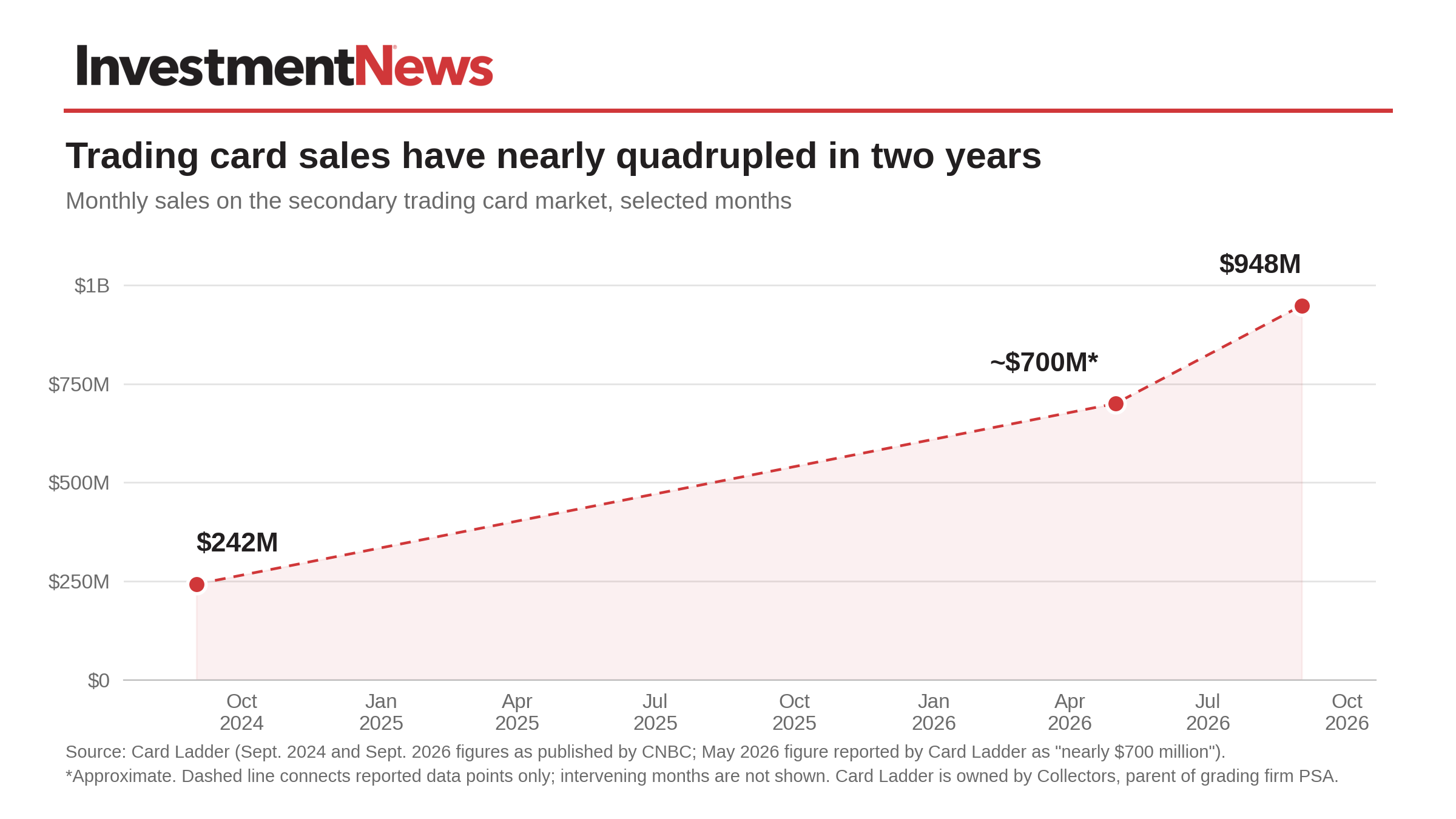
Paul’s card is an outlier. The market under it isn’t. Card Ladder, a pricing service, tracks sales on the secondary market. Its data, published by CNBC, shows monthly trading volume rising from about $242 million in September 2024 to about $948 million in September 2026. One caveat: Card Ladder is owned by Collectors, the same company that owns the industry’s dominant grading firm. Think of the figures as the house’s view of the casino floor.
The clearest sign of demand is the line at the grading desk. Professional Sports Authenticator, or PSA, graded about 2 million cards in 2020 and more than 19 million in 2025. Its parent company is now spending $200 million over 18 months to double its footprint and hire roughly 1,000 more people. PSA president Ryan Hoge told CNBC that trading card games such as Pokémon, Magic: The Gathering and Yu-Gi-Oh! now make up half of PSA’s business. That is more than all sports cards combined. Mickey Mantle, meet Charizard.
Two generations of clients are fueling the boom. Baby boomers held on to their baseball cards, and some of those cards survived bicycle spokes and spring cleaning long enough to become real assets. Millennials grew up with Pokémon, which turns 30 this year, and some now have the money to buy back their childhoods at grown-up prices.
Advisors who have worked in this niche say it’s no joke. Florida planner Thomas Ruggie built a 10-point scorecard to help clients assess their collections, covering documentation, insurance and exit plans. “There’s been such a boom financially in the collectibles space that for some people, it’s a big part of their overall net worth,” Ruggie told InvestmentNews last year.
Read next: Cashing in on the collectibles craze
So the cards belong in the discovery meeting, even if they never come anywhere near the model portfolio. A client who has spent six figures on graded Charizards has a concentration problem, a liquidity problem and an insurance problem, whether or not you ever bill on a single card.
Where money goes, counterfeiters follow, and they have clearly picked a favorite. PSA published its first public fraud report in May. It said the company caught collectibles with a projected market value of more than $200 million in 2025. According to the report:
The report also found that counterfeiters are no longer chasing only famous trophy cards. Increasingly they target modern cards with a recognizable name, decent resale value and simpler printing that’s easier to copy. In plain terms, the $800 card a client buys on a whim online is more exposed than the headline lot at a major auction house.
Read next: Early adopter who understands collectibles
Patience is also required. Industry trackers put PSA’s backlog at about 9.9 million items in early September. Clients who plan to send in raw cards for grading and sell them quickly should adjust their expectations. “Quickly” is doing a lot of work in that sentence.
This is where advisors earn their keep, because the rules mostly work against collectors.
Higher capital gains rate. The IRS treats trading cards as collectibles. Long-term gains are taxed at a maximum of 28% rather than the usual 20% top rate. Higher earners may owe the 3.8% net investment income tax on top of that. InvestmentNews has covered how the same rule catches investors who own physical gold and some gold funds. Pikachu and bullion, it turns out, are in the same tax bracket.
No, it can’t go in the IRA. Clients occasionally ask about buying cards through a self-directed IRA. Under Section 408(m), when an IRA or a self-directed account in a qualified plan buys a collectible, the purchase price is treated as a distribution. That typically means income tax, and possibly penalties if the client is under 59½.
Charitable gifts. Donating a valuable card has its own traps. Gifts of property worth more than $5,000 generally require a qualified appraisal. And if the charity has no mission-related use for the card and simply sells it, the deduction for tangible personal property is generally limited to what the client paid, not what the card is worth today. Unless the charity is a children’s museum with a very specific exhibit planned, that’s worth a conversation before the gift.
Estate planning. Collectibles held until death generally get a step-up in basis. That’s the good news. The bad news is that heirs who don’t know what’s in the binder, or where the grading certificates are, may end up selling a five-figure card at a yard sale for $5.
Even people inside the industry urge restraint. Joe Maddalena of Heritage Auctions told CNBC that buyers should put their money into the best single card they can afford rather than spreading bets across lots of cheaper ones. Jeff Copeland, a longtime collector and emeritus professor at the University of Northern Iowa, told CNBC he believes about 95% of non-sports card collectors aren’t in it for the money at all.
That’s probably the healthiest way for clients to think about it. Cards pay no dividends. They cost money to grade, insure and store, and selling at auction comes with hefty commissions. No regulator is watching the market, and there’s no circuit breaker when prices drop.
The record Pikachu shows what’s possible. The 125% jump in fakes shows what can go wrong. For advisors, the practical step is less dramatic than either: at the next review, ask clients what’s in the shoebox. The answer might surprise you, and it might be worth more than their bond allocation.

“Today’s actions send a clear message that even the biggest financial institutions are not above the law,” said Treasury Secretary Scott Bessent.

To build a truly self-sustaining practice, enterprising advisors have to start with a vision of what they want to be – and accept the realities that come with building toward it.

Serial acquirers add a 35-year-old Oregon wealth manager and a New York practice focused on women navigating life transitions.

Mara Glassel and Julie Fox will co-lead the fast-growing hybrid RIA’s ultra-high-net-worth and private wealth businesses.

The banking giant's wealth arm extends its revenue streak as it pushes to exit consent orders weighing on growth since 2020.
Knighthead Life entered the market with a competitive MYGA. A strong launch earned advisor confidence and paved the way for FIAs.
As AI makes financial information more accessible than ever, Lana Hock explains why human judgment, trust, and empathy remain the qualities clients value most in a financial advisor

