
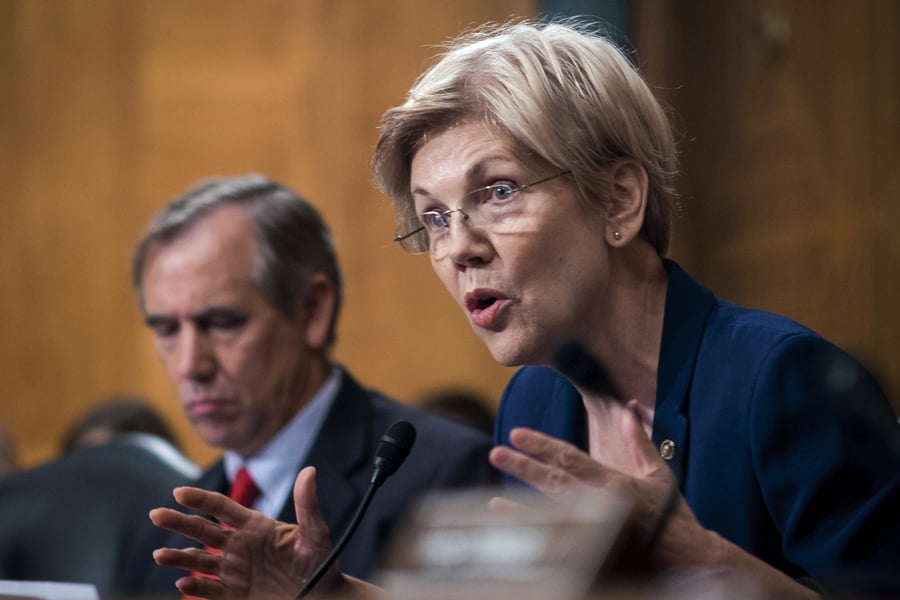
Sen. Elizabeth Warren, D-Mass., warned Thursday that digital currency markets pose threats to investors and pressed the Securities and Exchange Commission to do more to regulate them.
In a letter to SEC Chairman Gary Gensler, Warren expressed concern that cryptocurrency exchanges “lack the same types of basic regulatory protections” as the New York Stock Exchange or Nasdaq.
While the crypto exchanges surged in volume — Coinbase grew from $30 billion to $335 billion over the last year — they may be able to sidestep regulation if the currency traded on them is not deemed a security under federal law, Warren said.
“As the cryptocurrency markets continue to grow and expand, the lack of regulation to provide basic investor protections is unsustainable,” Warren wrote. “The SEC regulates national securities exchanges, and cryptocurrency exchanges that operate in a similar manner should be subject to similar regulatory standards.”
Warren cited a Federal Trade Commission study showing that from October to March, nearly 7,000 people reported losses totaling about $80 million in cryptocurrency scams — a 12-fold increase in reports and a 1,000% increase in losses from a year earlier.
“The harms to consumers as a result of this under-regulated market are real and continue to proliferate in the absence of effective SEC regulations,” Warren wrote.
In her letter, Warren posed a series of questions about the extent of the SEC’s authority to regulate cryptocurrency exchanges. She said she was trying to parse what the SEC can do now “and the potential need for Congress to take additional action on these matters.”
An SEC spokesperson was not immediately available for comment.
In online congressional testimony in May, Gensler acknowledged the limitations on the SEC’s ability to regulate cryptocurrency exchanges. At the Financial Industry Regulatory Authority Inc. conference later in the month, he said additional investor protections are needed.
Legislation may be required to empower the SEC to police the cryptocurrency markets.
Warren has gone to the forefront among lawmakers seeking more investor safeguards surrounding digital currencies. She called on Congress to “confront these issues head-on” during a Senate Banking subcommittee hearing she chaired last month.
“I think she’s correct to point out that there are risks to crypto due to a lack of understanding by consumers,” said Ashley Ebersole, a partner at Bryan Cave Leighton & Paisner. “She wants to add her voice to the chorus of people hectoring for there to be a regulator of the spot crypto market.”
Increased regulation of cryptocurrency could unfold in two ways, said Ebersole, a former senior counsel in the SEC’s Division of Enforcement. The SEC and the Commodity Futures Trading Commission could develop a new set of crypto rules or Congress could create a new agency to oversee digital assets.
“I wouldn’t discount the possibility we could see a new regulator,” Ebersole said.
Salespeople at the firm often went beyond the matching algorithm to recommend network advisors on its Zoe Wealth platform, according to the regulator.

The Protect College Sports Act would cap school payments and codify NIL rights, with implications for advisors guiding young athletes.

"I know the number that I want to be able to retire on, and now I just want out," says Wilmington Trust's Marguerite Weese, describing a common refrain among business-owner clients.

Bessemer and Brown Brothers Harriman veteran Robert Ludricks III and private markets specialist Olof Akesson join the ultra-high-net-worth push on the East Coast.
765 investors were promised 260% annual returns on truck leases
As AI makes financial information more accessible than ever, Lana Hock explains why human judgment, trust, and empathy remain the qualities clients value most in a financial advisor
Northern Trust’s Ken Lassner shows advisors how to convert volatility into after-tax portfolio gains

