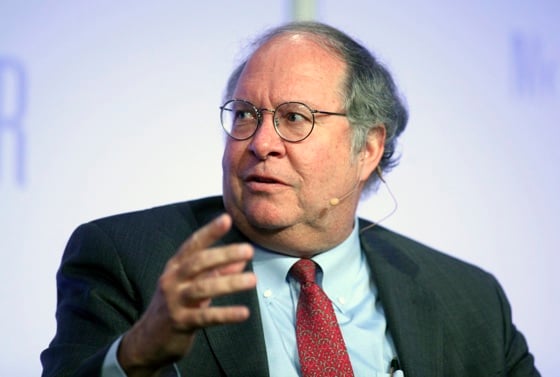
Bill Miller, who estimated a decade ago that Eastman Kodak Co. was worth about $100 a share, sold his flagship fund's stake in the imaging company for a lot less.
Legg Mason Capital Management Value Trust, run by Miller since 1982, disclosed in a semi-annual report last week that the fund sold 18.2 million Kodak shares late last year and during this year's first quarter for about $3.89 each on average. The fund realized a $551 million loss through the divestiture, according to the report.
Miller, 61, began loading up on Kodak shares in 2000 and, by the end of 2005, his firm owned as much as 25 percent of the Rochester, New York, company. Value Trust, one of several Legg Mason funds and accounts to hold Kodak stock, kept the bulk of its stake for more than a decade, only to sell after the film company had lost more than 90 percent of its market value.
“Part of it was just this mentality that this was just a temporary setback and Kodak would be able to get quickly back on track,” said Bridget Hughes, an analyst at Morningstar Inc., a Chicago-based stock and fund research firm. “It was not only a mistake, it was also causing a lot of client angst.”
The $3.4 billion Value Trust has declined about 2.3 percent this year, a performance that ranks it behind 94 percent of rival funds that follow a similar strategy, according to data compiled by Bloomberg. Miller and his colleague Sam Peters are plowing more of the fund's assets into companies with large market capitalizations.
Large Cap Investor
Miller gained fame for beating the Standard & Poor's 500 Index for a record 15 straight years through 2005, only to trail the U.S. benchmark during the next three years as he invested in beaten down banks and homebuilders. Miller outperformed peers in 2009 as the stock market rebounded.
During the six months ended April 30, Value Trust invested in Apple Inc., Johnson & Johnson, Pfizer Inc., and Chevron Corp., according to the semi-annual report filed last week with the U.S. Securities and Exchange Commission. At the same time, the fund has been selling or reducing its holdings in companies with smaller market values, including Amgen Inc., AES Corp. and Kodak.
As a result, the average market value of companies held by the fund rose about $30 billion during the six months ended April 30 to $94 billion, the SEC filing shows. The moves also left the Value Trust holding stocks with a lower price-to- earnings ratio, about 9.9 times estimated earnings for 2012, the filing said.
“They do see the best value in large cap and Kodak's market cap was inconsistent with that,” Mary Athridge, a Legg Mason spokeswoman, said in an e-mail response to questions.
The Legg Mason Opportunity Trust, a smaller fund managed by Miller, continued to hold 17.8 million Kodak shares as of March 31, according to regulatory data compiled by Bloomberg.
[More: Legendary fund manager goes from penthouse to outhouse]
‘Building a Company'
“Both the board and long term investors understand we are building a new company and they know that this isn't accomplished overnight,” said Gerard Meuchner, a Kodak spokesman, adding that Legg Mason remains one of the company's largest shareholders. “They also believe our strategy will deliver sustainable profitable growth.”
Now valued at $923 million, Kodak was once much bigger, ranking as the third-largest company in the Standard & Poor's 500 Index in June 1974 with a market capitalization of $17 billion, said Howard Silverblatt, a senior index analyst at New York-based S&P. After reaching a peak of $26.7 billion at the end of 1996, the company's market value began shrinking, and in December Kodak was removed from the S&P 500 along with the New York Times Co., he said.
“It was a commentary to some degree on the newspaper and film industries,” Silverblatt said in an interview. “That was more of a macro change, looking at the way the economy has shifted.”
Loyal Shareholder
Miller, the chief investment officer at Legg Mason Capital Management Inc., began buying Kodak shares for Value Trust during the second quarter of 2000. In a shareholder report for the period, Miller said that concerns about the impact of digital photography on the company's film business were tempered by continued growth in conventional camera sales and picture taking.
“We think Kodak, currently selling around $56, is worth close to $100,” Miller said in the report, adding that he expected the company to generate free cash equal to almost half of its market capitalization over the next five years.
By the end of 2005, Legg Mason funds and accounts owned a combined 24.9 percent stake comprised of 71.5 million Kodak shares, according to the film company's annual proxy statement. That included 23 million shares held by Value Trust.
Share Price Decline
Kodak shares closed at $3.43 yesterday, down from $66.25 at the end of 1999. Revenue totaled $7.19 billion last year, down from $14.3 billion in 2005, according to Bloomberg data.
The company is now competing with Hewlett-Packard Co. in providing digital printing technology to consumers and commercial enterprises, according to Mark Kaufman, an analyst at Rafferty Capital Markets Inc. in New York. Kaufman rates Kodak shares a buy, citing the prospects for the new digital printers as well as the company's ability to continue churning out money, even at reduced revenue levels.
“Their old film business, which everyone abhors and denigrates, has been generating cash over the years consistently,” Kaufman said in an interview. “The other big cash generator has been their licensing fees from their patent portfolio.”
--Bloomberg News--