
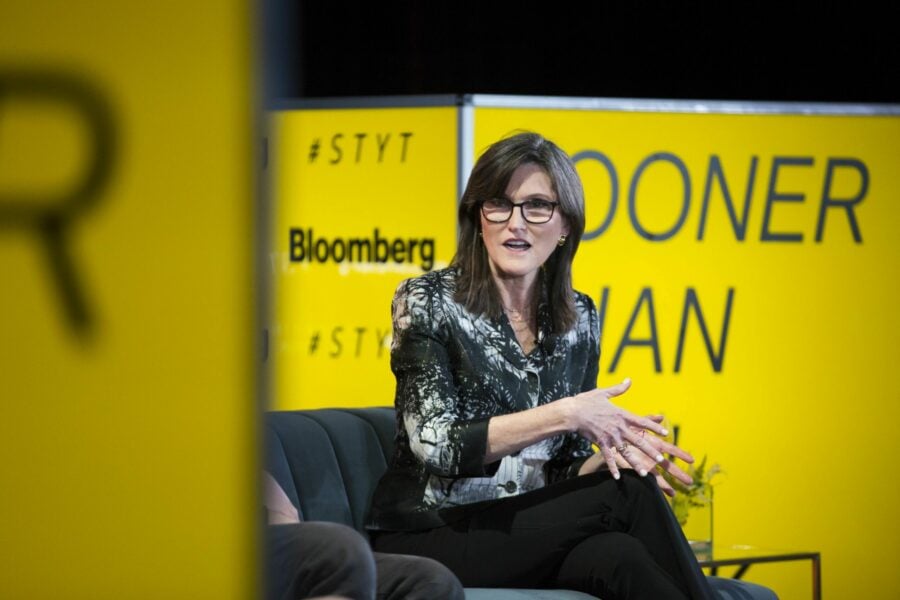
Don’t let the current lofty stock market valuations take your eye off the long game of investing.
That was among the takeaways during the closing session of the Morningstar Investment Conference, featuring the head of Ark Investment Management, Cathie Wood, and Research Affiliates chairman Rob Arnott.
“Be very careful about short selling bubbles; they can go much further and last much longer than most people think,” Arnott said. “You can make a ton of money if you have a good exit strategy.”
For her part, Wood insisted, “We’re not in a bubble.”
She explained that the bursting of the tech bubble in 2000 and the 2008 financial crisis “put fear into people, and that continued for the first few years of our existence.”
“The word volatility puts fear into investors’ heads,” Wood added.
In addition to tamping down market-bubble fears, the two high-profile investors also agreed that the financial services industry is “ripe for disruption,” citing trends toward free trading, fractional shares, and the reluctance of younger investors to trust Wall Street institutions.
Digging into specific investments, Wood said she would sell Tesla Inc. if its price hit her five-year target in the coming year.
The electric-vehicle maker’s stock is now roughly $750 and her base price target in five years is $3,000, she said. “If nothing were to change in our outlook and we got to $3,000 next year, my guess is that we would be peeling out of it.”
During the session, Wood debated Arnott, who has been skeptical of high-valuation growth stocks like Tesla. Arnott asked Wood how investment managers should decide when to get out of positions.
“What’s the sell discipline that can protect those gains?” he said. “What’s the sell discipline that can rotate you into undiscovered disruptors where the market is unaware of what they’re doing?”
Wood’s answer on selling Tesla came during the press briefing, when his question was repeated. But during the panel, she defended her famous Tesla bet.
Along with listing some of the advantages of electric vehicles — including that she hasn’t had to go to a gas station since September 2018 — Wood cited the price drops in battery pack systems.
Due to those declines, she said she expects the average price of an electric vehicle to fall below that of a gas-powered car in the next year or so. That trend will continue into 2025, when she expects the average electric vehicle to cost $18,000 while a regular car using gasoline will be roughly $25,000 to $26,000.
It’s been a dramatic year for Wood after her firm’s exchange-traded funds beat most of the U.S. market last year. Her flagship Innovation ETF (ARKK) is down 5% this year after returning nearly 150% last year.
Wood continued to advocate for her bets on disruptive technology and said she expects a 30% compound annual rate of return for her flagship strategy. She also said that she did not think that the market was in a bubble.
Ark’s funds have offloaded some Tesla stock this month after shares of the company rallied. Still, the electric-vehicle maker is their biggest holding, according to data compiled by Bloomberg. Ark’s strategy regularly involves selling some of its winners to invest in other targets.
Also during the news briefing, Arnott was asked about what will happen with China Evergrande Group. He said that he has lost six basis points on his investment in the property developer, but expected that Beijing would “ring-fence” the firm to limit its economic fallout.
— Jeff Benjamin contributed to this article.

A Nationwide survey finds 47% of GLP-1 users have never discussed the drugs’ financial impact with an advisor, even as many dip into savings.

The hundreds of millions of dollars from a sale of Inspired Healthcare properties does not mean an immediate windfall for investors.

Its SEC filings said one thing - a congressional probe said another.

Sham agreements allegedly padded revenue by 345%.

"Most pre-retirees are uncomfortable making key retirement income decisions without an advisor's help," said Chris Bailey of Cerulli.
Knighthead Life entered the market with a competitive MYGA. A strong launch earned advisor confidence and paved the way for FIAs.
As AI makes financial information more accessible than ever, Lana Hock explains why human judgment, trust, and empathy remain the qualities clients value most in a financial advisor

