
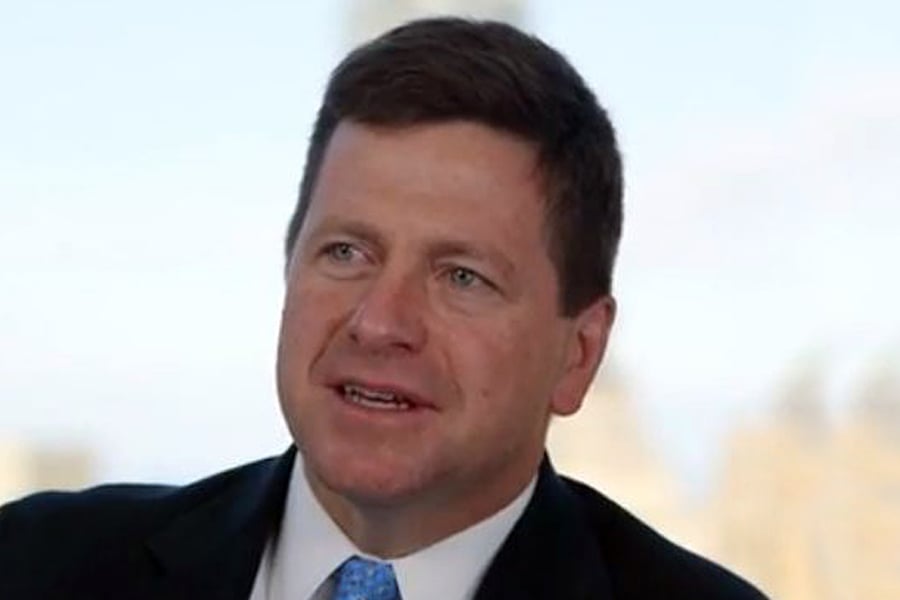
Democratic lawmakers previewed what they’d like to see from the next chairman of the Securities and Exchange Commission Tuesday by criticizing the outgoing chair -- Jay Clayton -- in what was likely his last public visit to Capitol Hill.
In a Senate Banking Committee hearing, the panel’s top-ranking Democrat, Sherrod Brown of Ohio, asserted that under Clayton’s leadership, the agency did not do enough to protect ordinary investors.
Brown criticized one of Clayton’s signature rulemakings, the new broker investment advice standard Regulation Best Interest. He implied it lacked the teeth to curb broker conflicts of interest, echoing a charge made by many Democratic lawmakers and investor advocates.
“You pushed for what you call ‘Regulation Best Interest,’ a new standard that applies when brokers give advice to clients, but it doesn’t put mom-and-pop customers first,” Brown told Clayton during an online committee hearing.
Brown noted that in a recent SEC roundtable on the measure, SEC staff highlighted compliance failures since Reg BI was implemented on June 30.
“Even though you said firms are making ‘good faith efforts,’ your staff reported shortcomings in compliance and failures to fully disclose disciplinary history to clients,” Brown said. “In fact, it doesn’t seem like you have any way to tell if this rule will help at all. Not a very auspicious beginning.”
Later in the hearing, Clayton defended Reg BI, which he maintains is much stronger than the previous suitability standard.
“We’ve increased the regulation of broker-dealers when they deal with customers significantly,” Clayton told lawmakers.
Clayton announced Monday that he would step down at the end of the year. He will be replaced permanently by a chair appointed by President-elect Joe Biden. The five-person commission will have a 3-2 Democratic majority during the Biden administration. Until the Senate confirms a Clayton replacement, the commission will be led by an acting chair.
Clayton and Sen. Elizabeth Warren, D-Mass., had a tense exchange about company reporting requirements related to climate threats. Warren said the agency has failed to establish a mandatory uniform reporting standard.
“Climate change is an existential risk,” Warren said. “We need a new SEC chair who will put this climate crisis at the top of the agency’s agenda.”
Clayton, a political independent appointed by President Donald Trump, took the helm of the agency in May 2017. Prior to his public service, Clayton was a lawyer at Sullivan & Cromwell, a law firm that represents Wall Street banks and firms.
Republicans on the Senate Banking Committee praised Clayton.
Chairman Mike Crapo, R-Idaho, commended the SEC for forging ahead despite the coronavirus pandemic to approve rules that deepened the pool of sophisticated investors who can purchase unregistered securities and made it easier for small and medium-size emerging companies to raise capital in the private markets.
“Your regulatory agenda has been and continues to be ambitious,” Crapo said.
Sen. Patrick Toomey, R-Pa., said that under Clayton’s leadership, the agency has implemented rules mandated by legislation to promote small-company stock offerings.
“I particularly appreciate your efforts to expand investment opportunities for average investors,” Toomey said.
But Clayton also took criticism from the Republican side. Sen. Tom Cotton, R-Ark., asserted that the agency’s crackdown on inadequate disclosure of 12b-1 fees by investment advisers was regulation by enforcement.
Republicans and financial industry opponents of the initiative focusing on the recommendation of high-fee mutual funds said the SEC punished firms without making clear through rules or guidance what it expected on fee disclosures.
“These are all facts-and-circumstances situations,” Clayton said. “I understand that some people felt they were within the bounds of the law when we felt they were not. I’m hopeful that there’s been more clarity brought to this. I’m also confident that the [SEC] Enforcement Division pursued this believing ... they were on the right side of the law.”
The Senate Banking Committee session was likely Clayton’s last congressional hearing before he departs the agency.

Siddharth Jawahar was sentenced 11 years in prison and $31M in restitution for running Swiftarc Capital fraud scheme

Wall Street banks expand wealth services as ultra-high-net-worth client demands extend further above and beyond investment management.

The acquisition of $2 billion Gilbert & Cook extends a buying spree for the ultra-high-net-worth firm that has already touched six states this year.

After years of encouraging sacrifice and delayed gratification, advisors have to do the next emotional lift: helping clients let go of a potentially harmful scarcity mindset.

A new JPMorganChase Institute report reveals how deeply stock market wealth now drives everyday American spending, especially for retirees.
Northern Trust’s Ken Lassner shows advisors how to convert volatility into after-tax portfolio gains
Dan Biagini of American Equity says the steady decline of pensions, longer lifespans and a reset in interest rates are rewriting how advisors build retirement income

