
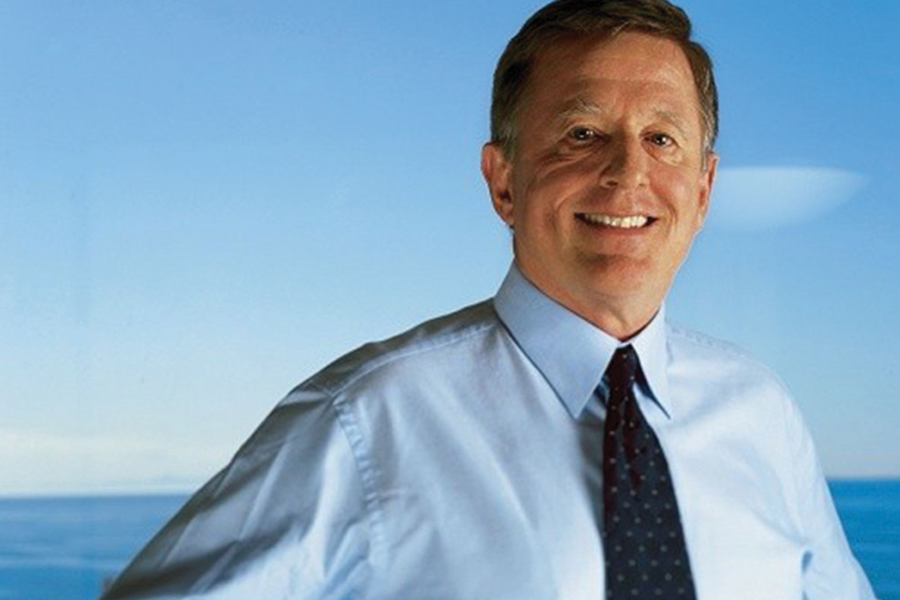
For the first time in years, David Booth’s old-school views on investing are back in fashion. The co-founder of quant giant Dimensional Fund Advisors is finding a receptive audience for his belief that value investing will win out in the long haul -- just as the academics said it would.
Having cratered in last year’s pandemic-fueled crash, the strategy of buying cheap equities just notched the best quarterly outperformance in 20 years. And after long resisting the passive boom, the company with $637 billion under management is suddenly busy hoovering up assets across its exchange-traded funds.
No wonder the 74-year-old Booth, who has spent four decades in money management, is in fighting spirits.
“I’m celebrating,” he said, referring to the value rotation. “I feel like my head has been in a vise for the last three years.”
The Russell 1000 Value Index is up 14% year-to-date versus a 8.2% gain for its growth counterpart as investors bet on cyclical and riskier companies. The durability of that market rebound is now occupying Wall Street. Everything from muted economic growth and low inflation expectations to the rise of new technologies has been blamed for the investing style’s famous underperformance for much of the past decade.
According to Booth, that rough period has been more about the unbelievable strength of growth stocks than the death of value. Even after all these years, he reckons the science is still sound.
“In our core funds we do hold growth stocks, and FAANG stocks, they’re in there somewhere,” Booth said. “We just tilt toward value because over the long haul it’ll improve returns. We still believe that.”
While its investment strategy may be relatively immovable, Dimensional has accepted that the way it implements its approach may need to move with the times to embrace cheaper and easier-to-trade tools.
So after resisting the siren song of the ETF industry for years, it now has three products with more than $1.1 billion under management just a few months after their launch. In June, Dimensional plans to make history by converting more than $20 billion of mutual funds into the exchange-traded wrapper.
Booth, whose name adorns the University of Chicago’s famed business school after a $300 million donation in 2008, is less convinced by other market innovations -- for now.
The boom in Bitcoin and mania for non-fungible tokens might be good investments with which to “have fun,” he said. But he wouldn’t recommend putting a lot of money into them.
“I’m not arguing there’s any problem with Bitcoin,” Booth said. “Just we haven’t found a compelling argument for us to get involved.”
Instead of digital art, the investor is focused on his real-life collection. The veteran is making plans to turn his Austin estate and internationally acclaimed art collection into a museum after he’s passed away.
“When you get to be my age, you want to be able to look back think you improved things a bit,” Booth said. “I’m feeling really good about that, actually, right now.”

Eric J. Stone was fired by Fidelity in 2021 after facing claims he took loans from clients.

Chicago-based Curi Capital gets new majority owner as $14 billion RIA eyes acquisitions and expanded family office services

Partnership pairs organic lead detection with paid ad targeting to help end "spray-and-pray" marketing for growth-seeking advisory firms.

Jonathan Lewis joins the wealth management giant as it proceeds with a $2 billion AI and technology push for advisors.

A third-generation Pennsylvania firm with 24 advisors and $1.6 billion in client assets has left Cambridge Investment Research.
Northern Trust’s Ken Lassner shows advisors how to convert volatility into after-tax portfolio gains
Dan Biagini of American Equity says the steady decline of pensions, longer lifespans and a reset in interest rates are rewriting how advisors build retirement income

