
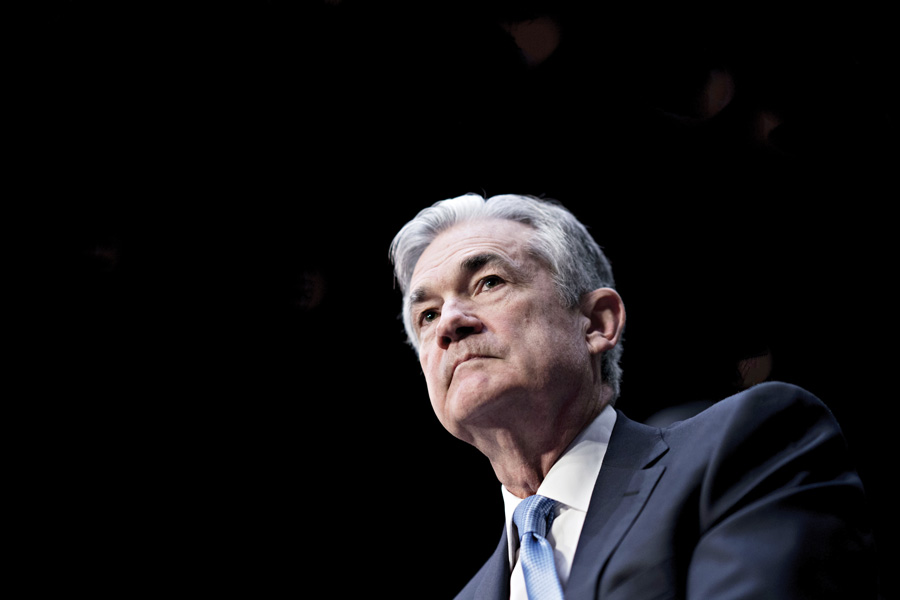
Chair Jerome Powell said the time has come for the Federal Reserve to cut its key policy rate, affirming expectations that officials will begin lowering borrowing costs next month and making clear his intention to prevent further cooling in the labor market.
“The time has come for policy to adjust,” Powell said Friday in the text of a speech at the Kansas City’s Fed’s annual conference in Jackson Hole, Wyoming. “The direction of travel is clear, and the timing and pace of rate cuts will depend on incoming data, the evolving outlook and the balance of risks.”
The Fed chief also acknowledged recent progress on inflation, which has resumed moderating in recent months after stalling earlier in the year: “My confidence has grown that inflation is on a sustainable path back to 2%,” he said, referring to the central bank’s inflation target.
While those remarks provided some clarity for financial markets in the near term, they offered few clues as to how the Fed might proceed after its September gathering.
Still, the speech confirmed the Fed is on the cusp of a key turning point in its two-year battle against inflation. For most of that time, the labor market proved surprisingly sturdy, giving officials room to focus doggedly on lowering inflation toward the central bank’s 2% target.
The Fed has held its benchmark rate in a range of 5.25%-5.5% — its highest level in more than two decades — for the last year in support of that goal, propping up borrowing costs across the economy.
Yet just as inflation has neared its target, cracks have appeared on the employment front, prompting several Fed officials to worry that high rates now pose a threat to the economy’s continued strength. Warning signals included a disappointing July jobs report that rattled financial markets.
“We do not seek or welcome further cooling in labor market conditions.” Powell said, adding that the slowdown in the labor market was “unmistakable.”
After being late to raise rates in response to an inflation surge during the Covid-19 pandemic, Powell’s remarks underscore how Fed officials are hoping to avoid another policy error now that price growth is easing. Their success or failure will determine whether there’s a so-called soft landing, the rare feat of smothering a burst of inflation without tipping the economy into recession.
“Our objective has been to restore price stability while maintaining a strong labor market, avoiding the sharp increases in unemployment that characterized earlier disinflationary episodes when inflation expectations were less well anchored,” Powell said. “While the task is not complete, we have made a good deal of progress toward that outcome.”
At their last gathering in July, the “vast majority” of Fed officials felt it would likely be appropriate to cut rates in September if economic data continued to come in as expected.
While inflation remains above the Fed’s goal, it has retreated markedly from its recent peak of 7.1% in 2022. The central bank’s preferred inflation gauge, the personal consumption expenditures price index, rose 2.5% in June from a year earlier.
Powell’s comments will likely be well-received by Americans contending with high interest rates attached to mortgages, autos, credit cards and other borrowing. Investors are widely anticipating a quarter-point cut when the Federal Open Market Committee next meets Sept. 17-18.
Questions remain about the Fed’s path forward and Powell provided no additional clarity.
Investors are weighing whether another negative jobs report would compel the Fed to cut rates by a larger-than-usual 50 basis points in September. Another key matter is how policymakers might proceed with the pace and size of rate cuts in subsequent months.
Powell said policymakers “will do everything we can to support a strong labor market as we make further progress toward price stability.”

A Nationwide survey finds 47% of GLP-1 users have never discussed the drugs’ financial impact with an advisor, even as many dip into savings.

The hundreds of millions of dollars from a sale of Inspired Healthcare properties does not mean an immediate windfall for investors.

Its SEC filings said one thing - a congressional probe said another.

Sham agreements allegedly padded revenue by 345%.

"Most pre-retirees are uncomfortable making key retirement income decisions without an advisor's help," said Chris Bailey of Cerulli.
Knighthead Life entered the market with a competitive MYGA. A strong launch earned advisor confidence and paved the way for FIAs.
As AI makes financial information more accessible than ever, Lana Hock explains why human judgment, trust, and empathy remain the qualities clients value most in a financial advisor

