

The emerging-market bargain buyers are in celebration mode. And the party’s not over yet.
The prospect of a Joe Biden presidency checked by a divided Congress has gotten everyone from Eaton Vance Corp. to Medley Global Advisors predicting a fresh boost for risk assets, just a week after the stocks, currencies and bonds of developing nations hit the buffers as the U.S. election approached.
BlackRock Inc. says developing-nation assets, which look more appealing in this low-rate world, could benefit from a more moderate leader in the White House. The Biden administration’s policy approach will probably reduce uncertainty, according to UBS Global Wealth Management.
Gains for emerging markets would support the view that the election result is likely to cap U.S. interest rates for longer and weaken the dollar, boosting the debt and currencies of developing nations as they struggle to finance efforts to contain the worst of the COVID-19 pandemic.
Gauges of developing-nation stocks and currencies were both at the highest levels in more than two years after getting whipsawed last month by uncertainty over the U.S. election outcome. Last week, local bonds had their best weekly performance since April. The Mexican peso and offshore yuan surged on the prospect of reduced trade tensions.
“A Biden presidency with a Republican Senate is likely the best possible scenario for emerging-market assets and if this outcome holds it should provide a very strong backdrop for the asset class,” said Eric Stein, chief investment officer of fixed income at Eaton Vance. “Biden should have a less confrontational approach to China and other countries than Trump.”
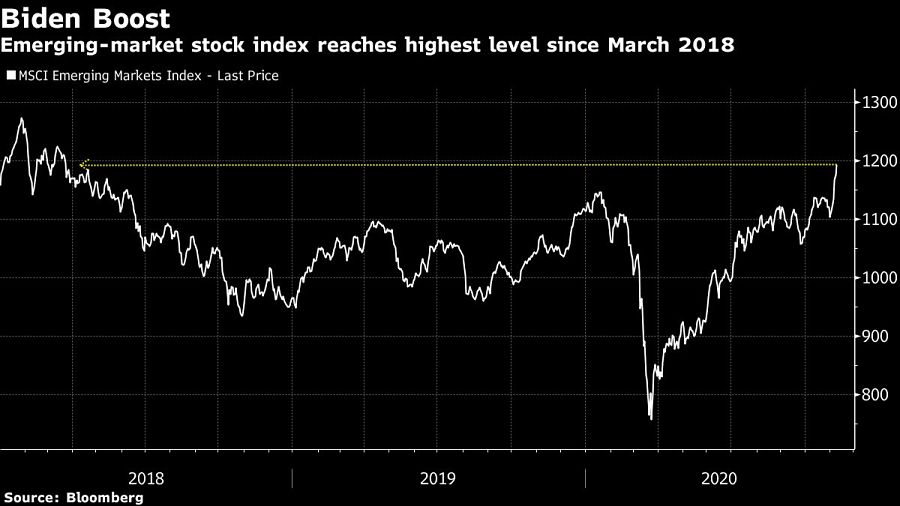
Asia’s markets will likely outperform their emerging peers as the region’s control of the coronavirus pandemic helps economies recover faster than in other parts of the world where strict lockdowns are returning. China’s October exports unexpectedly accelerated and inflation and credit reports due this week will likely signal stable underlying demand.
“The flows data over the past few months suggest that investors’ purchases of EM assets have been heavily biased toward a handful of Asian countries,” said Nick Stadtmiller, a strategist at Medley Global Advisors in New York. “Asian economies are expected to grow faster than other emerging market peers in the coming year, and that growth differential has been supportive of Asian markets.”
Still, there are some fragile spots to be worried about. Turkey remains on top of traders’ watchlist after President Recep Tayyip Erdogan fired the country’s central bank governor and his son-in-law unexpectedly resigned as the country’s economy czar. Zambia could become Africa’s first sovereign defaulter since the onset of the pandemic if investors reject on Friday a request to defer interest payments on its $3 billion worth of Eurobonds until April.
In Latin America, Mexico and Peru will decide on interest rates, while an International Monetary Fund mission will arrive in Argentina to negotiate with authorities on a new program.

The financial advice industry has been facing inquiries into its cash sweep programs for years now.

Investor money allegedly went to strip clubs, exotic cars, and landscaping

Procyon adds $415 million in assets under management in New Jersey while Savant picks up a $213 million Southern California planning firm

With a growing number of real estate-rich Baby Boomers aging into retirement, some advisors may be failing to consider all the options available for those clients' assets.

Cornerstone Advisors study reveals compliance bottlenecks stall campaigns weeks after customer opportunities close.
As AI makes financial information more accessible than ever, Lana Hock explains why human judgment, trust, and empathy remain the qualities clients value most in a financial advisor
Northern Trust’s Ken Lassner shows advisors how to convert volatility into after-tax portfolio gains

