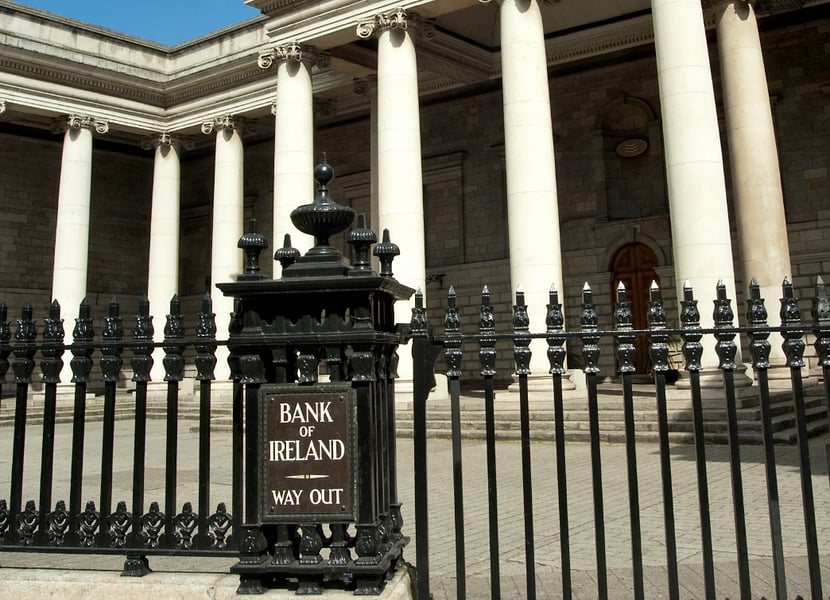
The global financial markets are still trying to regain some stable footing following the $116 billion bailout of some of Ireland's largest banks.
The Irish rescue package delivered by European governments, first announced over the weekend, is being interpreted by market-watchers as another reminder of the fragile state of the global economy.
“There's a feeling that the last shoe has not dropped yet,” said Brian Gendreau, a market strategist at Financial Network Investment Group, with has $36 billion under management.
“Right now, people are acting without all the information and it has affected all risk assets,” he added.
The latest flight to quality, which has strengthened the dollar against the euro, pushed the Dow Jones Industrial Average below the 11,000 mark for much of the day yesterday.
The Dow, which was down four of the last five trading days, is down about 40 points in midday trading today, hovering around the 11,000 mark.
(Click here for the most current quote.)
Investors are spooked because the extent of the European debt crisis is unknown – and many believe that countries such as
Spain, Greece or Portugal could be next in line for a bailout.
“It is yet another illustration of Europe's failure to get ahead of the crisis in its periphery,” said Mohamed El-Erian, chief executive and co-chief investment officer of Pacific Investment Management Co. LLC, which manages $1 trillion.
“While the package provides emergency loans to Ireland, it does not solve the country's problems, which center on the government's having taken on way too much debt when it decided to bail out the banks and their creditors,” he added. “The decision by the [European Union] and the [International Monetary Fund] to kick the can down the road was driven primarily by concerns that other approaches would involve collateral damage and unintended consequences.”
The general perception that Europe is avoiding the impending crises in Greece and Ireland is leading creditors to pre-emptively sell their holdings of peripheral economies, Mr. El-Erian said.
“The longer the uncertainty prevails regarding Europe's peripheral crises, the more likely that more creditors will exit,” he said. “This means that the risk spreads will remain very elevated, worsening the debt dynamics and discouraging new investment, growth and employment creation.”
Even with earnings estimates for the S&P 500 at record highs, the stock market is being dubbed too risky right now, Mr. Gendreau said.
Investors are so skittish at this point, he said, that “it doesn't take a perception of increased risk for the markets to fall; it only takes a bit of uncertainty for the markets to fall.”
While the solvency issues facing the Irish banks has been mounting for months, the bailout package confirmed further suspicions of trouble, and ultimately rattled the global markets.
But what's still missing, according to Mr. Gendreau, is a sense of relief from the bailout.
“The bailout should have been settling for the markets,” he said. “But the market right now is always wondering if it's enough.”