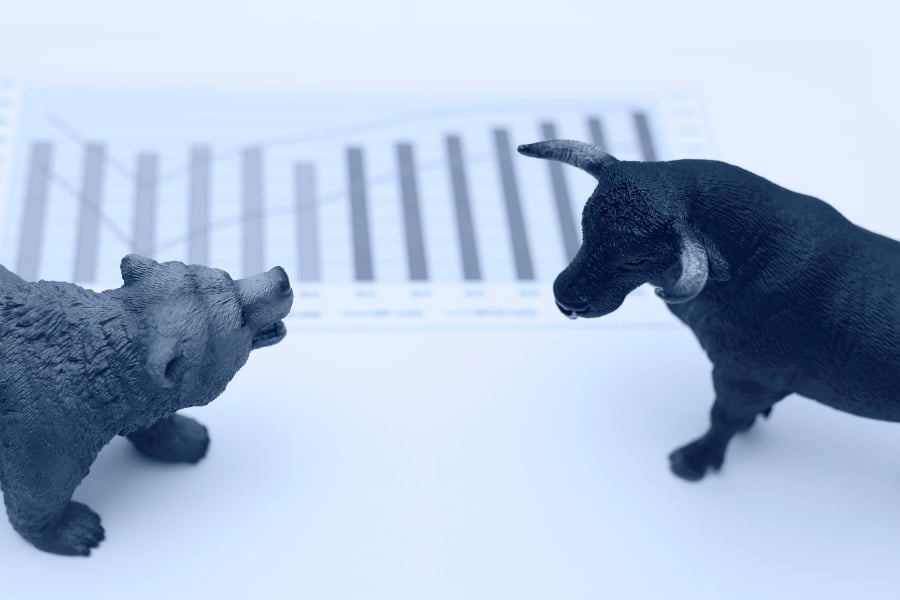
Bill Gross said the bull market “supercycle” for stocks and bonds is approaching its end, as the unconventional monetary policies that have kept it alive since the financial crisis are running out.
The attempt by global central banks to cure a debt crisis with more debt doesn't have much further to run, which will end a rally that's lasted three and a half decades, the 71-year-old manager wrote in an investment outlook for Janus
Capital Group Inc. Investors should stop focusing on price appreciation and instead look to “mildly levered income,” such as his recommendation to short German government debt, he said.
RUNNING OUT OF OXYGEN
“Credit-based oxygen is running out,” Mr. Gross wrote in the outlook, titled
“A Sense of an Ending,” in which he compared the final stages of the market cycle with his own mortality. “I merely have a sense of an ending, a secular bull market ending with a whimper, not a bang.”
Mr. Gross, the manager of the $1.5 billion Janus Global Unconstrained Bond Fund, acknowledged that his calls for the end of the bond rally in both February and April of 2013 were too early. This time around, he noted that he's in prominent company, as investors including Stanley Druckenmiller, George Soros, Ray Dalio and Jeremy Grantham have cautioned that financial markets may be overpriced or bubbly, potentially setting the stage for lower returns.
Mr. Gross, who referenced Julian Barnes' novel “The Sense of an Ending” in his outlook, said he continues to see a subdued interest rate environment for a prolonged span. He advised investors last month to leverage returns in an environment of persistently low interest rates and inflated asset prices.
'CONVENIENTLY FORGET'
The former chief investment officer at Pacific Investment Management Co. until his sudden departure in September, Mr. Gross has produced a 1.5% return this year through the end of April in his new fund at Janus, beating 56% of peers, according to data from research firm Morningstar Inc. Since he began overseeing the fund on Oct. 6, it returned 1%, outperforming 66% of peers.
Mr. Gross, a billionaire who had more than $700 million of his wealth invested in his fund at year-end, also took a swipe at his own industry.
Active asset managers “conveniently forget” that their fees haven't fallen even as assets have multiplied by a factor of 20 since 1981, Mr. Gross wrote.