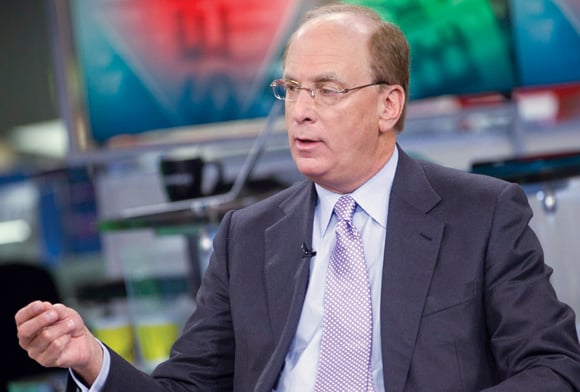
Investors should have 100 percent of investments in equities because of valuations and higher returns than bonds, said Laurence D. Fink, chief executive officer of
BlackRock Inc., the world's largest money manager.
Investors who seek the safety of treasury bonds will have minimal returns and will not be able to meet their needs with the U.S.
Federal Reserve expected to keep interest rates low, said Fink, who in 1988 co-founded the New York-based manager with $3.5 trillion of assets. By contrast, equities are trading at the lowest valuations in 20 or 30 years.
“I don't have a view that the world is going to fall apart, so you need to take on more risk,” he said in an interview with Bloomberg Television in Hong Kong today. “You need to overcome all this noise. When you look at
dividend returns on equities versus bond yields, to me it's a pretty easy decision to be heavily in equities.”
The Federal Open Market Committee last month pledged they would keep borrowing costs low through at least late 2014 to boost the economy and put more Americans back to work, extending a previous end date of mid-2013. Investors pulled money from mutual funds that buy U.S. stocks for a fifth year in 2011, the longest streak in data going back to 1984, according to the Investment Company Institute in Washington.
Fink's recommendation is at odds with investment-management guidelines that urge investors to diversify their holdings by putting 60 percent of their money in stocks and 40 percent in bonds.
Investment Guidelines
Investors tend to reduce their dependence on stocks as they get older, to cut volatility in their investments. Investors in their twenties had 73 percent of their 401(k) retirement assets in equities, while those in their sixties had 48 percent of their 401(k) assets in equities, according to research conducted by Investment Company Institute and the Employee Benefit Research Institute at year-end 2009.
Fink, who co-founded BlackRock in 1988 as mainly a fixed- income manager, was a pioneer in the mortgage industry earlier in his career at First Boston, which was later acquired by
Credit Suisse Group AG. There, he traded bonds in the 1980s, and helped slice and pool mortgage bonds that were then sold to investors as collateralized mortgage obligations. About $1.25 trillion of BlackRock's assets were in fixed-income as of Dec. 31, compared with $1.56 trillion in equities.
Stocks Versus Bonds
Fink said in a May 31 interview he's more bullish on U.S. equities than bonds because companies are benefiting from the weak dollar and have surplus cash to invest for growth. While equities around the world were off to the best start in 18 years, the S&P 500 Index gained just 1.2 percent since Fink's prediction last year, compared with the 6.8 percent return in Treasuries, according to
Bank of America Merrill Lynch indexes.
The MSCI All-Country World Index rallied 5.8 percent last month, topping gains in commodities and handing investors January's best returns in almost two decades, according to data compiled by Bloomberg. The measure, which rose 0.2 percent as of 1:38 p.m. in Hong Kong, is trading at 13.6 times earnings, less than half its valuation of 32.4 times at the end of 2009, according to the data.
Fink said the Greek debt crisis will be resolved as it's not in anyone's interest to have a blowup now. Greece is trying to win a 130 billion euro ($172 billion) second aid package to prevent the country's collapse, strike a deal with private creditors and remain in the euro area. European leaders in recent days stepped up pressure on Greek politicians to meet the conditions of the rescue.
‘Very Bullish'
“I'm very bullish on the market,” he said, citing the increased liquidity from the U.S. and European central banks. “I think the market is focusing too much on noise like Greece. And yet we're going to have a lot of volatility and we're going to have to live with it.”
Greek Prime Minister Lucas Papademos was scheduled to meet late yesterday with representatives from the so-called troika of European Commission, the European Central Bank and the International Monetary Fund again to put final touches on terms required for the rescue package that Finance Minister Evangelos Venizelos said would determine the country's ability to stick to its plan to remain in the euro zone.
The European Central Bank would be able to provide liquidity to stabilize the European markets this year, Fink said. In the U.S., he doesn't see another round of quantitative easing for at least a year.
Quantitative Easing
“The only reason that I would think we would do a quantitative easing three is if the dollar gets too strong,” he said. “I think the ECB is going to bring down the value of the euro. I think the euro will break $1.20 this year.”
A weak euro is going to stimulate a recovery in parts of Europe, jeopardizing some of the U.S. economic growth, he said. The U.S. did “particularly better than our estimates” because of the weakening of the dollar, driven in part by the quantitative easing, he added.
Asked if he would become the next Treasury Secretary should President Barack Obama win re-election, Fink said: “A, it's eight months, nine months away; we have to see if the president will be re-elected. B, we're going to see if the president would want me. And C, I have to ask my wife would she ever let me. Put those all together, I would say it's pretty foggy, uncertain if that would ever happen.”
Treasury Secretary Timothy F. Geithner said in an interview on Jan. 25 he doesn't expect Obama to ask him to stay in office if the President is re-elected later this year.
--Bloomberg News--