
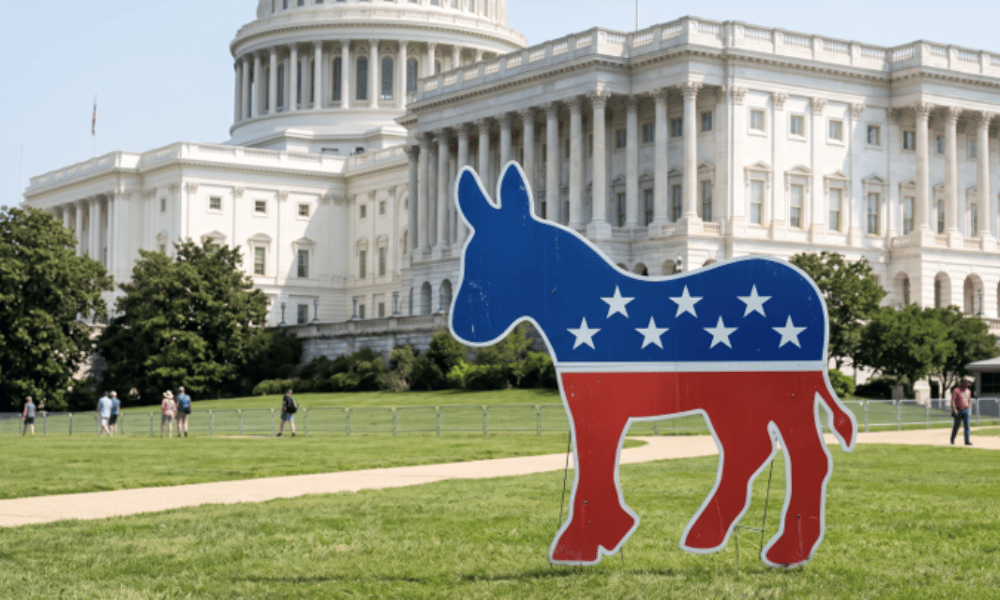
Democrats swept both chambers of Congress Tuesday night, flipping the House and Senate in the most significant midterm rebuke of a sitting president in recent memory.
The results carry immediate implications across technology stocks, AI infrastructure, bond markets, the dollar, and broader portfolio strategy. US stock futures are trending higher early Wednesday as investors digest the impact of the election result.
The clearest immediate winner was fixed income with the yield on the benchmark 10-year U.S. Treasury bond down 4.7 basis points to 4.918% by 5am ET, while the two-year bond yield dropped 3.7 basis points to 4.597%. The dollar weakened 0.5% against a basket of six major currencies.
Matthew Ryan, Head of Market Strategy at global financial services firm Ebury, told InvestmentNews that the election result is mildly bearish for the greenback. "A Democratic Congress is likely to rein in Trump’s fiscally expansionary agenda, easing deficit concerns and taking some of the heat out of the Treasury sell-off. Lower yields could narrow the rate advantage that has propped up the dollar, while calmer bond markets may sap the safe-haven flows that have supported it in recent months," he said.
But Ryan added that the result is not a gamechanger: "Democrats can put a brake on Trump’s fiscal agenda, but with his veto intact and a two-thirds Senate majority unlikely to override it, Congress can block new spending but cannot unwind what is already in place. Yields are also unlikely to fall far while the Iran war drags on. A Democratic Senate curbs Trump’s ability to install dovish Fed governors, though with few board seats set to open before the end of his term, the practical impact is small. The real fiscal test will be the debt ceiling negotiations in 2027.”
Democrats have already signaled they intend to scrutinize the tech sector directly.
Rep. Greg Casar, Democrat of Texas and chair of the Congressional Progressive Caucus, stated that "AI company CEOs should be called to testify under oath." Rep. Robert Garcia, Democrat of California and presumptive next chair of the House oversight committee, delivered a sharper message: "Lawyer up."
Texas is projected to overtake Virginia as the world's biggest data center market by 2030, according to commercial real estate firm JLL. Newly elected Texas Governor Gina Hinojosa has committed to forcing state lawmakers to regulate the AI data center industry - a potential headwind for data center REITs and utilities stocks tied to AI power demand.
Data centers have also been in President Trump’s sights. He recently urged developers to seek local backing by issuing “dividends” to residents. The president is keen that data centers should be built, calling them “Good for the USA.”
The election results added to uncertainty on Wall Street as investors weighed what a shift in Washington's balance of power could mean for taxes, government spending, artificial intelligence, Big Tech, defense, health care, banking, and cryptocurrency regulation.
According to a CNBC analysis of Federal Election Commission records, crypto, AI, and online gambling interests poured more than $377 million into races - most of it on the losing side. Advisors with clients holding digital asset positions should flag that a Democratic-controlled Congress is likely to pursue tighter crypto oversight. Focus has been on the safety of crypto exchanges following the recent Binance hack which saw more than $6 billion stolen from accounts.
George Efstathopoulos of Fidelity International views the midterms as a "clearing event" and considers it a good moment to gradually re-enter tech, arguing that fundamentals and prices have diverged. Michael Arone of State Street Global Advisors said that the bigger risk is not the election result itself but investors overreacting to it.
History offers some reassurance: an analysis by Wells Fargo & Co. found that the S&P 500 has risen in the 12 months following every midterm election in the post-World War II era. Near-term volatility, in other words, may not reflect the medium-term direction.
That said, a portfolio review is warranted. Technology and semiconductor exposure, AI infrastructure plays, data center REITs, and cryptocurrency positions all face a more adversarial regulatory environment than existed 48 hours ago.
Clients with significant holdings in any of these areas should be briefed proactively on what the political shift means for their strategy - before markets do it for them.

A four-advisor group from UBS joins Raymond James in Beachwood while a 36-year Cetera veteran moves his $390 million practice to LPL.

Bluespring, Robertson Stephens, Cetera and Aprio each close acquisitions as independent advisory firms weigh their next chapter.

The $71 billion firm’s latest tuck-in lands as middle-market sellers face rising buyer selectivity and steeper equity demands.

Executives allegedly sold while key revenue metric was inflated.

The advisor, Gregory W. Ricker, started his career in the securities industry in 1995.
Knighthead Life entered the market with a competitive MYGA. A strong launch earned advisor confidence and paved the way for FIAs.
As AI makes financial information more accessible than ever, Lana Hock explains why human judgment, trust, and empathy remain the qualities clients value most in a financial advisor

