
Goldman Sachs Group Inc. has effectively bowed to pressure from the continuing rally in U.S. stocks and abandoned its call for another steep sell-off.
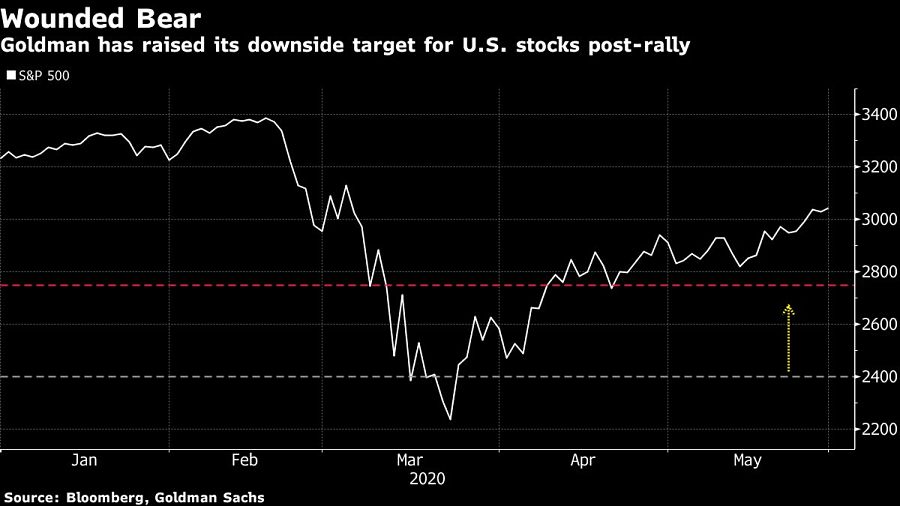
Strategists led by David Kostin have rolled back their prediction that the S&P 500 would slump to the 2,400 level -- over 20% below Friday’s 3,044 close -- and now see downside risks capped at 2,750. The U.S. equity benchmark could even rally further to 3,200, they wrote in a note Friday.
“The powerful rebound means our previous three-month target of 2,400 is unlikely to be realized,” the strategists wrote. “Monetary and fiscal policy support limit likely downside to roughly 10%. Investor positioning has oscillated between neutral and low and is a possible 5% upside catalyst.”
The shift came just after JPMorgan Chase & Co.’s strategists shifted in the other direction -- reining in their bullish outlook. JPMorgan’s Marko Kolanovic warned about rising U.S.-China tensions in a note Thursday.
Goldman’s strategists maintained their year-end target of 3,000 for the benchmark U.S. stock gauge.
Goldman continues to argue that short-term returns are skewed to the downside -- “or neutral at best” -- thanks to the risk of an economic, earnings, trade or political “hiccup” to the normalization trend. A broader participation in the rally would be needed for the S&P 500 to move meaningfully higher.
The S&P 500 has climbed 36% from its March 23 low, helped by massive fiscal and monetary support, mega-cap outperformance and optimism about the economy restarting, according to Goldman. Last month it argued that fear of missing out was a key driver of the rebound in stocks.

Ballast Rock Private Wealth has also brough on a veteran advisor focused on multigenerational planning for business owners and families

Edward Jones study finds caregivers to older adults spend $8,737 a year out of pocket in "generosity paradox" as savings, careers and health absorb the strain

The dispute apparently dates back to deals done ago during the time two advisors worked at Deutsche Bank Securities, or Alex. Brown.

The Pennsylvania-based recordkeeper is 'playing Switzerland' as data on 16 million savers will help plan advisors reach 401(k) participants at rollovers and retirement

A BCG report finds private credit and hedge funds driving CIB growth while AI reshapes bank operating economics through 2030.
Knighthead Life entered the market with a competitive MYGA. A strong launch earned advisor confidence and paved the way for FIAs.
As AI makes financial information more accessible than ever, Lana Hock explains why human judgment, trust, and empathy remain the qualities clients value most in a financial advisor

