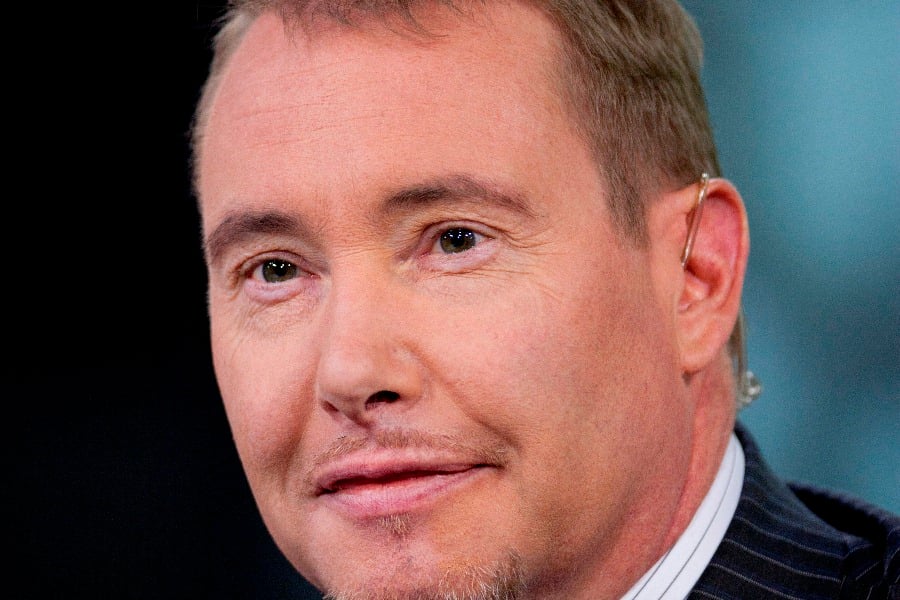
One of the market's biggest bears says there's more bad news ahead.
Falling commodity prices are signs of China's weakening economy, which will lead to more destabilizing devaluations of the yuan, Jeffrey Gundlach said Tuesday during a market outlook webcast. Moves by the
Federal Reserve to raise interest rates are fighting non-existent inflation and hurting gross domestic product growth, he said, adding that stocks are going to follow high-yield bonds down and low oil prices may lead to political instability.
“This is a capital-preservation market, not a money-making environment,” said Mr. Gundlach, co-founder of Los Angeles-based DoubleLine Capital. For economic growth, “2016 is not looking all that great, potentially.”
(More: Emerging markets now in bear territory)
Mr. Gundlach, whose $52.3 billion DoubleLine Total Return Bond Fund beat 94% of its Bloomberg peers last year, has been sounding warnings for months, saying the economy is too shaky for interest rate increases. Global growth might slow to 1.9% this year with U.S. manufacturing already in a
recession, he said on Tuesday's call, putting the odds of a
recession at about 50% if the services sector falls more.
BUYING OPPORTUNITY?
Stock markets are likely to keep struggling early in 2016 before a “buying opportunity” arises later in the year, Mr. Gundlach said. High-yield bonds also probably will fall more in the first part of this year as redemptions increase at hedge funds that used leverage to invest in them, according to Mr. Gundlach.
“We could be looking at a really ugly situation during the first quarter of 2016,” he said. “It's particularly more likely to happen if the Fed keeps banging this drum of raising interest rates against falling inflation.”
CHINA ROUT
Others also see things getting worse before getting better. The China-led rout that is sending shock waves through global markets may deepen, and if it does, that's when investors should turn back to equities, said Christian Mueller-Glissmann of
Goldman Sachs Group Inc. Further declines could create opportunities to invest, especially in Europe, the company's managing director for portfolio strategy said in an interview.
The Federal Reserve indicated in December that it may raise interest rates four times before the end of this year.
Rather than try to get out in front of the market for long-term debt, Mr. Gundlach said Tuesday that he plans to wait and see whether the 10-year Treasury rate goes up or down.
“You don't have to try to call a direction right now,” he said. “If it's going to move, it's going to move big and we're going to play a go-with-it strategy.”
LOW OIL PRICES
Oil prices, which fell to 12-year lows in the last week, seemed to hit a floor Tuesday and may climb back to $45 a barrel, Mr. Gundlach said. Such a price rebound still wouldn't be enough to save highly leveraged energy firms, which will lead to more credit defaults, according to Mr. Gundlach.
The outlook for corporate borrowers worldwide is the worst since the global financial crisis, according to Standard & Poor's. Potential downgrades by the ratings company exceed possible upgrades by the most since 2009, in percentage terms, according to a Jan. 11 report.
Low oil prices are likely to lead to more political instability in regions such as the Middle East, Mr. Gundlach said on Tuesday's call.
“Oil goes below $40, it's frightening for geopolitical behavior,” he said. “Guess what, folks? It's below $40 and this frightening political behavior is upon us. And, also, compounding the problem is that we have a lame-duck president, who I think will do absolutely nothing in response to military activity or other bad actors out there.”
President Barack Obama delivered his last State of the Union speech to Congress on Tuesday evening, after Mr. Gundlach spoke.
Commodities may be hitting a bottom as gold shows signs of rallying, the money manager said. Mr. Gundlach said he expects gold to reach $1,400 an ounce.
A year ago, he incorrectly predicted that the price of gold was likely to rise, one of the few forecasts he got wrong. In January 2015, Mr. Gundlach accurately predicted that oil prices would fall, Treasuries would be little changed, inflation wouldn't materialize and high-yield debt would face headwinds from lower commodity and energy prices.