
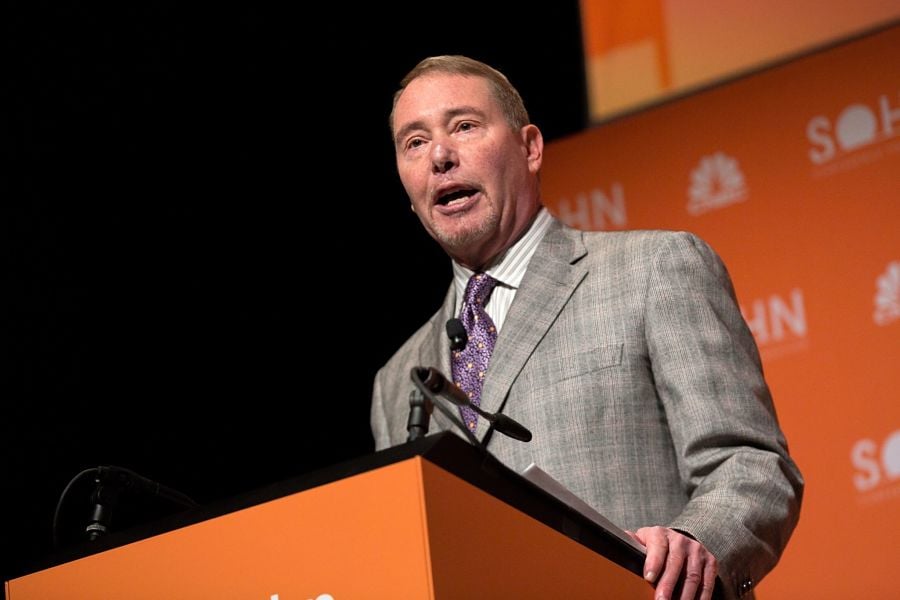
The S&P 500 Index is likely to surpass its March lows in April as economic uncertainty further riles investors, according to bond manager Jeffrey Gundlach.
“I think we’re going to get something that resembles that panicky feeling again during the month of April,” Gundlach, chief investment officer for DoubleLine Capital, said Tuesday during a webcast on the market and economic impact of the coronavirus pandemic.
The S&P 500 fell 12.5% in March, its worst monthly performance since October 2008. The gauge’s decline ended the longest bull market in history.
The U.S. is likely to follow Japan, Europe and emerging economy stock markets that haven’t rebounded to highs reached more than a decade ago, according to Gundlach.
“It won’t be back to where it was prior for a long time to come,” he said, “particularly on a real basis.”
Gundlach also said that it will take time — and sacrifice — for the U.S. economy to eventually grow stronger.
“We will get back to a better place, but it’s just not going to bounce back in a V-shape back to January of 2020,” he said.
Among his other comments:
• Projections by major banks that the U.S. economy will quickly recover from the coming recession are too optimistic.
• The current economy resembles a “depression.”
• The U.S.’s economic and monetary stimulus will likely reach $10 trillion.
• Unemployment will rise to 10%.
• The dollar is likely to weaken.
In his prior webcast on March 17, Gundlach said there may be a 90% chance of a U.S. recession this year, the national debt could grow to $30 trillion in two to three years and investors should prepare for “en masse” corporate debt defaults and downgrades. He later attacked government bailouts as plans to backstop “greed and mismanagement,” according to a March 19 Twitter post.
The $51 billion DoubleLine Total Return Bond Fund, Gundlach’s mortgage-focused flagship fund, lost 1.3% this year through Monday and returned an annual average of 2.6% over five years.

Goldman Sachs retirement survey finds 83% want guaranteed income, while the annuities providing that income increasingly hold private credit.

The AI meeting assistant's Advisor Intelligence plugin turns client conversation data into annual reviews, tax scans and attrition alerts.
Chuck Roberts and Stifel have been facing scrutiny due to sales of structured products and structured notes.

Among other updates, the proposals would let advisors to regulated funds earn performance fees and allow interval funds to offer monthly repurchases.

What will financial advice look like 20 years from now? Evan Vladem explores how AI may transform wealth management while reinforcing the enduring value of human guidance, trust, and empathy.
As AI makes financial information more accessible than ever, Lana Hock explains why human judgment, trust, and empathy remain the qualities clients value most in a financial advisor
Northern Trust’s Ken Lassner shows advisors how to convert volatility into after-tax portfolio gains

