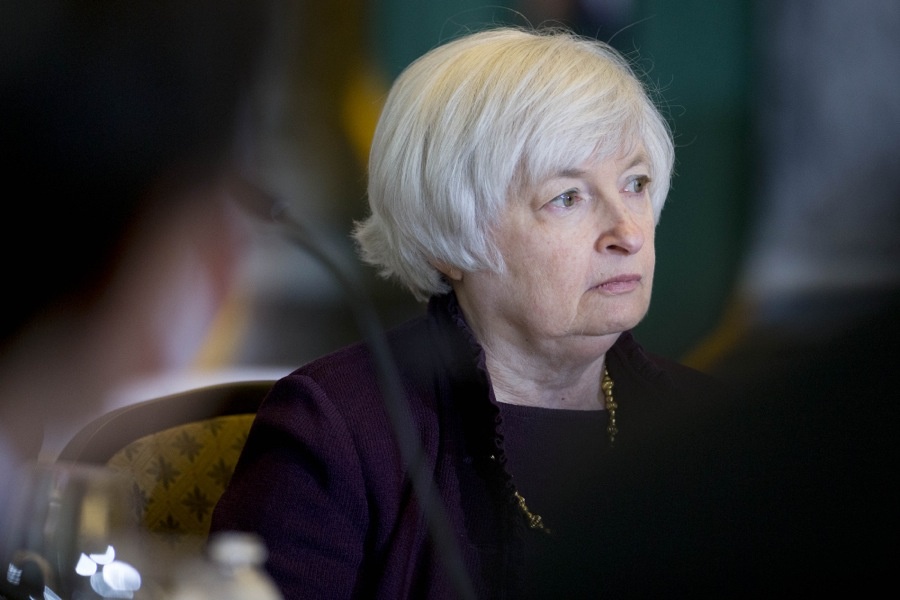
Federal Reserve chairwoman Janet Yellen said it is appropriate for U.S. central bankers to “proceed cautiously” in raising interest rates because the global economy presents heightened risks.
The speech to the Economic Club of New York made a strong case for running the economy hot to push away from the zero boundary for the Federal Open Market Committee's target rate.
“I consider it appropriate for the committee to proceed cautiously in adjusting policy,” Ms. Yellen said in the text of prepared remarks Tuesday. “This caution is especially warranted because, with the federal funds rate so low, the FOMC's ability to use conventional monetary policy to respond to economic disturbances is asymmetric.”
U.S. Treasuries extended gains following her remarks, while the dollar weakened and U.S. stocks erased earlier losses. The Standard & Poor's 500 Index was up 0.2% to 2,041.03 at 12:22 p.m. in New York, after falling as much as 0.4%.
“Yellen has doubled down on the dovishness from the March statement and press conference,” said Neil Dutta, head of U.S. economics at Renaissance Macro Research LLC in New York. “Global economic developments are cited very prominently.”
(Related read: Why the Fed must change course to stop the economy's downward trajectory)
ON HOLD
Fed officials left their benchmark lending rate target unchanged this month at 0.25% to 0.5% while revising down their median estimate for the number of rate increases that will be warranted this year to two hikes, from four projected in December.
Ms. Yellen said the FOMC “would still have considerable scope” to ease policy if rates hit zero again, pointing to forward guidance on interest rates and increases in the “size or duration of our holdings of long-term securities.”
“While these tools may entail some risks and costs that do not apply to the federal funds rate, we used them effectively to strengthen the recovery from the Great Recession, and we would do so again if needed,” she said.
Fed officials' quarterly economic forecasts for the U.S. didn't change much in March, while Ms. Yellen stressed in a March 16 press conference that their sense of risks from global economic and financial developments had mounted.
(Opinion: What happens if the Fed goes negative?)
Ms. Yellen mentioned two risks in her speech. Growth in China is slowing, she noted, and there is some uncertainty about how the nation will handle the transition from exports to domestic sources of growth. A second risk is the outlook for commodity prices, and oil in particular. Further declines in oil prices could have “adverse” effects on the global economy, she said.
Since the March meeting, Fed officials have seen more evidence that the pace of domestic growth may be slowing. U.S. gross domestic product decelerated to 1.4% pace in the fourth quarter, while the Atlanta Fed's GDPNow estimate for the first quarter is 0.6%, partly due to slower rates of consumer spending growth.
On the other hand, inflation measures have shown a trend of gradual firming. The personal consumption expenditures price index minus food and energy rose 1.7% for the year ended February, the fastest pace in three years.
Ms. Yellen said she was confident that inflation would gradually return to the Fed's 2% goal over time, while noting that the course of prices was a two-sided risk.