
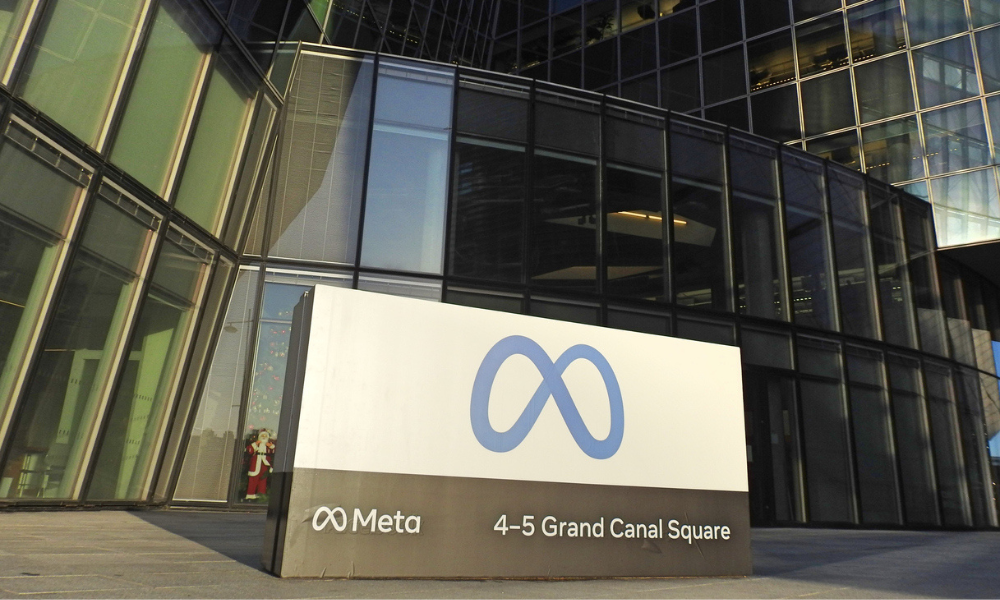
A registered investment advisor that aligns portfolios with Jewish values is urging Meta Platforms shareholders to back a proposal demanding the social media giant publish a detailed account of how it handles antisemitism and other forms of online hate on its platforms.
JLens wants shareholders to vote for Proposal 8 at Meta's annual meeting on May 27, which would require the company to produce a transparency report on its content moderation policies and their effectiveness, including ad policies, enforcement practices, and user protections.
The full text of the resolution reads:
"Shareholders request that Meta Platforms, Inc. prepare a report, at reasonable cost and omitting proprietary information, detailing the company's policies, practices, and effectiveness in addressing antisemitism and other forms of online hate on its platforms and services. The report should evaluate the adequacy of moderation, enforcement, user protection, ad policies, and transparency efforts, with findings made publicly available within one year."
Glass, Lewis & Co., the independent proxy advisory firm, has recommended shareholders vote in favor of the proposal.
A nearly identical measure JLens brought to Meta's 2025 annual meeting captured close to 47% support among the company's independent shareholders.
Ari Hoffnung, JLens managing director, is explicit that the campaign is rooted in material risk analysis as much as communal advocacy. With roughly 97% of Meta's revenues tied to advertising, he told InvestmentNews that content governance failures have a direct line to earnings.
"Content moderation failures have moved from a reputational concern to a concrete financial one — and Meta's numbers make the exposure hard to ignore,” he said. “With roughly 97% of Meta's revenues tied to advertising, any dynamic that erodes advertiser confidence or degrades the platform experience has a direct line to earnings. Meta's recent policy rollbacks coincided with a documented fivefold increase in antisemitic harassment on its platforms, according to ADL research. That's not an abstraction. It's the kind of brand-safety trigger that moves large advertisers.”
Hoffnung noted that Meta’s own 10-K acknowledges that damages and penalties across active legal proceedings could reach hundreds of billions of dollars. Researchers found the platform failed to remove 93% of the hateful and extremist content they flagged.
"Meta's inaction can expose millions of users to harmful content on its platforms and services every day," said Hoffnung. "In addition to the impact on society at large, this apparent and appalling lack of concern for hateful content has the potential to alienate users and advertisers. We believe the remedy is transparency, accountability and responsibility, and we urge shareholders to vote FOR Proposal 8."
Hoffnung points to the experiences of YouTube and X as documented warnings rather than hypothetical scenarios.
YouTube's 2017 "Adpocalypse" when major brands pulled advertising after discovering their ads appeared alongside extremist content, forced a wholesale policy overhaul. At X, content moderation changes following the 2022 ownership transition triggered an advertiser exodus and significant revenue declines, with market research showing roughly 25% of advertisers planning to cut spending further in 2025 over brand safety concerns. Active daily users in the UK fell from 8 million to 5.6 million in just over a year.
“For financial advisors, brand safety should not be treated as a secondary reputational issue. It is fundamentally a revenue sustainability question,” Hoffnung said. “Meta's advertising model depends on offering platforms that premium brands want to be on. Content governance failures put that at risk on both sides — advertisers pull back, and high-value users migrate to better-moderated alternatives. Over time, both dynamics can erode the long-term value of Meta’s core platform ecosystem.”
The campaign is part of a broader strategy JLens describes as "own and advocate" — holding shares in U.S. public companies and deploying shareholder advocacy tools rather than relying on divestment screens. JLens's Jewish Investor Network now includes 40 Jewish institutions representing $15 billion in communal capital.
"When nearly half of independent shareholders vote for a proposal that management opposes, the message is clear: investors are not satisfied with the level of transparency they're getting," Hoffnung said.
Investors can already see the mounting litigation, advertiser sensitivity around brand safety, and growing regulatory scrutiny. What they still cannot assess from Meta's public disclosures, he argues, is whether the company's content moderation practices are actually working.
But he says that regulators are moving in the same direction: the EU's Digital Services Act is already generating enforcement actions with fines tied to a percentage of global revenue, and US state litigation is accelerating.
“When regulatory scrutiny, litigation exposure, and advertiser sensitivity all move in the same direction, institutional investors can no longer afford to treat these issues as peripheral concerns,” he said. “Content governance is becoming a standard element of platform company due diligence, particularly for companies whose business models depend heavily on advertising, user engagement, and public trust.”
JLens has filed a Notice of Exempt Solicitation with the Securities and Exchange Commission laying out the rationale behind the proposal.

The Carmel, Indiana RIA grew nearly 150% in assets since severing ties with its first backer following a FINRA dispute.

Meanwhile, Raymond James' employee arm adds a defector from D.A. Davidson, and South Carolina-based RIA Ballast Rock Private Wealth recruits a new advisor.

A FINRA arbitration panel sided with a former wealth manager fired over a $642 deli platter and a disputed client event.

From disruptive AI to a looming advisor shortage and an impending migration of clients amid the Great Wealth Transfer, every headline of crisis hides an industry-defining opportunity.

New ICI research shows savers approaching retirement are most likely to ditch the glide path for a more personalized approach.
As $84 trillion prepares to change hands, advisors who treat estate planning as peripheral are quietly building a sieve, not a book.
In volatile markets, the advisors who win aren't the ones with the best calls - they're the ones whose clients stay the course.

