

Retirement savers entered 2022 with average 401(k) balances at a record high. In just a few weeks, the return tables have reversed on many of the largest retirement funds.
A look at the 15 largest funds held in 401(k) plans, as measured by data firm BrightScope Inc., shows that only one has a positive return — barely — for the year as of Feb. 17. The top performer, Dodge & Cox Stock, is up 0.3%. At this time last year, only one of the 15 was negative, the Vanguard Total Bond Market Index Fund, down 1.8%.
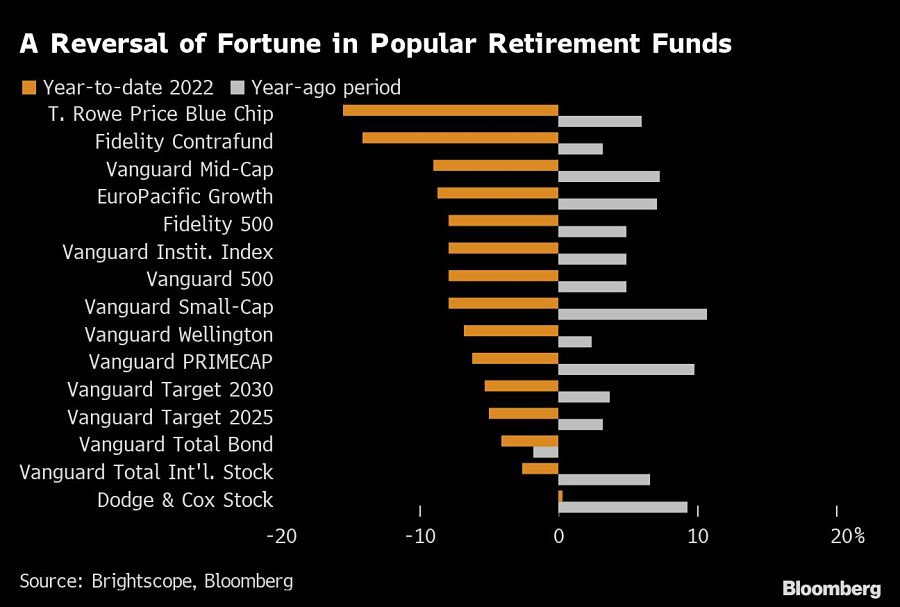
Dodge & Cox Stock’s 0.3% gain is a far cry from its performance at this time last year, when it was up 9.3%. That made it the third-best performing fund of the bunch back then, after Vanguard PRIMECAP’s 9.8% return and Vanguard Small-Cap’s nearly 11% gain.
Dodge & Cox Stock takes a far more value-oriented approach than many of the largest equity funds in 401(k)s. While it has a big slug of financials, it also contains a hot technology stock among its top 10 holdings — Alphabet Inc. is its third-largest position, at 3.8% as of Dec. 31. The fund’s largest positions are Wells Fargo & Co., at 4.3% of assets, and Charles Schwab Corp., at 4.2%.
The biggest loss so far this year among the retirement fund giants? That’s in the T. Rowe Price Blue Chip Growth Fund, which is down 15.5%. It’s taken a hit from its exposure to large tech companies, which are all in the red as the prospect of Federal Reserve rate hikes makes the future earnings of growth stocks less appealing. The fund's top five holdings are Microsoft Corp., Amazon.com Inc., Alphabet, Apple Inc. and Meta Platforms Inc., all of which are down more than 5% this year, with Meta slumping nearly 40%.
The average 401(k) balance at the beginning of the year was $130,700, according to the latest data from Fidelity Investments.

Deal creates a $20B-plus custody platform for private market investing in IRAs, months after Schwab closed its Forge Global purchase

Cullen marks the fourth firm the New York-based RIA aggregator has bought in 2026 as deal volume heads for a record year.

The quality of AI ROI measurement depends on pre-deployment decisions around business outcomes, leadership alignment, and establishing trusted information, among other factors.

A state-by-state analysis of retail investor behavior reveals AI-powered research tools are reshaping how clients approach investment decisions.

LPL picks up $1.1B from Wells Fargo's independent channel as the wirehouse gains a $410M family team from UBS.
Knighthead Life entered the market with a competitive MYGA. A strong launch earned advisor confidence and paved the way for FIAs.
As AI makes financial information more accessible than ever, Lana Hock explains why human judgment, trust, and empathy remain the qualities clients value most in a financial advisor

