Growth at the biggest tech companies is slowing at the same time criticism of Silicon Valley's monopolistic tendencies is rising
There are two companies in the history of American business that have been worth a trillion dollars. First came Apple Inc., which crossed into thirteen-figure territory on Aug. 2. It stayed there for exactly three months, before closing the trading day on Nov. 2 valued at a paltry $986.6 billion. Next was Amazon.com Inc., which spent a portion of a single day in early September as a trillion-dollar concern.
The milestone served as a reminder of how much the technology industry has come to dominate the economy — and capped a remarkable, decade-long run that ushered in sweeping changes in American business and society.
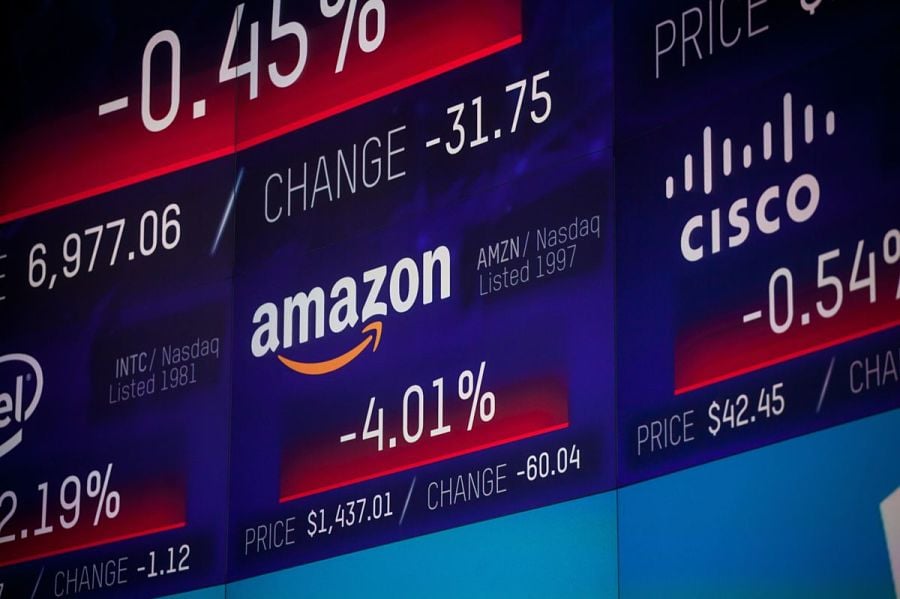
But Silicon Valley's recent downtick raises the possibility that the industry may have come over the summit. Apple has lost about 20% of its market value since its peak; Amazon is down 26%.
On Monday alone, Apple's shares shed 4% of their value. (Amazon's were down 5%.) Wall Street has also been punishing the other giants of the American technology industry this fall, with Alphabet Inc. down about 20% from its peak, and Facebook down twice that much. Microsoft Corp. shares have dropped 10%.
It's not just a quirk of market dynamics. Growth at the biggest tech companies is slowing. When it last reported quarterly performance earlier this month, Apple said it would no longer release numbers about how many iPhones it sells, a sure sign it planned to sell fewer of them.
Amazon's online retail business has slowed for four consecutive quarters, and in October it warned investors of a relatively subdued holiday season. Prime membership growth has also stalled. Facebook's main social network has slowed considerably, and has been relying increasingly on other services it owns, like Instagram, for growth.
Brian Wieser, a senior research analyst at Pivotal Research Group, said in a report earlier this month that Facebook's and Google's ad businesses were approaching a saturation point. The overall proportion of Americans using the internet and social media stopped growing two years ago, according to the Pew Research Center.
Now's a good time to pause and acknowledge that predicting a pending tech shakeout has been a tremendous way to be dead wrong over the last few years. In 2012, smart people warned that Facebook would be laid low by its inability to adapt to smartphones, and argued that Apple's growth was running into some basic limits of economics. That year, journalists, business people, and economists debated whether the industry was in a bubble — then kept doing so all the way through 2013, 2014, 2015, 2016 and 2017.
Big Tech continues to be phenomenally successful by any tangible standard, said Crawford del Prete, chief operating officer of research firm IDC. There just haven't been many companies as impactful as Apple, Amazon, or Alphabet's Google. It was always inevitable that sales growth at companies of this size would slow.
"The undercurrent of all this is that people need to get their stupid expectations under control," Mr. del Prete said.
Of course, publicly traded companies are beholden to the expectations of Wall Street, no matter how stupid they are. For Silicon Valley businesses, there's bound to be tension between the need to find new ways to wring profits out of their operations, and the new demands that they address the responsibilities that come with being some of the most powerful institutions on earth.
Not coincidentally, tech's increasing dominance has corresponded with growing uneasiness about the power tech companies hold over the global economic, cultural and political systems. As Big Tech has grown, so has criticism about Silicon Valley's monopolistic tendencies, its distorting effects on democracy and civil discourse, and the job-killing efficiency of its products.
While there hasn't yet been any significant new regulation on American technology companies, the appetite for it is increasing. In Europe and the U.S., there have been calls for antitrust action to keep technology companies from using their market power to enter new business lines in dominant positions.
Mr. Del Prete said he expects that large, cash-rich tech companies will look to make more acquisitions as their own businesses mature, pushing them further into tense political situations.
"These companies have mostly been praised for changing the world," he said. "I think the next chapter is going to be antitrust."
President Donald J. Trump has already hinted at skepticism of the market power amassed by Google and Amazon, but no firm plan for real movement on antitrust has emerged.
A confrontation with large corporate interests during a time that Republicans control the presidency and the Supreme Court would be unusual, said David Yoffie, a professor at Harvard Business School and the co-author of "The Business of Platforms," a forthcoming book about business strategy in the age of Big Tech.
Mr. Yoffie thinks the primary front of the conflict will more likely be across the Atlantic.
"The pressure in Europe probably does increase if the economy does turn down, because companies Google is competing with are under enormous pressure," he said.
Regulations on privacy or disinformation would almost certainly squeeze tech's traditional profit centers, as would any preemptive actions tech firms take to forestall it.
Facebook, for example, has been hiring thousands of additional content moderators to address misinformation. David Wehner, the company's chief financial officer, also said this summer that increased user control over privacy could lead to lower revenue growth at the company.
And some moves to find new areas for growth have the potential to increase controversy. Reports about Google's plans to cooperate with Chinese censors as a price of being able to build a search engine to serve the Chinese market led to a wave of employee resignations, echoing earlier employee discontent with the company's work on an artificial intelligence system to aid the U.S. military.
The seeds of these tensions were planted during Silicon Valley's rise. In part, it is a coincidence that they are boiling over just as the markets seem to be turning. But a growing economy has served to paper over tensions that will emerge in tighter times.
Matt Stoller, policy director at the Open Markets Institute, a group pushing for aggressive antitrust action, said that the fight over Big Tech's power seems to be just beginning.
"Wile E. Coyote has run off the cliff," he said. "He hasn't looked down yet."
(More: Faced with market rough patch, stock pickers fail to shine)