
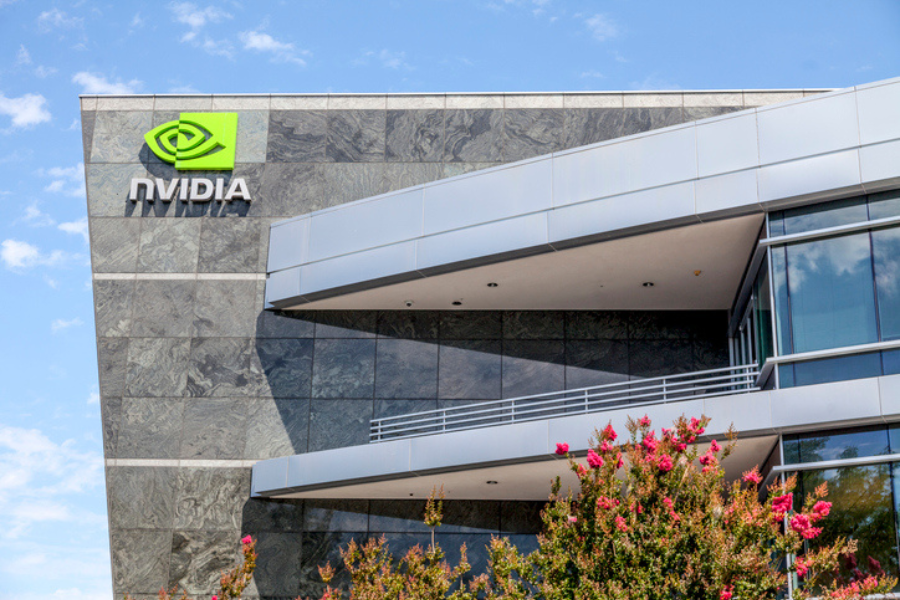
Nvidia has claimed the top spot in the Wall Street Journal's inaugural Best Companies for the Future ranking.
The ranking, compiled by Bendable Labs for the Journal’s Leadership Institute, scored all S&P 500 companies across 30 metrics in six categories: AI readiness, innovation, talent readiness, financial fitness, supply-chain resilience and corporate agility. Nvidia topped the AI readiness, financial fitness and agility sub-rankings outright, with Alphabet, Microsoft, Meta Platforms and Cisco Systems completing the overall top five.
While WSJ announced its rankings over the weekend, Nvidia itself was making its own announcement.
The company has entered into a partnership with South Korea's LG Group to build an AI factory spanning robotics, autonomous driving, data centre technologies and GPU cloud services — connecting model development, robot simulation, edge deployment and factory-scale digital twins into a unified workflow.
But despite the glowing accolade and partnership announcement for the chipmaker, a selloff for the chip market Friday highlights how even those at the top of their game can be hit by external forces. The pullback by investors erased around $1.3 trillion in market value across US-traded semiconductor stocks, triggered by a weak quarterly report from Broadcom (itself ranked only 110th in the WSJ index despite its size).
The PHLX chip index slumped 10.3% on Friday, its steepest single-day decline since March 2020. Nvidia fell around 6%, while Advanced Micro Devices — 16th in the WSJ ranking — lost almost 11%. Micron tumbled 13%.
"The semiconductor sector was way overbought. That's why we're seeing the sell-off. I don't think it's the end of the (semiconductor) bull market," Ohsung Kwon, chief equity strategist at Wells Fargo told Reuters.
The Wall Street Journal rankings has Equinix leading the innovation ranking ahead of Nvidia and Microsoft. Texas Pacific Land tops financial fitness, ahead of Nvidia and Alphabet. Delta Air Lines heads talent readiness despite ranking only 103rd overall. Moderna leads on resilience, followed by Amgen and Marsh & McLennan. Intel takes second place on AI readiness behind Nvidia, with Alphabet third.
Financial sector names also break through the overall top 25: Mastercard ranks seventh, S&P Global thirteenth and Visa fifteenth, while drugmakers Johnson & Johnson and Eli Lilly take the 20th and 22nd spots.
Bendable chief data scientist Kelly Tang noted the overall results broadly align with market valuations.
"If our general drift is in line with what the stock market is saying — that these are the most valuable companies — great," Tang said.

Meanwhile, DPL Financial Partners adds two annuity executives and Prime Capital Financial hires a Mid-Atlantic retirement plan consultant

Andrew Komarow pleaded guilty Thursday in federal court in Hartford to defrauding three financial services companies of close to $3.3 million.

Elsewhere, Cetera picks up a $210 million Connecticut team from MML, while Wells Fargo FiNet adds a San Diego family practice from LPL

Celebrity endorsements, $500M in claimed assets, and a state regulator stepping in.

“We needed to become a more agile and efficient organization,” said American Express CEO Stephen Squeri.
Knighthead Life entered the market with a competitive MYGA. A strong launch earned advisor confidence and paved the way for FIAs.
As AI makes financial information more accessible than ever, Lana Hock explains why human judgment, trust, and empathy remain the qualities clients value most in a financial advisor

