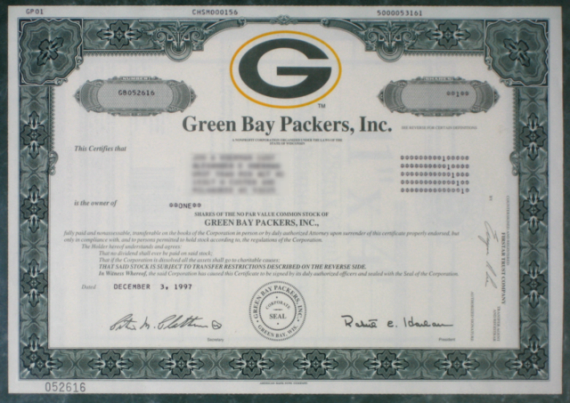
The Green Bay Packers have proven once again that devoted sports fans will do almost anything if it makes them feel more devoted.
In the most recent example of investors not reading the fine print, the professional football franchise is selling 250,000 shares of “stock” at $250 per share as a way to help finance a $143 million upgrade to the Packers home stadium, Lambeau Field.
As if the notion of multimillionaire players and owners asking fans for financial support isn't bizarre enough, the truly crazy part is that the “stock” isn't stock at all.
In fact, each share amounts to nothing more than a fancy certificate, ideal for framing and a perfect holiday gift for the sports fan on your list.
Unlike traditional stock that might pay dividends or fluctuate in value, or actually trade on an exchange, the Green Bay stock does absolutely nothing at all.
The
offering document explains that the “stock” does not constitute an investment. It can't be sold or traded, and the Green Bay Packers will never buy it back.
“It's a joke to most of us financial advisers,” said Chad Karl, and lifelong Packers fan and owner of Karl & Associates, a $125 million advisory firm.
Mr. Karl, who grew up “17 minutes from Lambeau Field,” sees the stock sale for what it really is — a celebrated donation that doesn't even come with a tax deduction.
“It would be great if I could do something like that and get my clients to pay for my building,” he said. “I suppose if you have $250 burning a hole in your pocket there are worse things you can do with your money, but I'd rather spend my money buying a ticket to a game.”
Judging by the initial response to the stock sale, fans like Mr. Karl are in the minority.
According to published reports, more than 185,000 shares sold during the first 48 hours of the sale, which kicked off on Dec. 6.
The sale is scheduled to remain open through the end of February.
The Packers are considered the only publicly owned team in the NFL, even though the shares have almost no public market value.
This is the fifth stock sale in franchise history by the defending Super Bowl champion team, with the last sale held 15 years ago.