
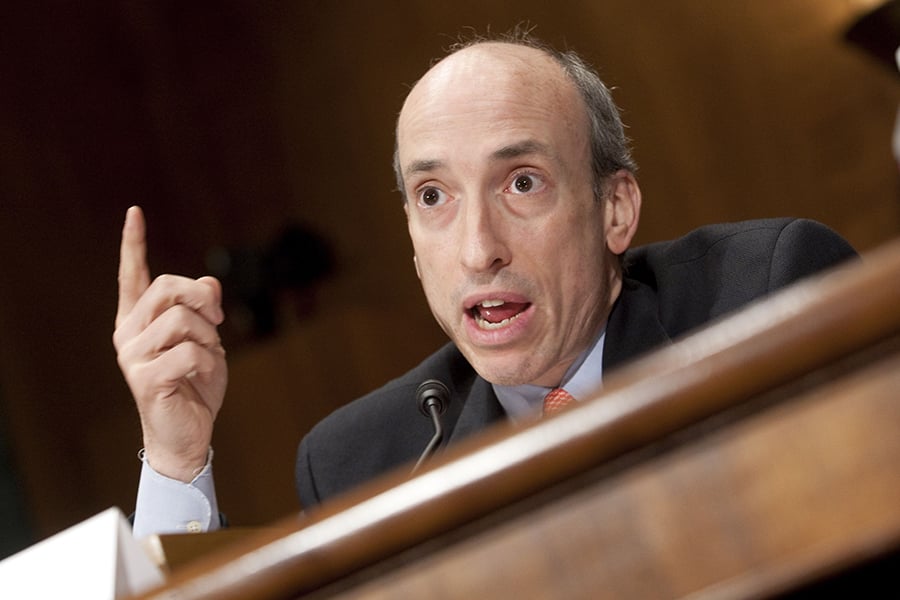
Securities and Exchange Commission Chair Gary Gensler has a warning about the synthetic stocks popping up on blockchains: Firms selling the tokens to U.S. investors are likely to end up in trouble with regulators.
In a Wednesday speech, Gensler made it clear that tokens that mirror the performance of Amazon.com Inc., Tesla Inc. and other well-known companies are probably still covered by U.S. securities laws.
He also pledged to use all the resources in the SEC’s “enforcement toolkit” to go after those who might be offering such assets without registering them.
“It doesn’t matter whether it’s a stock token, a stable value token backed by securities or any other virtual product that provides synthetic exposure to underlying securities,” Gensler said at an event held by the American Bar Association. “These platforms -- whether in the decentralized or centralized finance space -- are implicated by the securities laws and must work within our securities regime.”
Gensler’s comments referenced what’s known as DeFi, a fast-moving corner of the cryptocurrency market where tokens that track the performance of huge companies have started emerging. The trading has triggered regulatory scrutiny that’s prompted some in the industry to pull back. Cryptocurrency exchange Binance Holdings announced last week that it was phasing out support for tokens linked to equities.
Gensler has repeatedly said that cryptocurrencies need more oversight. In May, he told a House panel that he was looking forward to working with Congress and other regulators “to fill in the gaps of investor protection.” He added that digital token exchanges were ripe for additional rules and urged lawmakers to pass legislation giving the SEC authority to police the trading venues.

CFP, CFA and CPA holders could gain accredited investor status as regulators weigh wider private market access for advisory clients

DeepVest, Vanilla and Libretto roll out tools to help financial advisors launch firms, close estate plans and sharpen planning skills

“People aren't effectively using their wealth in retirement,” said David Blanchett of Prudential.

Second-generation NFL ref Shawn Hochuli co-founded IWM Partners in Irvine, California, a wealth management practice with more than $500M in client assets

U.S. seniors lose $28.3 billion annually as a result of financial exploitation, according to a 2023 AARP study.
As AI makes financial information more accessible than ever, Lana Hock explains why human judgment, trust, and empathy remain the qualities clients value most in a financial advisor
Northern Trust’s Ken Lassner shows advisors how to convert volatility into after-tax portfolio gains

