

Manufacturing data last week from China hinted at a small respite for the nation’s ailing economy, which has struggled to grow amid a property crisis, high unemployment for young workers, and myriad other problems.
But any positive signs in the near future might not be enough to persuade US investors, as it’s not clear whether China is set for years of stagnation, and economists can’t seem to agree on the outlook.
In March, Goldman Sachs Wealth Management’s chief investment officer and head of the investment strategy group, Sharmin Mossavar-Rahmani, told Bloomberg that even though clients are interested, the company was advising them not to invest in China given numerous factors, including a lack of reliability in the country’s economic and policy data. Economists generally don’t predict a strong comeback from a country’s post-pandemic slowdown, although some are more optimistic about China achieving moderate growth than others.
Even ahead of manufacturing sector data last Monday from the purchasing managers index that showed increased production and purchasing levels, net outflows from Chinese equities had declined as some global fund managers began adding stocks back into their portfolios.
That isn’t necessarily an indication that investors should get in now and buy at a low point, and some advisors recommend proceeding with caution even at the best of times.
“From the time people were selling everything to get in on the China train way back, I have said I will not touch any security from that country. Folks forget it’s still a Communist country, and you cannot trust any of the numbers that come out of there,” Kashif Ahmed, president of American Private Wealth, said in an email. “How are you going to do due diligence and valuation of securities when you cannot, in all honesty, have faith in the integrity of those financials? Stay away. [There are] plenty of great investment opportunities right here in the USA.”
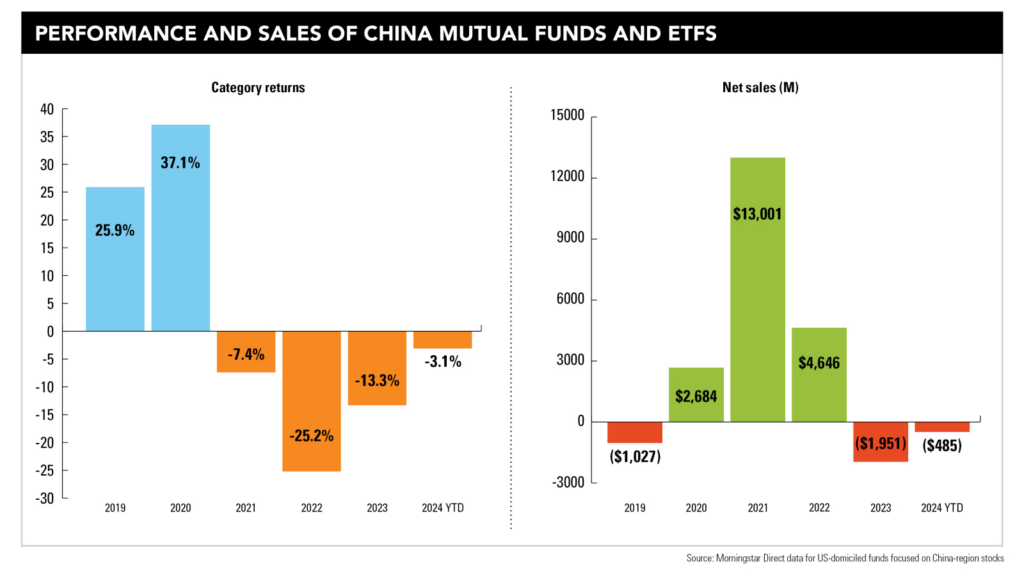
Amid the COVID-19 pandemic, the performance of US funds focused on Chinese holdings took a dive. Across the US-domiciled funds and ETFs that invest the majority of their assets in stocks based in China, Taiwan, or Hong Kong, average annual returns went from 37 percent in 2020 to -7 percent in 2021, -25 percent in 2022, -13 percent in 2023 and -3 percent year to date in 2024, according to data from Morningstar Direct.
Fund sales were slow to react, remaining net positive until last year, when the category bled about $2 billion. In the first two months of 2024, $485 million has poured out, the Morningstar data show.
Of 37 US ETFs focused on China, the average flow this year has been -$26 million, excluding products that are closed to new purchases or that registered no net sales, according to data from VettaFi. A big reason for the net outflows is redemptions from one product, the $4.9 billion iShares MSCI China ETF, which has bled $820 million year to date but is nonetheless the second-biggest ETF in the category. The largest, the $5.4 billion KraneShares CSI China Internet ETF, has had slightly lower returns than the iShares MSCI China ETF this year, at -2.8 percent versus -2.5 percent, but it has seen nearly $158 million pour in.
The recent difference in sales of the two funds may come down to demand for tech-related stocks as opposed to other categories in the Chinese market, like financials and industrials, said Todd Rosenbluth, head of research at VettaFi.
“There seems to be a fair amount of debate about whether it’s actually a good time to start buying,” he said.
Excluding the iShares MSCI China ETF, average net sales for ETFs in the category so far this year are positive, at about $1 million, the VettaFi data show.
“The flows have been stronger than one would expect, given how poor the performance has been,” Rosenbluth said.
Including the iShares MSCI China ETF, average net sales for the category have been -$73 million over a year. But over three and five years, sales were positive, at $520 million and $576 million.
The poor performance of China-based equities as a whole has brought down returns for funds in the emerging markets category, as the country represents one of those funds’ largest components, Rosenbluth noted. That appears to have fueled demand for emerging markets ETFs that exclude Chinese holdings, as returns and sales for those have been stronger, he said.
Further, the list of US ETFs that invest in Chinese holdings offer different types of exposure, as some trade in mainland China rather than Hong Kong, and they diverge on holdings of state-owned versus privately owned enterprises, he said. One ETF, the $356 million WisdomTree China ex-State-Owned Enterprises Fund, focuses on companies not owned by the government, for example.
“There is government control of some of the companies, and for some people that’s a good thing, for others it’s something you want to avoid and exclude, because there’s not broader shareholder rights,” Rosenbluth said. “I’m not a believer that you should just buy the cheapest, but in the Chinese ETF market or the market investing in Chinese equities, the devil is often in details.”
Chuck Roberts and Stifel have been facing scrutiny due to sales of structured products and structured notes.

What will financial advice look like 20 years from now? Evan Vladem explores how AI may transform wealth management while reinforcing the enduring value of human guidance, trust, and empathy.

The Boston deal is set to push the PE-backed consolidator past $187 billion amid a broad RIA M&A slowdown and a potential shift in its ownership.

Advisors with clients who own second homes in New York City face fresh uncertainty as the city seeks a stay and plans an appeal.

Meanwhile, a deal in the Midwest gives NorthRock Partners a new office in Wisconsin, while two teams join OnePoint BFG in Georgia and Atlanta.
As AI makes financial information more accessible than ever, Lana Hock explains why human judgment, trust, and empathy remain the qualities clients value most in a financial advisor
Northern Trust’s Ken Lassner shows advisors how to convert volatility into after-tax portfolio gains

