
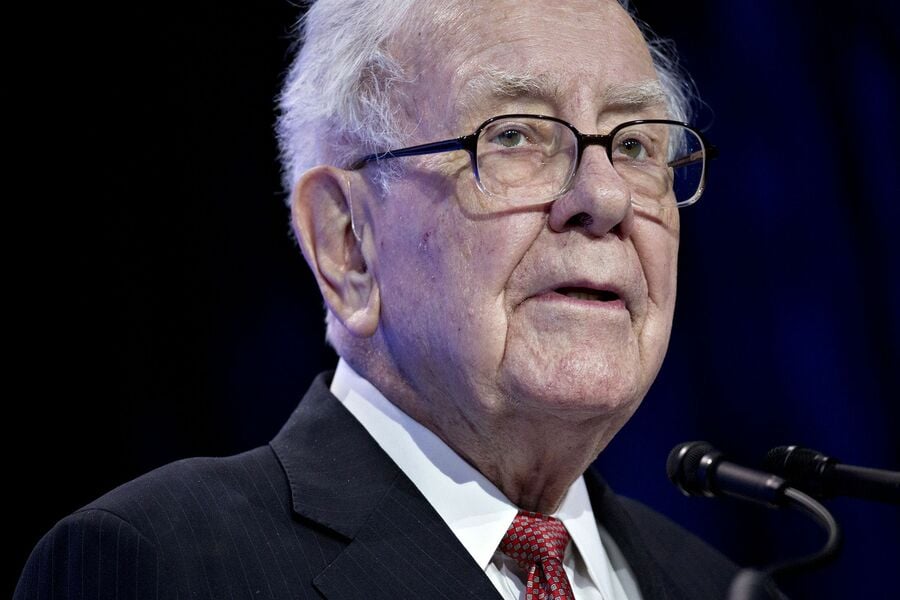
Warren Buffett, the legendary investor and longtime leader of Berkshire Hathaway, has announced he will step down from his role as the company’s chief executive at the end of the year, marking the end of an era for one of America’s most closely watched conglomerates.
In a letter pubilshed Monday, Buffett, 95, said he will no longer write Berkshire’s annual report or speak at the company’s marathon annual meetings.
“As the British would say, I’m ‘going quiet,’” Buffett wrote, before adding, “Sort of.”
He confirmed that Greg Abel, currently vice chair overseeing Berkshire’s non-insurance businesses, will take over as CEO at the end of the year. Buffett described Abel as “a great manager, a tireless worker and an honest communicator,” and wished him “an extended tenure.”
Buffett’s announcement was accompanied by news that he had converted 1,800 Berkshire Hathaway A shares into 2.7 million B shares, which he donated to four family foundations, including the Susan Thompson Buffett Foundation and the Sherwood Foundation. Based on recent market prices, the value of these shares is estimated at around $1.35 billion .
Reflecting on his decades at the helm, Buffett’s letter was characteristically personal, recalling his Omaha roots, early brushes with mortality, and the influence of friends and colleagues such as his former partner Charlie Munger, Stan Lipsey, and Don Keough. He credited much of his and Berkshire’s success to the company’s Midwestern base, writing, “The center of the United States was a very good place to be born, to raise a family, and to build a business.”
Buffett also addressed the realities of aging and succession, acknowledging that “Father Time, to the contrary, now finds me more interesting as I age. And he is undefeated; for him, everyone ends up on his score card as ‘wins.’” He noted that while he generally feels good and remains active in the office, his unexpected longevity has required him to accelerate the pace of his charitable giving and finalize succession plans.
Elsewhere in the letter, the Oracle of Omaha warned about the risks of cognitive decline at the top of large organizations, writing how CEOs of parent or subsidiary companies will inevitably "succumb to dementia, Alzheimer’s or another debilitating and long-term disease.
"The Board must be alert to this possibility at the CEO level and the CEO must be alert to the possibility at subsidiaries," he said, alluding to the urgent need for succession planning at the highest levels. "Directors should be alert and speak up is all that I can advise.”
Turning to Berkshire’s future, Buffett expressed confidence in Abel’s leadership and the company’s prospects. “Greg Abel has more than met the high expectations I had for him when I first thought he should be Berkshire’s next CEO,” Buffett wrote.
He emphasized that Berkshire’s businesses have “moderately better-than-average prospects, led by a few non-correlated and sizable gems,” but acknowledged that the company’s size means “there will be many companies that have done better than Berkshire” in the coming decades.
Over the six months since Buffett first teased his plans to step down, Berkshire's stock has dipped by roughly 5%, compared to the 20% gain for the S&P 500 over the same period.
He also commented on how efforts to increase transparency around executive compensation have backfired. He pointed to well-meant efforts at shaming companies into divulging CEO pay compared to average employees, which led to 100-plus page proxy statements, compared to less than 20 pages previously.
"Based on the majority of my observations – the CEO of company 'A' looked at his competitor at company 'B' and subtly conveyed to his board that he should be worth more," he wrote. "Of course, he also boosted the pay of directors and was careful who he placed on the compensation committee."
Buffett closed with advice for shareholders and a broader audience, urging readers not to dwell on past mistakes and to “get the right heroes and copy them.”
“When you help someone in any of thousands of ways, you help the world," he said. "Kindness is costless but also priceless.”

MyComplianceOffice's AI-assisted surveillance links employee chats on Slack and Telegram with prediction market trades as Wall Street tightens rules

Elsewhere, Raymond James absorbs a family-run practice from Commonwealth into its independent channel, while RBC welcomes a father-son tandem formerly from UBS.

Fuel-driven inflation drove the supersized adjustment, but advocates say retirees are still losing ground as trust fund insolvency nears.

State mandates and plan complexity are opening doors for financial advisors in the 401 market.
New LIMRA data reveal a stubborn advice gap that financial professionals are well-positioned to close.
Knighthead Life entered the market with a competitive MYGA. A strong launch earned advisor confidence and paved the way for FIAs.
As AI makes financial information more accessible than ever, Lana Hock explains why human judgment, trust, and empathy remain the qualities clients value most in a financial advisor

