
Barclays Plc is axing nearly half of its U.S.-listed ETNs a year after revealing a paperwork error tied to its products that cost the bank hundreds of millions of dollars.
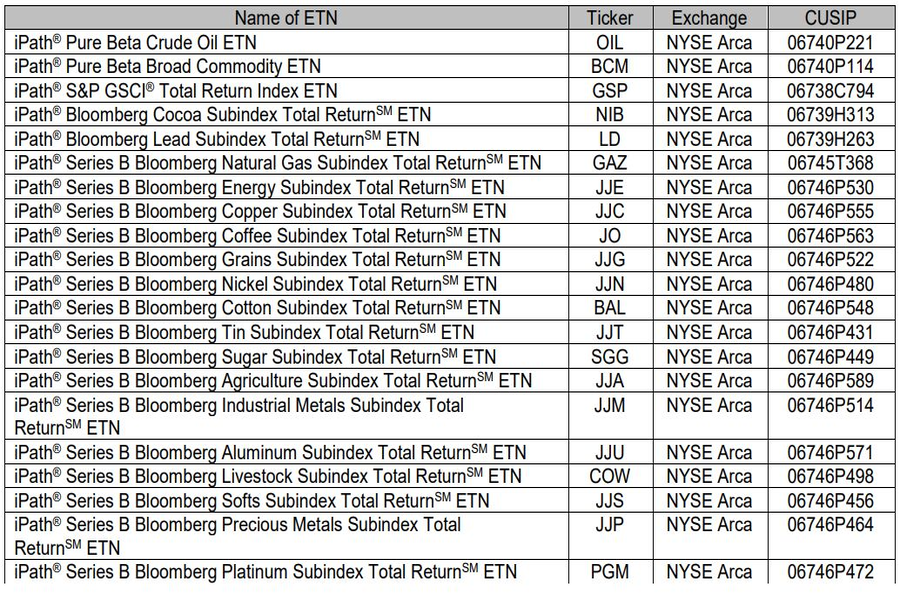
The U.K.-based lender announced Tuesday it will redeem 21 of about 50 exchange-traded notes in June. The $71 million iPath Series B Bloomberg Copper Subindex Total Return ETN (JJC) is the largest of the notes being closed, which hold around $533 million assets in total.
The redemption announcement comes less than 13 months after Barclays said it had erroneously sold $15 billion more structured notes and ETNs over the course of about a year than it had registered for. The bank was forced to suspend any further issuance — including for its biggest ETNs and then on the majority of its ETN lineup — as it worked to resolve the issue.
This prevented any new cash from entering the products, and disrupted the mechanism that kept note prices in line with the value of their assets.
“Barclays is focused on a core set of products and services that match client interest and demand. We are firmly committed to building a leading position in global equity exchange-traded products, which are a strategically important part of our Equities and Global Markets businesses,” a spokesperson for Barclays said about the redemptions.
The bank didn’t provide comment on whether the closures were linked to the issuance error in its structured note and ETN business.
“I’m not terribly surprised that they’re closing a lot of these,” Bloomberg Intelligence analyst James Seyffart said. “ETNs have been broadly out of favor in the U.S. for quite some time.”
The majority of the notes set to be redeemed are derivatives-based and track commodities. “Unfortunately, a bunch of these that are closing are the only ETPs available in the U.S. to bet on specific commodity subindexes, like coffee or sugar or cotton,” Seyffart said.
ETNs are a close cousin of exchange-traded funds, often lumped in with their more-popular relatives. The key difference is that ETNs are unsecured debt obligations which are backed by the bank that issued them, rather than the assets the product is linked to. In many eyes, this adds extra risk.
The Barclays blunder is one of several high-profile incidents that have helped make ETNs notorious in financial circles. One of the most famous saw Credit Suisse Group AG’s VelocityShares Daily Inverse VIX Short-Term ETN (XIV) — which was designed to profit in calm markets — at the heart of 2018’s “Volmaggedon” episode. The product was thought to have got so big that it helped fuel the volatility that wiped out almost all its own assets.
After a series of delistings and following a takeover by UBS Group AG, the future of Credit Suisse’s note business is now unclear. Alongside the Barclays redemptions, it suggests a period of extreme retrenchment for the ETN arena.
“In the U.S., the investments in ETNs has, overall, been declining for a number of years,” said Deborah Fuhr, founder of London-based research firm ETFGI. “Investors prefer the structure and benefits of ETFs.”
In the fallout from its issuance error, the Securities and Exchange Commission ultimately found Barclays had offered and sold approximately $17.7 billion of securities in unregistered transactions. The regulator’s head of enforcement described the scope of the conduct at issue as “simply staggering.”
The bank agreed to pay $361 million to resolve SEC charges. It was forced to offer to buy back affected notes, and said in a September filing that $7.7 billion of securities had been submitted for that so-called recission offer. The final cost of the entire episode is unclear.
“ETNs can be money makers for banks, but Barclays’ mistake was not only very expensive for them in dollar terms, but it also came at a big reputational cost,” said ETF Think Tank’s Cinthia Murphy.

Parents must still act to get the $1,000 federal seed and employer contributions, giving financial advisors a role in the rollout.

FINRA booted Rudy Anguiano from the industry for “conversion - the intentional and unauthorized taking of another person’s property.”

Notice 2026-62 also flags box spread ETFs and tax-aware fund trades as Treasury opens month-long consultation period.

Heartwood Wealth Advisors deal marks the serial acquirer's 36th-ever transaction as third-quarter RIA M&A volume slips 19%

The AI lab disclosed more than $8 billion in 2025 losses on an operating basis as financial advisors weigh a supersized listing likely to land past the midterms.
As AI makes financial information more accessible than ever, Lana Hock explains why human judgment, trust, and empathy remain the qualities clients value most in a financial advisor
Northern Trust’s Ken Lassner shows advisors how to convert volatility into after-tax portfolio gains

