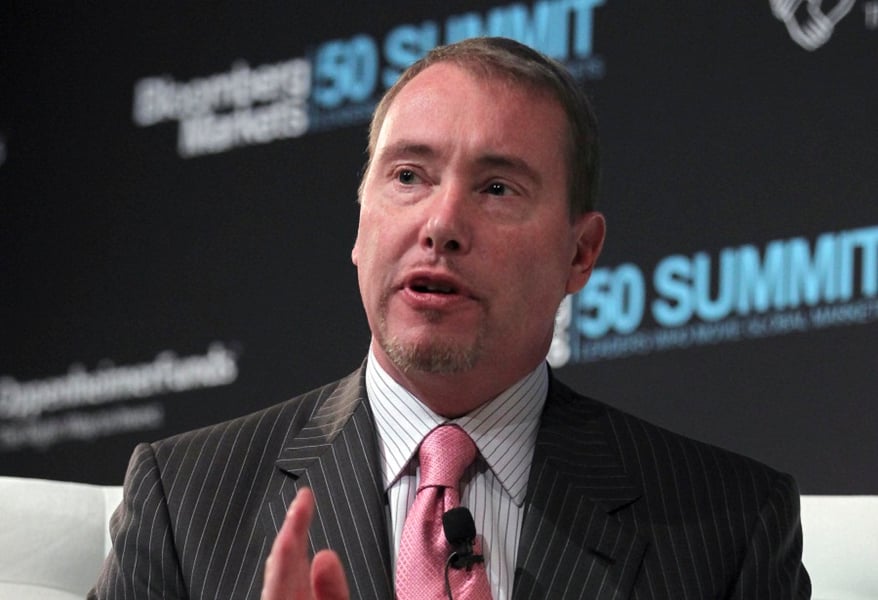
The last of the rock star portfolio managers is about to see how big his name really is.
The SPDR DoubleLine Total Return Tactical exchange-traded fund (TOTL) launched Tuesday. It will be managed by Jeffrey Gundlach, who also runs the DoubleLine Total Return Bond Fund (DBLTX), a top-performing mutual fund. TOTL is the 26th ETF to be launched this year, but it is possibly the most important as a test of whether active management can ever thrive inside the ETF industry.
Actively managed ETFs haven't exactly inspired investors. There are 120 of them with a total of $19 billion in assets. That may sound like a lot until you realize it's less than 1% of ETF assets. Even the ones with three-year track records of beating their benchmarks are struggling to attract investors.
A rare exception to the rejection of active management by ETF investors has been Bill Gross and the Pimco Total Return Bond ETF (BOND). BOND collected $1 billion in assets within three months when it came out in 2012—unheard of for an ETF. Assets eventually topped $4 billion. Mr. Gross
left Pimco in September of last year and is running a Janus mutual fund. BOND's assets are now a bit more than $2 billion.
Active management's struggle extends beyond ETFs. Index mutual funds took in $125 billion last year, while ETFs took in $243 billion. Meanwhile, actively managed mutual funds lost $52 billion, according to the Investment Company Institute.
(More: American Funds ready to double-down on active investing in 2015)
Mr. Gundlach's mutual fund has bucked those trends. Assets increased $10 billion last year to reach $44 billion in less than five years. His new ETF will invest mostly in U.S. investment-grade debt, though it can invest as much as 25% in high-yield debt and up to 25% in emerging markets.
Mr. Gundlach's ETF, like Pimco's BOND, costs investors 0.55% of assets; the retail class of Mr. Gundlach's mutual fund charges 0.73%. (ETFs can be a good way to fight back against high mutual fund fees.) But while cheaper than a mutual fund, TOTL is six times more expensive than popular aggregate bond ETFs, such as the iShares Core U.S. Aggregate Bond ETF (AGG) and Vanguard Total Bond Market ETF (BND). Both charge 0.08% in annual fees.
Mr. Gundlach will also contend with newer and more sophisticated fixed-income ETFs that have come out since BOND's launch. It's fitting that the
iShares U.S. Fixed Income Balanced Risk ETF (INC) comes out the same week as TOTL. It weights bond allocations by risk, with half the risk tied to interest rates and 50 percent to credit risk. INC charges 0.30% in annual fees.
Regardless of all the headwinds, a famous name can trump all sorts of challenges. Mr. Gross proved that. Now, can Mr. Gundlach?