

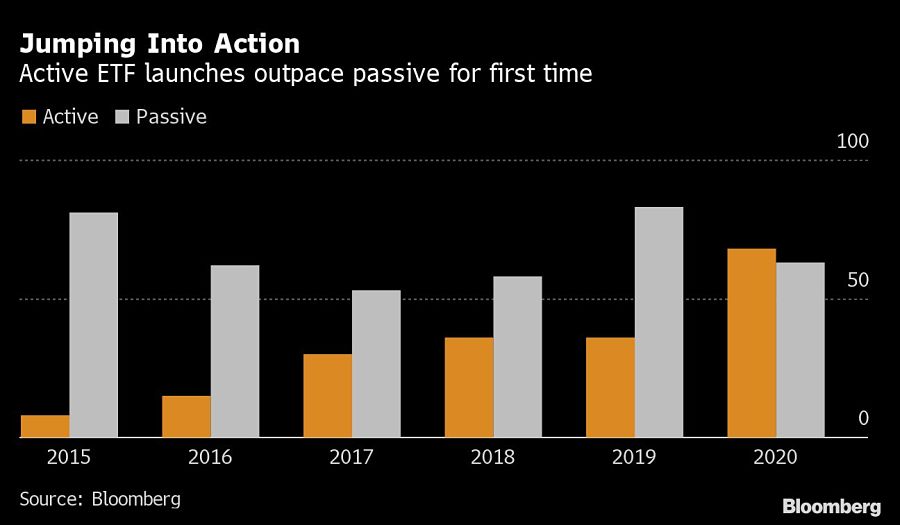
Debuts of actively managed ETFs are outnumbering those of traditional funds at a record pace as issuers bet on investor demand for stock picking.
It’s the first time in at least 20 years that this has happened, with 68 active exchange-traded funds launching so far in 2020, compared with 63 passive ones, according to data compiled by Bloomberg. On Thursday, Franklin Templeton became the latest firm to add to the trend with the release of an active fixed-income fund.
Amid continued volatility spurred by a resurgence in coronavirus cases and an uncertain earnings season, some investors are favoring active management. Those funds have attracted more than $5.3 billion in both May and June, and another $2.5 billion so far in July, data compiled by Bloomberg show. That brings their total assets to a record of $122 billion.
“The ETF industry is so saturated that investors are ready for different content than just passive products,” said Linda Zhang, CEO of Purview Investments. “They are looking for active content that provides hopefully long-term, much more attractive performance.”
The actively managed Franklin Liberty Ultra Short Bond ETF (FLUD) started trading Thursday, aiming to provide investors with diversification in the ultra-short debt investment category.
Other recent launches of active funds include the American Century Mid Cap Growth Impact ETF (MID) and the American Century Sustainable Equity ETF (ESGA) on Wednesday, focusing on the environmental, social and governance factors.
Those active funds are also semitransparent, a new format that is further boosting the profile of actively managed ETFs. In particular, they’re the first to employ NYSE’s proxy-based structure, which is designed to prevent front-running.
Some active funds’ outperformance is drawing increased attention to the category. For instance, ARK Innovation ETF (ARKK) is up almost 60% this year.
“Performance is going to be a big driver,” said Jillian DelSignore, principal at Lakefront Advisory. “Investors look to active management for the ability to outperform, so if these products deliver, I think they should see inflows.”

Siddharth Jawahar was sentenced 11 years in prison and $31M in restitution for running Swiftarc Capital fraud scheme

Wall Street banks expand wealth services as ultra-high-net-worth client demands extend further above and beyond investment management.

The acquisition of $2 billion Gilbert & Cook extends a buying spree for the ultra-high-net-worth firm that has already touched six states this year.

After years of encouraging sacrifice and delayed gratification, advisors have to do the next emotional lift: helping clients let go of a potentially harmful scarcity mindset.

A new JPMorganChase Institute report reveals how deeply stock market wealth now drives everyday American spending, especially for retirees.
Northern Trust’s Ken Lassner shows advisors how to convert volatility into after-tax portfolio gains
Dan Biagini of American Equity says the steady decline of pensions, longer lifespans and a reset in interest rates are rewriting how advisors build retirement income

