
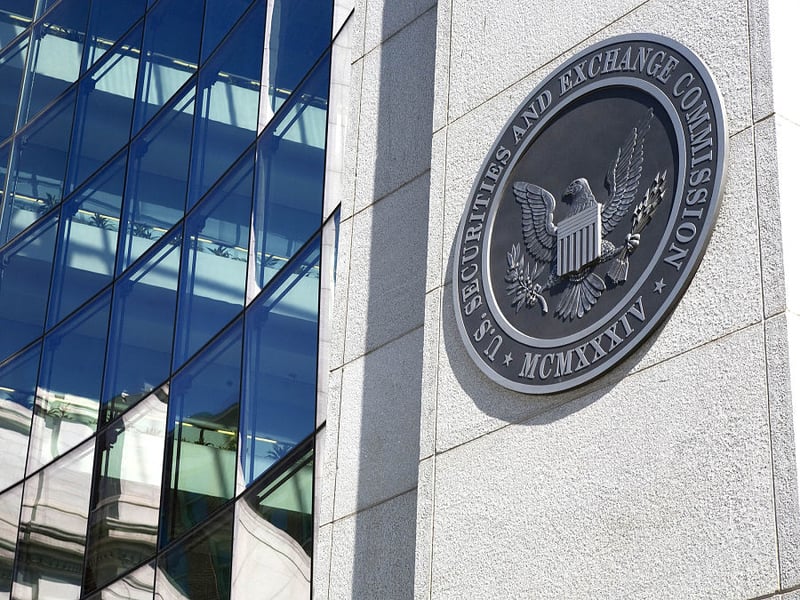
The Securities and Exchange Commission won't ask a federal appeals court to reconsider a decision that paves the way for Grayscale Investments to launch a spot Bitcoin exchange-traded fund, according to a person familiar with the matter.
In August, the DC Circuit Court of Appeals overturned the SEC’s rejection of Grayscale’s bid to convert its trust into an exchange-traded fund. The ruling was made by just three of the judges on the court and the regulator could have sought a review by a full slate of judges. The agency is not planning any other appeals in the case, said the person, who asked not to be identified discussing the ongoing matter.
Grayscale has said that investors would benefit from conversion to an ETF, as shares could be easily created and redeemed. The current closed-end structure doesn’t let investors redeem shares when prices decline, leading to trading at steep discounts relative to the underlying bitcoin.
The August decision was heralded by crypto advocates as a watershed moment for the industry, and a rebuke of the SEC’s stance under Chair Gary Gensler. In that ruling, Judge Neomi Rao said the denial of Grayscale’s proposal was “arbitrary and capricious” because the regulator hadn’t explained its rationale.
After the court’s ruling back in August, shares of GBTC rallied more than bitcoin did, with the trust’s discount to its underlying holdings narrowing significantly. The gap earlier this year stood above 45% but has constricted to below 20%, data compiled by Bloomberg show.
The case is Grayscale v. SEC, 22-1142, US Court of Appeals for the District of Columbia Circuit.

Parents must still act to get the $1,000 federal seed and employer contributions, giving financial advisors a role in the rollout.

FINRA booted Rudy Anguiano from the industry for “conversion - the intentional and unauthorized taking of another person’s property.”

Notice 2026-62 also flags box spread ETFs and tax-aware fund trades as Treasury opens month-long consultation period.

Heartwood Wealth Advisors deal marks the serial acquirer's 36th-ever transaction as third-quarter RIA M&A volume slips 19%

The AI lab disclosed more than $8 billion in 2025 losses on an operating basis as financial advisors weigh a supersized listing likely to land past the midterms.
As AI makes financial information more accessible than ever, Lana Hock explains why human judgment, trust, and empathy remain the qualities clients value most in a financial advisor
Northern Trust’s Ken Lassner shows advisors how to convert volatility into after-tax portfolio gains

