
Federal Reserve officials raised interest rates by 75 basis points for the third consecutive time and forecast they would reach 4.6% in 2023, stepping up their fight to curb inflation that’s persisted near the highest levels since the 1980s.
In a statement Wednesday following a two-day meeting in Washington, the Federal Open Market Committee repeated that it “is highly attentive to inflation risks.” The central bank also reiterated it “anticipates that ongoing increases in the target range will be appropriate,” and “is strongly committed to returning inflation to its 2% objective.”
Chair Jerome Powell began a press conference at 2:30 p.m.
The decision, which was unanimous, takes the target range for the benchmark federal funds rate to 3% to 3.25% — the highest level since before the 2008 financial crisis, and up from near zero at the start of this year.
Officials expect the benchmark rate to rise to 4.4% by year end and 4.6% during 2023, according to the median estimate in updated quarterly projections published alongside the statement. That indicates a fourth-straight 75 basis-point hike could be on the table for the next gathering in November, about a week before the midterm elections.
Further ahead, rates were seen stepping down to 3.9% in 2024 and 2.9% in 2025.
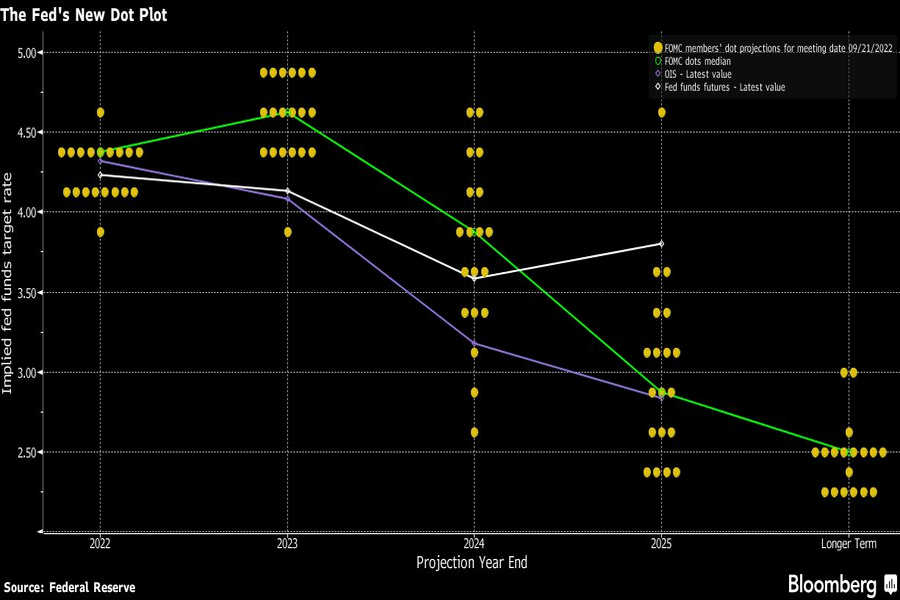
The projections, which showed a steeper rate path than officials laid out in June, underscore the Fed’s resolve to cool inflation despite the risk that surging borrowing costs could tip the US into recession.
Before the release, traders expected rates to reach 4.5% in early 2023 before falling about a half point by the end of the year.
Powell and his colleagues, slammed for a slow initial response to escalating price pressures, have pivoted aggressively to catch up and are now delivering the most aggressive policy tightening since the Fed under Paul Volcker four decades ago.
The updated forecasts also showed unemployment rising to 4.4% by the end of next year and the same at the end of 2024 — up from 3.9% and 4.1%, respectively, in the June projections.
Estimates for economic growth in 2023 were marked down to 1.2% and 1.7% in 2024, reflecting a bigger impact from tighter monetary policy.
Inflation peaked at 9.1% in June, as measured by the 12-month change in the U.S. consumer price index. But it’s failed to come down as quickly in recent months as Fed officials had hoped: In August, it was still 8.3%.
Job growth, meanwhile, has remained robust and the unemployment rate, at 3.7%, is still below levels most Fed officials consider to be sustainable in the longer run.
The failure of the labor market to soften has added to the impetus for a more-aggressive tightening path at the U.S. central bank.
Fed action is also taking place against the backdrop of tightening by other central banks to confront price pressures which have spiked around the globe. Collectively, about 90 have raised interest rates this year, and half of them have hiked by at least 75 basis points in one shot.
Fed action is also taking place against the backdrop of tightening by other central banks to confront price pressures which have spiked around the globe. Collectively, about 90 have raised interest rates this year, and half of them have hiked by at least 75 basis points in one shot.

Chicago-based Mesirow Fiduciary Solutions adds flexPATH's plan-level outsourced fiduciary book, boosting its retirement market reach to $164 billion.

Also, Raymond James's employee advisor channel adds breakaways from Wells Fargo and Stifel, while UBS welcomes an ex-Morgan Stanley duo in Indiana.

It promised guaranteed principal and 10% monthly returns. The SEC says it invested nothing.

Ten years after entering the fee-based annuity market, MassMutual Ascend says nearly half its lifetime sales came in the past two years alone – but barriers remain among fee-only advisors.

Amplify, WealthReach, Zeplyn and Zocks have unveiled partnerships aimed at automating portfolio management, content creation, account opening, and client communication.
Northern Trust’s Ken Lassner shows advisors how to convert volatility into after-tax portfolio gains
Dan Biagini of American Equity says the steady decline of pensions, longer lifespans and a reset in interest rates are rewriting how advisors build retirement income

