
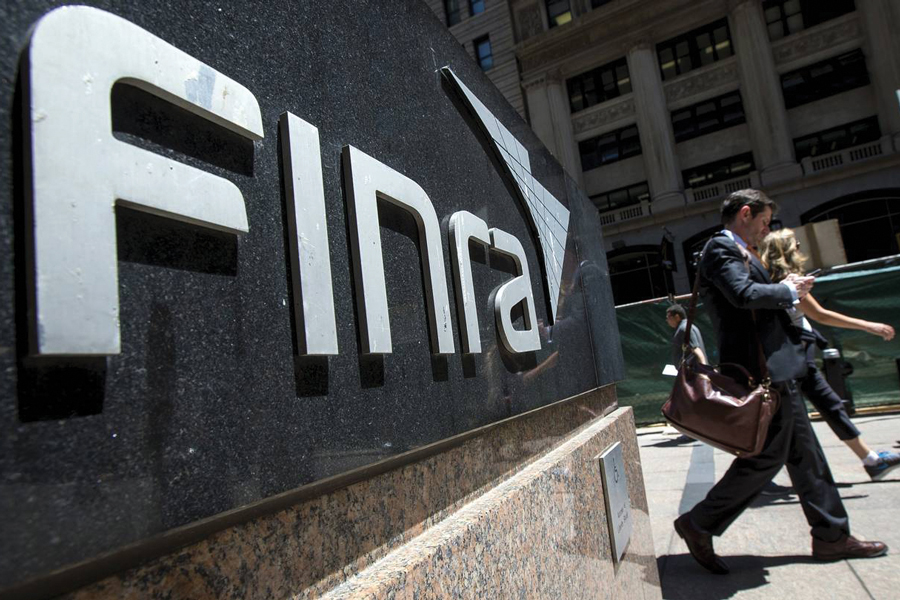
The Financial Industry Regulatory Authority Inc. is probing Robinhood Financial CEO Vlad Tenev and co-founder Baiju Bhatt for not being licensed as registered brokers.
The online brokerage, whose highly anticipated initial public offering is slated for Thursday, disclosed in a filing Tuesday that it received an investigative request seeking documents and information related to its compliance with Finra registration requirements for member personnel, including the non-registration status of Tenev and Bhatt.
“Robinhood is evaluating this matter and intends to cooperate with the investigation,” the company said in the filing. Robinhood did not respond to a request for comment.
The new investigation into Tenev and Bhatt lacking a Finra license creates “poor optics” for Robinhood ahead of its IPO, though it won’t ultimately impact the IPO, said William Whitt, senior analyst at Aite Group.
Rather, Robinhood could run into further risk down the road, depending on how aggressive regulators choose to be when examining the multiple investigations the fintech is facing, including probes around its payment-for-order-flow revenue model, Whitt said.
Finra’s investigation into Robinhood’s personnel for a brokerage license could signal the regulator's attempt to retain its control over the fast evolving business, said William Trout, Javelin Strategy's head of wealth management.
“Licensing requirements have hardly evolved at all,” Trout said. “I understand that licensing is a way of holding advisers accountable and keeping the bad apples out, but if the definition of advice, and indeed, the adviser, is being turned on its head, should not Finra and others show similar flexibility? At least, if they want to stay relevant and support the growth of the industry?”
Finra does not comment on investigations. However, the Robinhood probe is not entirely unprecedented. In February, Finra sent a letter to Sen. Elizabeth Warren, D-Mass., in response to her calling on regulators to examine whether CEOs of brokerages like Tenev should be licensed and trained on market rules and risks.
In the letter, Finra notes that rules require generally that individuals associated with a Finra member and engaged in the investment banking or securities business of the member be appropriately registered with Finra as a “principal” or “representative.” That includes CEOs and CFOs, Finra said.
“Finra certainly has an interest in the persons who ultimately control brokerage firms,” said Ben Edwards, law professor at University of Nevada, Las Vegas. “If they are not registered with Finra, Finra may only have jurisdiction over the firm and not the individual.”
However, Robinhood’s competitors have CEOs with Finra licenses. Webull CEO Anthony Denier, M1 Finance CEO Brian Barnes, and Interactive Brokers CEO Milan Galik are all registered brokers.
Finra's new investigation comes on the heels of its record $70 million settlement with Robinhood announced in June.
Robinhood’s settlement comes during a tough year for the commission-free trading platform, which has experienced dramatic growth — from fewer than 500,000 customers in 2015 to more than 31 million today, according to Finra. Of those millions of accounts, 18 million were funded as of the first quarter 2021.
With Robinhood’s growth came a flurry of regulatory woes, including being charged by William Galvin, secretary of the Commonwealth of Massachusetts, with manipulating its users’ trading activity via gamification tactics.

CFP, CFA and CPA holders could gain accredited investor status as regulators weigh wider private market access for advisory clients

DeepVest, Vanilla and Libretto roll out tools to help financial advisors launch firms, close estate plans and sharpen planning skills

“People aren't effectively using their wealth in retirement,” said David Blanchett of Prudential.

Second-generation NFL ref Shawn Hochuli co-founded IWM Partners in Irvine, California, a wealth management practice with more than $500M in client assets

U.S. seniors lose $28.3 billion annually as a result of financial exploitation, according to a 2023 AARP study.
As AI makes financial information more accessible than ever, Lana Hock explains why human judgment, trust, and empathy remain the qualities clients value most in a financial advisor
Northern Trust’s Ken Lassner shows advisors how to convert volatility into after-tax portfolio gains

