
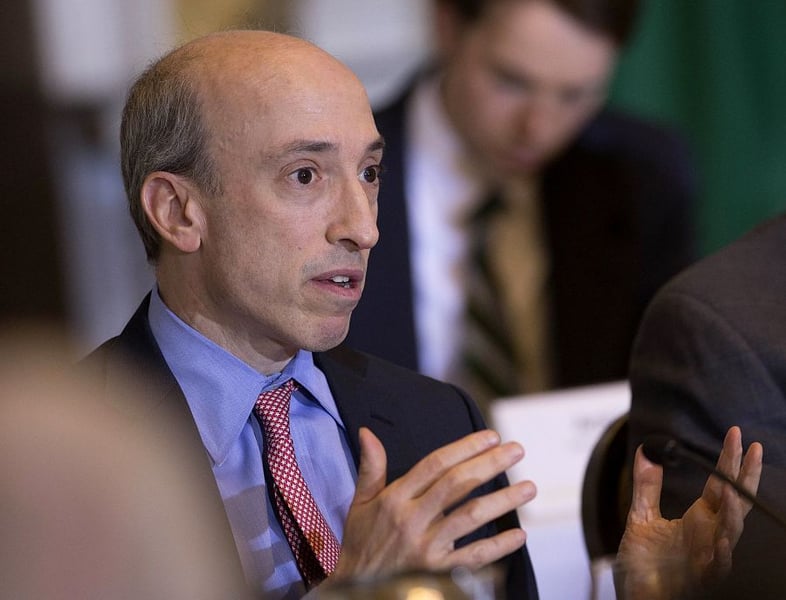
SEC Chairman Gary Gensler said Tuesday the agency will assess whether nudges on digital platforms that affect investor behavior should be regulated as investment recommendations.
Gensler said digital engagement practices used by financial platforms go beyond “gamification” and incorporate predictive analytics that raise questions about potential conflicts of interest, such as whether the sites are trying to optimize investors’ returns or their own revenue.
A robo-adviser “might steer us to higher-fee or more complex products, even if that isn’t in our best interest,” Gensler said in remarks during the online SEC Speaks conference hosted by the Practising Law Institute. “Moreover, a brokerage app might use DEPs to encourage more trading, because they would receive more payment from those trades. More trading, though, doesn’t always lead to higher returns.”
Gensler didn’t mention Regulation Best Interest, the broker standard of conduct, by name, but the implication is that the measure could be applied to online brokers if their investor encouragement is deemed a recommendation.
“When do these design elements and psychological nudges cross the line and become recommendations?” Gensler said. “The answer to that question is important, because that might change the nature of the platform’s obligations under the securities laws. Further, even if certain practices might not meet the current definition of recommendation, I believe they raise a question as to whether there are some appropriate investor protection guardrails to consider, beyond simply the application of anti-fraud rules.”
The Securities and Exchange Commission recently concluded a public comment period on broker and investment adviser digital engagement practices. The input the agency receives could lead to future rulemaking.
Robinhood Markets Inc., whose popular trading app makes it a prominent online brokerage, submitted a letter warning the SEC that imposing new rules for online customer engagement would be challenged in court.
In addition to conflicts of interest, Gensler raised concerns about digital financial platforms contributing to bias and systemic risk.
“[P]olicymakers, technologists, computer scientists, and market participants can come together, engage in robust debate, and tackle a number of important issues that the adoption of predictive data analytics presents,” Gensler said.
PROMOTING PRIVATE MARKETS
Other segments of the SEC Speaks conference featured two commissioners giving different takes on the rapidly growing private investment markets.
SEC Commissioner Allison Herren Lee raised concerns about the secrecy surrounding private companies even while investment capital has poured into them. She said the lack of visibility could put investors in harm’s way.
“We must evaluate the opacity of large and important segments of the economy and what that means to investors and our public markets,” Lee said.
So-called private placements investments are both risky and come with high fees. Buying an unregistered security is generally restricted to sophisticated investors who meet certain income and wealth thresholds.
Lee said mutual funds and pension plans increasingly invest in private markets, meaning that “the savings of everyday investors is increasingly exposed to the potential risks associated with a lack of transparency.”
But in his appearance at the conference, SEC Commissioner Elad Roisman said the agency should be doing more to make it easier for private companies to raise capital, which he said is crucial to spurring economic growth.
“While the pieces of our mission are sometimes presented as a system of trade-offs, as though we must sacrifice investor protection if we want to pursue capital formation, I believe this viewpoint is misguided,” Roisman said. “Our mission should work as a coherent whole, where appropriately tailored rules allow investors and businesses to work hand-in-hand, providing a stable framework within which to collaborate.”

Salespeople at the firm often went beyond the matching algorithm to recommend network advisors on its Zoe Wealth platform, according to the regulator.

The Protect College Sports Act would cap school payments and codify NIL rights, with implications for advisors guiding young athletes.

"I know the number that I want to be able to retire on, and now I just want out," says Wilmington Trust's Marguerite Weese, describing a common refrain among business-owner clients.

Bessemer and Brown Brothers Harriman veteran Robert Ludricks III and private markets specialist Olof Akesson join the ultra-high-net-worth push on the East Coast.

765 investors were promised 260% annual returns on truck leases
As AI makes financial information more accessible than ever, Lana Hock explains why human judgment, trust, and empathy remain the qualities clients value most in a financial advisor
Northern Trust’s Ken Lassner shows advisors how to convert volatility into after-tax portfolio gains

