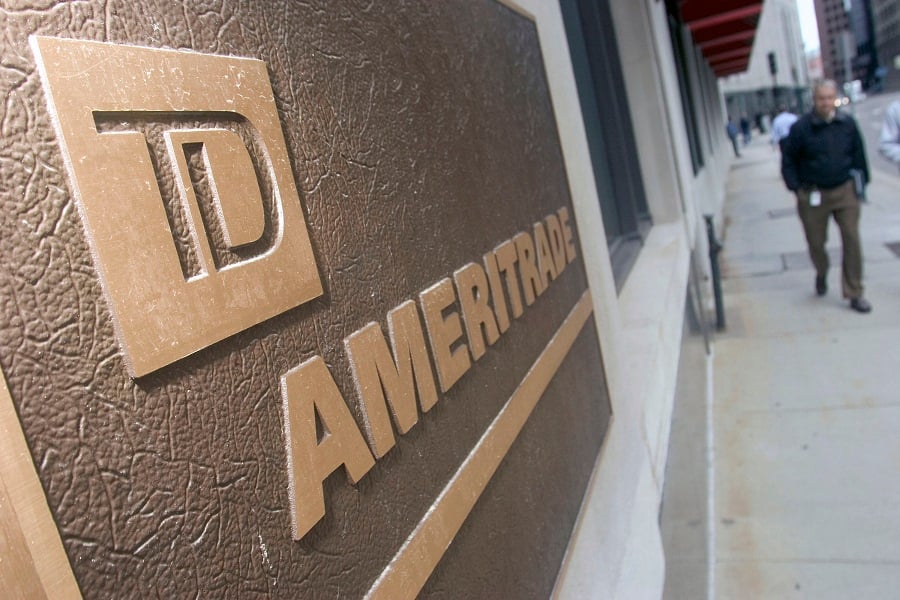
TD Ameritrade Holding Corporation has a new partnership with WeChat, a hugely popular Chinese app used for messaging, social media and mobile payments that has been criticized for violating users' privacy.
Through a mini program built within the WeChat app, retail investors in the United States (not China) can use WeChat as a portal to access market data, track a company's news and events, check account balances, open a TD account, and schedule an appointment at a local TD branch.
The firm is the first U.S. brokerage to launch a service on WeChat, which is looking to expand its American user base. WeChat boasts 1 billion monthly active users. TD launched a similar portal for Hong Kong users in August and is exploring an expansion into mainland China.
"We have been on a journey to build and expand our Asia footprint," said Sunayna Tuteja, TD Ameritrade head of strategic partnerships and emerging technologies. "If you want to be best-in-class you have reach users where they are, and in Asia they are on WeChat."
TD also inherited a large portfolio of users from Asia with its
acquisition of Scottrade, Ms. Tuteja said. The brokerage is looking to better engage these investors through WeChat.
Though TD's current footprint in the Asia-Pacific market is small, Ms. Tuteja said they are "highly active, engaged clients."
"Finance is still viewed as complex, abstract and — I'll say it — boring," she said, adding that TD wants to "break down those barriers and educate and empower and engage [investors] in a new way."
(More: TD Ameritrade expands reach to customers via new Twitter service)
But many have accused WeChat and its parent company, Tencent, of violating users' privacy. Last year, India's Defense Ministry instructed its armed forces to uninstall WeChat, citing "spyware or other malicious ware."
According to a memo
published by The Indian Express, "use of these apps by our force personnel can be detrimental to data security, having implications on the force and national security."
Australia's Defense Department
followed suit in March, banning staff and personnel from downloading the app to work phones.
The concerns aren't new. An
October 2016 report by Amnesty International ranked WeChat dead last when it came to encrypting data. For comparison, Facebook, which has data-privacy issues of its own, scored 73 out of 100. Apple scored 67, while Blackberry only received 20 points. Tencent and WeChat scored 0 points.
TD Ameritrade believes it can keep investors' personal and financial information safe on WeChat.
"As with all of our third-party chat integrations, all content and data remains on the TD Ameritrade side. The experience is just hosted on WeChat," a TD spokesperson said in an email. "That said, we did take extra measures in this case to ensure our data is protected."
Some tech-savvy millennials in China are quitting the platform over privacy concerns, but the app remains immensely popular,
according to the South China Morning Post. The app is downloaded on 83% of Chinese smartphones and used for everything from messaging to mobile payments, news and content, e-commerce, and social media. Those on WeChat can use their account as a digital ID and use it manage pensions, taxes and even file for divorce.
"The scale is unfathomable," Ms. Tuteja said. "We don't have anything like it on the States' side."
Financial institutions hoping to one day serve Chinese investors simply can't afford to ignore the platform. Phillip Kerkel, managing principle at technology consulting firm Capco, expects more U.S. financial institutions to follow TD's lead.
"I think you want to do it because you want that market penetration," he said. "We'll see more and more U.S. firms starting to look at [WeChat] as a way of doing business."
There will always be privacy concerns with any technology integration, Mr. Kerkel said, but firms can limit the consumer information shared with the tech platforms. WeChat would be no different than how financial institutions work with PayPal, Venmo or Zelle.
(More: Merrill adds Zelle to wealth management app to let clients make payments)
"Financial services firms are highly regulated and pay very close attention to customers' security and data," Mr. Kerkel said. "They wouldn't enter into these agreements if they thought their customers' data could be compromised."