

Fast-money wagers against longer-dated Treasuries have hit a record in a sign that hedge funds are positioning themselves ever more aggressively for a steeper yield curve.
Net short speculative positions in long bond futures saw the biggest weekly climb since 2007 to reach around 209,000 contracts, according to the latest Commodity Futures Trading Commission data. Meanwhile, net long positions on 10-year Treasuries have risen to their highest since October 2017.
So-called steepener trades are often seen as bets on reflation, while investors are also positioning for the possibility of greater deficits should the Democratic party prevail in November’s election.
A new Wall Street Journal/NBC News poll taken after Tuesday’s debate showed Joe Biden leading Donald Trump by 14 percentage points. It was taken before the president was diagnosed with coronavirus.
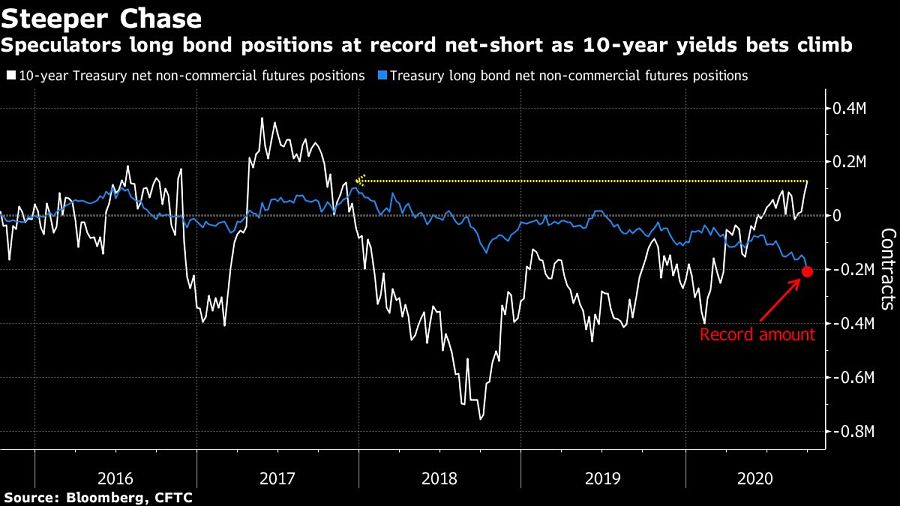
The surge in shorts appears to be related to new wagers on the direction of the curve, rather than so-called basis trades which bet on the spread between bonds and futures, according to JPMorgan Chase & Co. strategists including Jay Barry.
“We think curve positioning could be behind those moves,” they wrote in a note to clients Friday. “While outright exposure to duration positions are not large, curve steepening positions remain large relative to historic ranges, and the risk is these trades could be unwound.”
The spread between the 10-year and 30-year yields has widened by more than 30 basis points so far this year and was at around 79 basis points on Monday. It reached near 81 basis points in June, the high so far this year.
Similar bets are also being made in the swaption market. Options on swap rates show the cost to hedge against a 25 basis point rise in 30-year rates is at the highest in six months relative to protection against a decline of the same size.
[More: Bond market refresh]

Meanwhile, DPL Financial Partners adds two annuity executives and Prime Capital Financial hires a Mid-Atlantic retirement plan consultant

Andrew Komarow pleaded guilty Thursday in federal court in Hartford to defrauding three financial services companies of close to $3.3 million.

Elsewhere, Cetera picks up a $210 million Connecticut team from MML, while Wells Fargo FiNet adds a San Diego family practice from LPL

Celebrity endorsements, $500M in claimed assets, and a state regulator stepping in.

“We needed to become a more agile and efficient organization,” said American Express CEO Stephen Squeri.
Knighthead Life entered the market with a competitive MYGA. A strong launch earned advisor confidence and paved the way for FIAs.
As AI makes financial information more accessible than ever, Lana Hock explains why human judgment, trust, and empathy remain the qualities clients value most in a financial advisor

