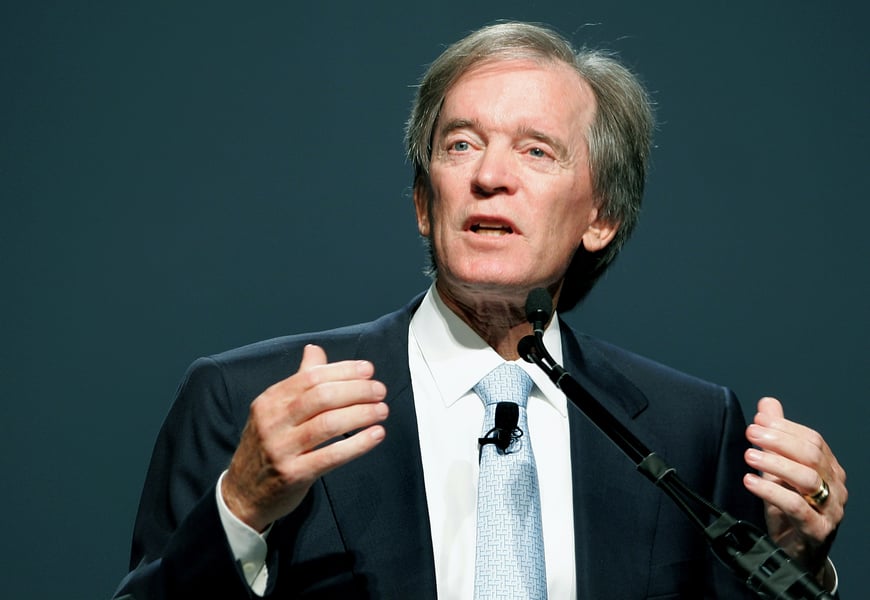
Bill Gross's Pimco Total Return Fund, the world's largest mutual fund, was the second-biggest decliner among the largest U.S. bond managers in the past month as clients pulled money for the first time in two years amid a selloff in Treasuries.
The $250 billion Pimco Total Return fell 3 percent in the 30 days through Dec. 8, trailing all but one of the 10 largest bond mutual funds, which lost an average of 2 percent, according to data compiled by Bloomberg. Only the $33 billion Vanguard Inflation-Protected Securities Fund declined more, falling 3.9 percent in the period.
Benchmark 10-year Treasuries had their biggest two-day slump since September 2008 this week after tax cuts, signs of an economic recovery and asset purchases by the
Federal Reserve fueled expectations inflation will accelerate. The losses may surprise investors who poured $267 billion into fixed income funds this year through October, ignoring warnings by Gross that the 30-year bond rally may have run its course.
“This is a very violent move we had this week,” said Richard Saperstein, managing director at Treasury Partners in New York, which oversees $10 billion in assets. “I think we're going to have a very volatile bond cycle here over the next two years.”
Assets in Pimco Total Return declined by $5.75 billion last month as the fund fell 1.4 percent. It has declined another 1.2 percent this month through yesterday, which would translate into a loss of $3 billion before any investor deposits or withdrawals. The assets are reported monthly.
(See the 5 fund families with the largest outflows this year.)
The fund gained 8.1 percent per year in the five years through Dec. 8, better than 98 percent of peers, Bloomberg data show.
Raising Forecast
Pimco Total Return, which became the biggest mutual fund in history last year, had its first net withdrawals in two years in November as investors pulled $1.9 billion, Chicago-based Morningstar Inc. said yesterday.
Pacific Investment Management Co., which manages the fund, yesterday raised its forecast for U.S. economic growth next year as policy makers pump a “massive amount” of stimulus into the economy, Chief Executive Officer Mohamed El-Erian said.
Pimco sees the economy growing 3 percent to 3.5 percent in the fourth quarter of next year from the same period of this year. That compares with its previous estimate for 2 percent to 2.5 percent growth and the 2.2 percent gain forecast for this year by the International Monetary Fund.
“The U.S. is using fiscal and monetary policy to try to attain escape velocity for the economy,” El-Erian said in a telephone interview from his office in Newport Beach, California. “What we don't know yet is whether that will be enough not just to change the economy's trajectory for one year but to place it on a medium-term sustainable path.”
‘Lifeline'
Pimco, Vanguard Group Inc., and Franklin Resources Inc. attracted the most money into their bond funds this year through November, Morningstar data show. Pimco pulled $57 billion into its bond funds this year through Nov. 30. Vanguard, based in Valley Forge, Pennsylvania got $33.4 billion, and Franklin, based in San Mateo, California, received $23.7 billion.
“Fixed income has been the lifeline for a lot of these firms,” said Douglas Sipkin, an analyst with Ticonderoga Securities in New York, in a telephone interview.
A drop in deposits into bond funds in the past month doesn't mean investor's love affair with fixed-income is over, said Russel Kinnel, director of fund research at Morningstar.
“It takes more than one month to reverse a trend as big as this one has been,” he said in a telephone interview.
‘Tax Goodies'
Bonds have tumbled this week after President Barack Obama agreed on Dec. 6 to a two-year extension of Bush-era tax cuts in exchange for an additional 13 months of unemployment insurance and cutting the payroll tax by $120 billion for a year. The yield on the 10-year note was at 3.20 percent yesterday, after touching 3.33 percent on Dec. 8, the highest since June 4. Bond prices fall as interest rates rise.
Obama's moves to extend tax cuts and “adding other tax goodies” will increase federal deficit levels, economist Edward Yardeni said by telephone in a Bloomberg Television “Inside Track” interview from London.
The federal deficit totaled $1.3 trillion in the fiscal year that ended Sept. 30, according to the Congressional Budget Office. The White House budget office projected the federal deficit this year will exceed $1.5 trillion, or 10.6 percent of gross domestic product.
‘Ponzi Scheme'
Gross, who reduced holdings of government debt in the Total Return Fund for a fourth month in October, has said that asset purchases by the Fed will probably signify the end of the 30- year rally in bonds.
“Check writing in the trillions is not a bondholder's friend,” Gross wrote in monthly investment outlook on Pimco's website on Oct. 27. “It is in fact inflationary, and, if truth be told, somewhat of a Ponzi scheme. It raises bond prices to create the illusion of high annual returns, but ultimately it reaches a dead end where those prices can no longer go up.”
Pimco Total Return reduced its holdings in government debt to 28 percent in October from 33 percent the previous month, according to the firm's website.
U.S. bond funds have taken in more money than stock funds every month since the end of 2007, data from the Washington- based Investment Company Institute show. For the first 10 months of this year, bond funds attracted an average of $27 billion per month. Over the past four weeks investors pulled a total of $1.7 billion from bond funds, led by $8 billion in withdrawals from municipal bond funds.
Muni Bond Selloff
Tax-exempt bonds had their worst monthly returns of 2010 in November as rising U.S. Treasury yields and record state and local fixed-rate debt sales sparked withdrawals from mutual funds investing in municipal securities. Taxable bond funds have continued to draw money, ICI data show.
“I think it is premature to say we have seen the peak in bond sales,” said Geoff Bobroff, a consultant based in East Greenwich, Rhode Island, in a telephone interview. The yield on the 10-year Treasury would probably have to reach 4 percent, he said, before investors are ready to change their behavior.
The yield on the 10-year will average 3.53 percent in 2011, according to economists surveyed by Bloomberg.
--Bloomberg News--