
Black Swan scribe: Government bonds will collapse

Black Swan scribe: Government bonds will collapse
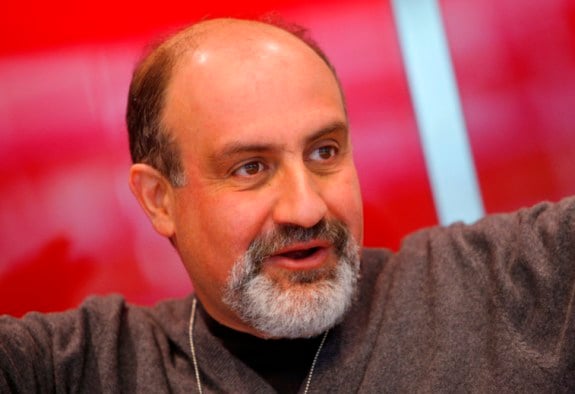
Nassim Nicholas Taleb, who warned that unforeseen events can roil markets in "The Black Swan," said he is "betting on the collapse of government bonds" and that investors should avoid stocks.
FEB 03, 2011
Nassim Nicholas Taleb, who warned that unforeseen events can roil markets in "The Black Swan," said he is "betting on the collapse of government bonds" and that investors should avoid stocks. “I'm very pessimistic,” he said at the Discovery Invest Leadership Summit in Johannesburg today. “By staying in cash or hedging against inflation, you won't regret it in two years.” Treasuries have rallied amid speculation the global economic recovery is faltering, driving yields on two-year notes to a record low of 0.4892 percent today. The Federal Reserve yesterday reversed plans to exit from monetary stimulus and decided to keep its bond holdings level to support an economic recovery it described as weaker than anticipated. The Standard & Poor's 500 Index retreated 16 percent between April 23 and July 2, the biggest slump during the bull market. The financial system is riskier than it was before the 2008 crisis that led the U.S. economy to the worst contraction since the Great Depression, Taleb said. Prior to the collapse of Lehman Brothers Holdings Inc. in September 2008, Taleb warned that bankers were relying too much on probability models and were disregarding the potential for unexpected catastrophes. His book labeled these events black swans, referring to the widely held belief that only white swans existed until black ones were discovered in Australia in 1697, and said that they were becoming more severe. Taleb helped pioneer the concept of hedging against these tail-risk events while trading options in the 1980s for banks such as First Boston Inc., now part of Credit Suisse Group AG. Now a professor at New York University's Polytechnic Institute, Taleb set up the tail-risk hedge fund Empirica LLC in 1999 and ran it for six years. In February, he told a conference in Moscow that “every single human being” should bet Treasury bonds will decline. It's a “no-brainer” to sell short the debt, he added. Since then, 2- and 10-year notes have rallied.

Latest News

Carson Group adds $236 million California team in latest deal

Omaha-based RIA expands Northern California footprint with Roseville acquisition amid record annual pace for wealth management M&A.

Envestnet expands tax-management push with Vanguard alliance

Advisor's Alpha framework joins Envestnet's platform, giving advisors new tools to manage client tax exposure year-round.

Russell Investments to be acquired by B Capital-led investor group

B Capital and pension giant CalPERS lead a consortium buying the 90-year-old asset manager from TA Associates and Reverence Capital Partners.

AI use reshapes advisor satisfaction and deepens client trust, separate studies reveal

Using artificial intelligence can have benefits for both advisors and their clients, according to new research.

Names of more B-Ds that sold deals of bankrupt Inspired Healthcare surface

Broker-dealers that sold the defunct securities backed by Inspired Healthcare generated more than $100 million in fees and commissions.

SPONSORED Who builds the income when the pension disappears?

Dan Biagini of American Equity says the steady decline of pensions, longer lifespans and a reset in interest rates are rewriting how advisors build retirement income

SPONSORED Why direct indexing stopped being optional

Direct indexing is on pace to outgrow ETFs and mutual funds. Northern Trust's Ken Lassner explains why the advisors who get it wish they had started sooner.